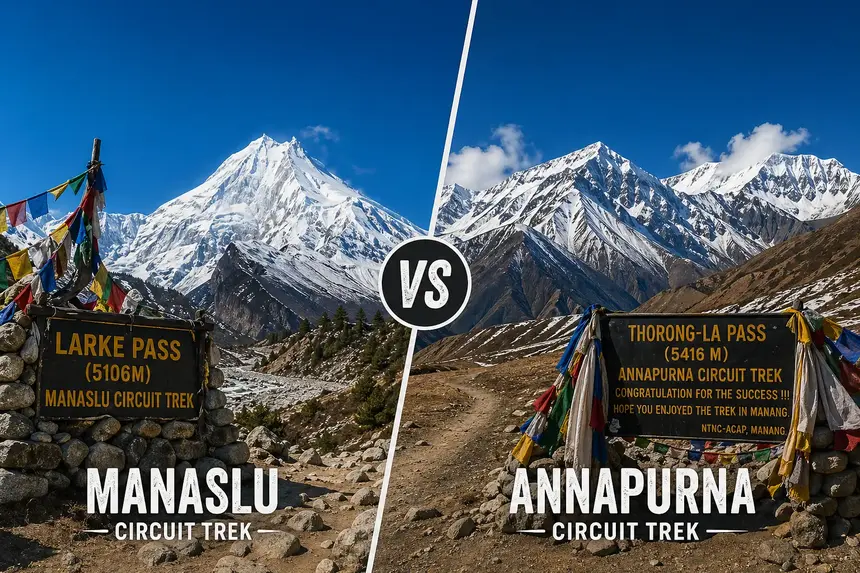
Manaslu vs Annapurna Circuit Trek 2026: Which Should You Choose?
By Pralad Simkhada - Guide | Adventure Mountain Treks | Last Updated on June 2026
I have been leading treks in the Himalayas since 2009. In that time, I have guided hundreds of trekkers across both the Annapurna Circuit and the Manaslu Circuit -in all seasons, in all weather, and in all conditions from ideal to brutal. When someone asks me, "Pralad, which trek should I choose?", my honest answer is always: “It depends on the kind of experience you are looking for.”
Both of these routes are genuinely magnificent. Both will change you. But they are fundamentally different experiences -in atmosphere, difficulty, cost, cultural depth, and what you see on the trail. The Annapurna Circuit is the grand, established classic: diverse, convenient, sociable, and iconic. The Manaslu Circuit is the raw, spiritual alternative: quieter, culturally deeper, and more demanding in the best possible way.
This guide is the most thorough, up-to-date comparison you will find anywhere in 2026. I am writing it from the trail, not from a desk, because I genuinely want you to make the right choice for your trip.
Quick Comparison: Manaslu vs. Annapurna Circuit at a Glance
| Feature | Annapurna Circuit Trek | Manaslu Circuit Trek |
|---|---|---|
| Max Elevation | 5,416m (Thorong La Pass) | 5,106m (Larkya La Pass) |
| Duration | 10 days | 13 days |
| Difficulty | Strenuous | Challenging to Strenuous |
| Crowd Level | High (Oct–Nov peak) | Low to Moderate |
| Road Intrusion | High (Manang, Muktinath sections) | Very Low (trail mostly intact) |
| Guide Required? | No (as of 2026 regulations) | Yes -mandatory |
| Minimum Group Size | Solo allowed | Recently Solo has been allowed, but should go with guide and potter. |
| Permits Requirement | Annapurna Conservation Area Permit | Special Permit from Immigration, Manaslu Conservation Area Permit, Annapurna Conservation Area Permit |
| Total Permit Cost (approx.) | USD $30–$60 | USD $100–$200+ |
| Teahouse Quality | Good to Excellent | Basic to Good |
| Cultural Character | Hindu-Buddhist blend | Pure Tibetan Buddhism |
| Best Season | Oct–Nov, Mar–May | Oct–Nov, Mar–May |
| Starting Point | Besisahar (from Kathmandu ~6 hrs) | Soti Khola / Arughat (from Kathmandu ~8 hrs) |
| Typical Cost (all-in, guided) | USD $900–$1,400 | USD $1,400–$2,200 |
1. The Annapurna Circuit: The Classic Trek in Transition
There is a reason the Annapurna Circuit has been called one of the world's greatest walks for four decades. Circling the entire Annapurna massif -through subtropical gorges, rice terraces, medieval Hindu villages, Tibetan Buddhist highlands, and the near-desert of the Mustang rain shadow -this trek delivers an astonishing diversity of landscape in a single route. From the lush, subtropical valleys around Besisahar where banana trees line the trail, you climb through rhododendron forests, past the cold blue waters of Tilicho Lake (the highest lake of its size in the world at 4,919m), and then over the highest motorable pass in the world at Thorong La (5,416m) before descending to the sacred pilgrimage town of Muktinath.
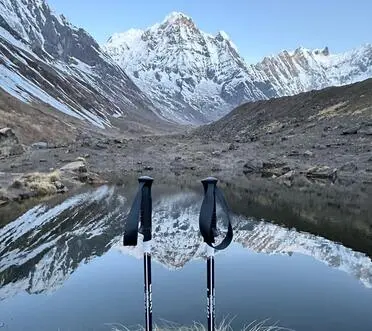
The teahouse culture is well-developed. You can expect hot showers, WiFi in most lodges, varied menus (dal bhat, pizza, apple pie, yak steak), and warm sleeping quarters with blankets. For many trekkers -especially first-time visitors to Nepal -this infrastructure is exactly what they want: the freedom to focus on the trail, the views, and the people, without worrying too much about logistics. If you are ready to start mapping out your adventure, check out the Full Annapurna Circuit Trek itinerary and pricing which would help you prepare for the logistics of the trail.
The 2026 Road Reality: What You Need to Know
I am not going to sugarcoat this, because too many agencies do: road construction has significantly altered the lower Annapurna Circuit. A jeep road now reaches Chame, Pisang, and in parts, beyond Manang. During the dry season especially March through May and October through November -sections of the lower and mid-circuit between Besisahar and Chame involve walking alongside a dusty, busy jeep track rather than a quiet mountain trail.
This is not a crisis, but it is a reality that changes the experience. At Adventure Mountain Treks, we have adapted our Annapurna Circuit itinerary specifically to avoid the most road-heavy sections. We use the Nepal Alternative Trekking Trails (NATT), which keep you on the original stone-paved footpaths through villages like Ngadi, Bahundanda, and Tal -places that still feel exactly as they did before the road arrived. We also use a short jeep-assisted section from Besisahar to Ngadi to skip the very lowest, most road-damaged stretch, saving your legs for the real trekking above Chamje.
The upper circuit -from Manang to Thorong La and down to Muktinath -remains largely unaffected by roads and is still every bit as spectacular as it ever was.
The Tilicho Lake Detour: Absolutely Worth It
If you have one or two extra days, I always recommend adding the Tilicho Lake side trip. This glacial lake at nearly 4,900m is one of the most stunning sights in all of Nepal, ringed by ice walls and high ridges. Most competitiors skip mentioning it or bury it as a footnote, but in my experience this detour genuinely elevates the Annapurna Circuit from "great" to "unforgettable." Our Annapurna Circuit with Tilicho Lake itinerary is specifically designed to include this without rushing.
Annapurna Circuit Trek: Pros and Cons
Pros:
- Extraordinary landscape diversity (subtropical to alpine to near-desert in one route)
- Well-developed teahouse infrastructure -comfortable lodges, varied food
- No mandatory guide requirement (you can trek independently)
- Strong acclimatization schedule built naturally into the route
- Iconic crossing of Thorong La, the world's highest-traversable pass
- Tilicho Lake side trip opportunity
- Easy access from Kathmandu and Pokhara
Cons:
- Road construction affects lower sections (though manageable with the right itinerary)
- High crowd levels in October–November peak season
- Some sections feel commercialized and lose trail character
- Popular villages like Manang and Muktinath can feel busy and touristy
2. The Manaslu Circuit Trek: Nepal's Best-Kept Secret (Not for Long)
If you ask me personally which trek excites me more in 2026, my honest answer is Manaslu. There -I said it. Not because it is objectively superior in every way, but because what it offers right now, in this moment, is something increasingly rare: an authentic, crowd-free, deeply cultural Himalayan circuit where you can still feel like an explorer.
The Manaslu Circuit circumnavigates Manaslu (8,163m), the world's eighth-highest peak, through a restricted area that requires special permits and a licensed guide. The route traverses the Budhi Gandaki River valley, cutting through some of the most remote and culturally preserved villages in Nepal. The architecture changes as you gain altitude - lower Gurung and Tamang settlements to the unmistakably Tibetan-Buddhist high villages like Lho, Samagaon, and Samdo, where prayer flags snap in the wind above whitewashed chortens, and where you are often the only group of trekkers staying that night. Looking for a complete guide of Manaslu Circuit Trek 2026?
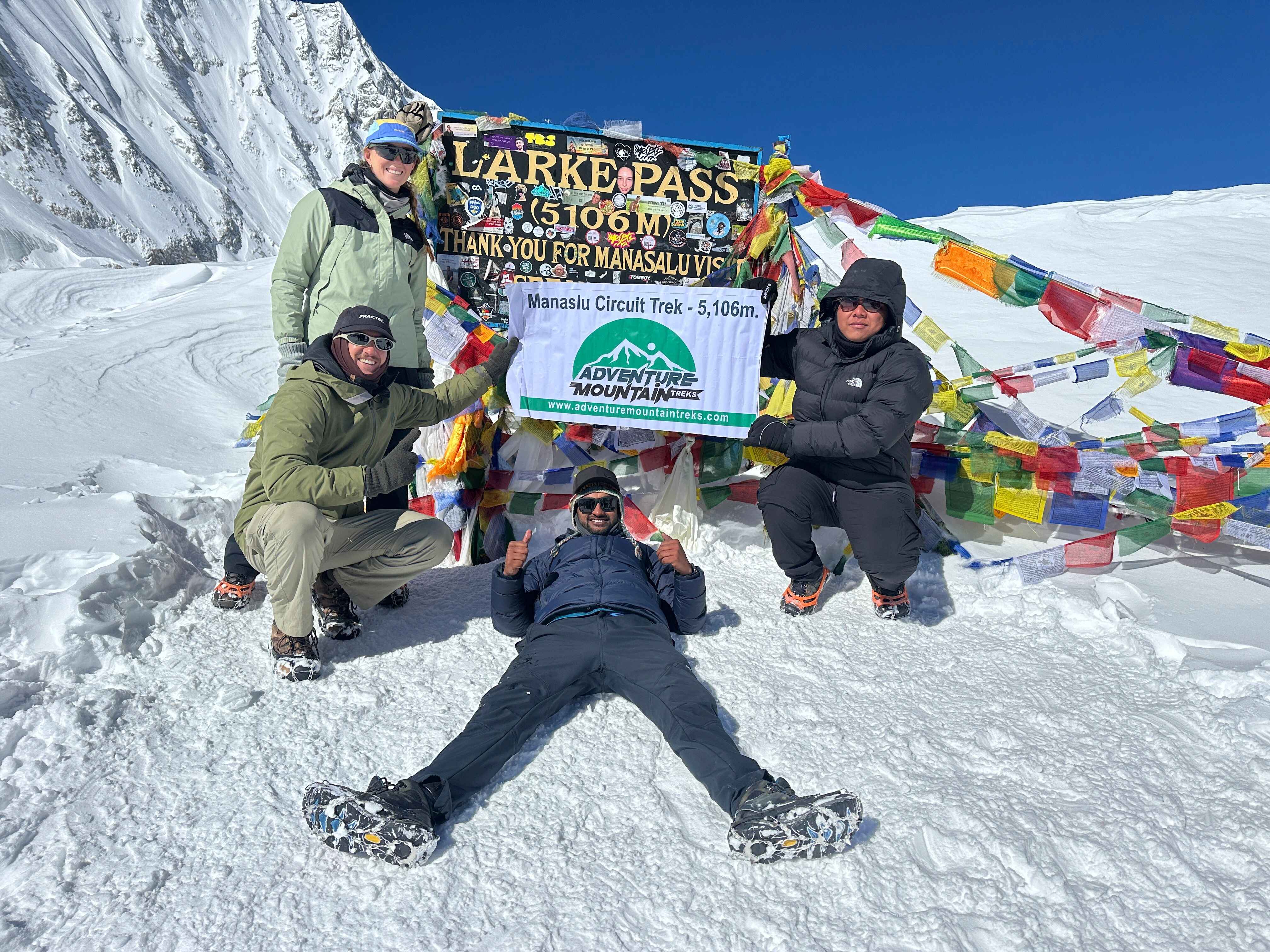
The high point of the trek is the Larkya La Pass at 5,106m - lower in elevation than Thorong La, but widely regarded by experienced trekkers (including myself) as the harder crossing. The ascent from Dharamsala involves a long pre-dawn start -often 2:00–3:00 AM -across a high, windswept plateau with a sustained glacier section and a demanding technical descent on the far side. It requires good fitness, proper acclimatization, and warm gear. But the views from the top, Manaslu, Himlung, Cheo Himal, and the Annapurna range all in one sweeping panorama -are among the most extraordinary I have ever witnessed in 17 years of guiding. Know more about things to consider before booking a Mansalu Circuit Trek.
Why the Restricted Area Requirement Is Actually a Good Thing
I know some trekkers see the mandatory guide and the two-person minimum as inconveniences. But consider what these restrictions have done for the Manaslu Circuit: they have kept it exactly what it is -a genuinely off-the-beaten-path experience. There are no hundreds of tea houses competing for your wallet with neon signs and Western menus. The villages feel like villages, not outdoor adventure resorts. The locals interact with you as a genuine guest, not as a transaction.
The restricted area permit (RAP) currently costs NPR 100 per person per week in September and NPR 75 per person per week in other months. Add the Manaslu Conservation Area Permit (MCAP) at NPR 3,000 and TIMS card, and your total permit cost is significantly higher than Annapurna -but for most trekkers who have done the research, this is a feature, not a bug.
Manaslu Circuit: Pros and Cons
Pros:
- Very low crowd density -you often have lodges entirely to yourself
- Pristine Tibetan-Buddhist culture almost untouched by commercialization
- No roads on the main circuit route (as of 2026) -every step is a footpath
- Spectacular views of Manaslu throughout the trek
- Larkya La crossing: challenging and deeply rewarding
- Easier to combine with Tsum Valley for a truly extended Himalayan adventure
- Strong sense of wilderness and remoteness
Cons:
- Mandatory guide and minimum group size (added cost and logistics)
- Higher permit costs than Annapurna
- More limited teahouse facilities, especially above Samagaon
- Less landscape diversity -predominantly alpine and Tibetan plateau character
- Longer drive from Kathmandu to the trailhead
3. Difficulty Comparison: Larkya La vs. Thorong La
This is one of the most commonly asked questions I receive, and I want to give you a straight answer rather than hedging.
Thorong La (5,416m) is higher on paper, but the ascent is well-worn, clearly marked, and you cross it in a single day from Thorong Phedi (4,540m) -a gain of roughly 875m before a very long descent of 1,600m to Muktinath. The main challenge is altitude and the sheer length of the descent, which punishes the knees. Because of the well-established route and the constant company of other trekkers, it can feel psychologically manageable even for people doing a first major pass crossing.
Larkya La (5,106m) is lower, but the pre-dawn start from Dharamsala (4,460m), the crossing of an actual glaciated section, and the long, steep, rocky descent to Bimthang make it a more technically demanding and physically exhausting day. You do this in a smaller group, often in much more solitary conditions, in a region with very limited rescue infrastructure. In my experience, it takes more out of people even than Thorong La.
Overall fitness requirement: Both treks require solid cardiovascular fitness and experience with multi-day mountain walking. Neither requires technical climbing skills. I would say Manaslu requires slightly higher baseline fitness and more cold-weather preparedness for the Larkya La crossing.
Altitude sickness risk: Both routes follow good acclimatization profiles. Annapurna has the advantage of Manang (3,519m) as an ideal rest and acclimatization stop with good medical facilities. Manaslu's acclimatization is naturally built into the itinerary through Samagaon (3,530m) and Samdo (3,860m), but medical facilities are much more limited -another reason having an experienced guide is non-negotiable.
4. Cultural Immersion: Two Different Worlds
Annapurna Circuit is a rich tapestry of Nepal's ethnic and religious diversity. In the lower valleys, you walk through Gurung and Magar villages, past Hindu temples and colourful festivals. As you climb, the culture shifts -prayer wheels appear, gompas (Buddhist monasteries) dot the hillsides, and by Manang you are firmly in Tibetan Buddhist territory. Muktinath, with its sacred temple complex venerated by both Hindus and Buddhists, is one of the most spiritually significant sites in all of South Asia.
Manaslu Circuit is almost entirely Tibetan Buddhist in character from mid-route onwards, and this cultural depth is one of its greatest strengths. The monasteries at Lho, Sama Gompa (above Samagaon), and Mu Gompa are ancient, active, and breathtaking -not tourist attractions but functioning centres of spiritual life. Sama Gompa, perched on a promontory above Samagaon with Manaslu's ice wall as its backdrop, is one of the most photogenic and spiritually affecting places I have visited anywhere in the Himalayas.
If Tibetan Buddhist culture is something you specifically want to immerse yourself in -and I mean properly, not just photographing it from a distance -Manaslu wins this comparison decisively.
5. Accommodation & Food: Comfort vs. Authenticity
On the Annapurna Circuit, the teahouse infrastructure has developed substantially. In Manang, you can find lodges with private ensuite bathrooms, solar-heated hot showers, and menus that include everything from yak burgers to apple crumble. Wifi is available at most stops. The food is often genuinely good -particularly the dal bhat, which is always my benchmark for how much a kitchen cares.
On the Manaslu Circuit, the accommodation is simpler and more variable. In Soti Khola, Jagat, and the lower villages, lodges are basic but clean. By Samagaon and Samdo, you are staying in purpose-built but spartan trekking lodges -often a single cold-water tap shared between the whole building, no wifi, and a menu that is essentially dal bhat, noodles, and occasionally eggs. I want to be clear: this is not a problem. The warmth and hospitality of the lodge owners in these villages is extraordinary, and many of our guests say these simple stays were their most memorable nights of the entire trip. But if you need a hot shower every day and a varied evening menu, you will find Annapurna more comfortable.
6. Cost Comparison: A Detailed Breakdown
Annapurna Circuit (10 days, guided)
| Expense | Approximate Cost (USD) |
|---|---|
| Permits (ACAP + TIMS) | $30–60 |
| Guide (per day, approx.) | $25–35/day |
| Porter (optional) | $18–25/day |
| Accommodation + meals (teahouse) | $20–35/day |
| Transport (Kathmandu–Besisahar + Pokhara return) | $40–80 |
| Total (guided, 10 days) | ~$900–$1,400 |
Manaslu Circuit (13 days, guided)
| Expense | Approximate Cost (USD) |
|---|---|
| Permits (RAP + MCAP + TIMS) | $100–200 |
| Guide (mandatory) | $30–40/day |
| Porter (strongly recommended) | $20–28/day |
| Accommodation + meals | $15–25/day |
| Transport (Kathmandu–Soti Khola return) | $60–100 |
| Total (guided, 13 days) | ~$1,400–$2,200 |
The Manaslu Circuit costs more primarily because of the mandatory guide and the restricted area permit. Paradoxically, daily accommodation and food costs are often lower on Manaslu because the simpler teahouses charge less. The premium is for access and expertise -and that investment is well worth it.
At Adventure Mountain Treks, our Manaslu Circuit Trek package and Annapurna Circuit Trek package both include permits, guide, accommodation, and meals, so you can see exactly what you are paying for with no hidden costs. Additional information would be shared before booking the package if any new cost arrises.
7. Crowd Levels and Trail Atmosphere
In October 2024, I counted over 40 trekking groups passing through Thorong Phedi teahouse in a single morning. Many were queuing to begin the Thorong La crossing by 3:00 AM. The trail was a long, moving line of headlamps -an extraordinary sight, but not exactly solitary.
On the Manaslu Circuit in the same season, the busiest sections might see three or four groups per day. Above Samagaon, it is entirely common to spend a night where your group is the only one in the lodge. This matters enormously for the quality of the experience -for the silence, for the depth of interaction with locals, and for that fundamental sense of wilderness that people come to the Himalayas to find.
If you are choosing between these two routes and crowd avoidance is important to you, Manaslu is the clear winner -and 2026 is still an excellent time to go, before the inevitable growth in popularity erodes that quietness.
8. Why 2026 Is the Year to Do the Manaslu Circuit?
I have been watching the trajectory of Nepal trekking for almost two decades. The Everest Base Camp trail was once quiet; now it resembles a motorway in peak season. The Annapurna Circuit was once wild; the roads have changed it irreversibly in the lower sections. These shifts are not judgments -they are facts, and they reflect how much the world has fallen in love with Nepal.
Manaslu is where Nepal's trekking culture currently sits at its sweet spot: accessible enough that good teahouses and trail infrastructure exist, but restricted enough that the crowds and commercialization have not yet arrived in force. Visitor numbers on the Manaslu Circuit have been growing by roughly 15–20% year-on-year. At this rate, the experience available today -the empty trails, the authentic gompas, the personal interactions with lodge families who sit with you in the evening because yours is the only group -will not last forever.
If you have been trekking the popular routes and want to rediscover what drew you to mountain trekking in the first place, do Manaslu Circuit Trek now.
9. Permits and Planning for 2026
Annapurna Circuit Permits
- ACAP (Annapurna Conservation Area Permit): NPR 3,000 (~USD 22) per person
- TIMS Card (Trekkers' Information Management System): NPR 2,000 (~USD 15) for group trekkers
- These can be obtained in Kathmandu (Nepal Tourism Board office) or Pokhara before departure
- No guide is legally required as of 2026 regulations, though having a guide significantly enhances the experience
Manaslu Circuit Permits
- RAP (Restricted Area Permit): NPR 100 per person per week (September) / NPR 75 per person per week (other months)
- MCAP (Manaslu Conservation Area Permit): NPR 3,000 (~USD 22)
- TIMS Card: NPR 2,000 (~USD 15)
- A licensed guide is legally mandatory and cannot be bypassed
- Minimum group size of 2 trekkers is required by law
- Permits must be arranged through a registered trekking agency in Kathmandu
Best Time to Go in 2026
October–November remains the gold standard: stable skies, excellent visibility, dry trails, and vibrant post-monsoon greenery at lower elevations. October on Manaslu is particularly spectacular because the trails are fresh after monsoon, the rhododendrons are lush, and the snow has not yet closed higher passes.
March–May is the second-best window, with spring rhododendron blooms in the Manaslu foothills and long days with good visibility. The risk of occasional afternoon cloud is higher than autumn, but the trails are less crowded.
My 2026 recommendation: For the Annapurna Circuit, consider late September or early December as "shoulder season" options when crowd levels drop substantially. For the Manaslu Circuit, October is hard to beat, but late March to mid-April is also excellent and significantly less crowded than the Annapurna Circuit in the same period.
10. Who Should Choose Which Trek?
Choose the Annapurna Circuit if you:
- Are on your first major Himalayan trek and want well-developed infrastructure
- Value landscape diversity -you want to experience everything from subtropical jungle to Tibetan plateau in one route
- Prefer the flexibility of trekking at your own pace without a mandatory guide
- Have 13–17 days and want the iconic Thorong La crossing + Tilicho Lake combination
- Enjoy the social energy of shared teahouse evenings with trekkers from around the world
- Are drawn to Muktinath's sacred significance as a pilgrimage site
Choose the Manaslu Circuit if you:
- Have done the Annapurna Circuit and want something wilder and more authentic
- Prioritise solitude and the feeling of genuine remoteness on the trail
- Are deeply interested in Tibetan Buddhist culture and want to experience it up close, not as a tourist attraction
- Are comfortable with more basic accommodation in exchange for a richer experience
- Have solid trekking fitness and want a challenging, rewarding pass crossing in Larkya La
- Want a route where roads have not yet intruded
- Are looking to do the trek in 2026 -before visitor numbers and commercialisation grow further
The Advanced Option: Do Both
If you have three to four weeks available, combining the Manaslu Circuit with the Annapurna Circuit in a single expedition is one of the great Himalayan adventures. The two routes link naturally via the Annapurna Circuit's northern section -cross Larkya La on Manaslu, descend to Dharapani, and continue directly onto the Annapurna Circuit through Chame and Manang. We run this as a combined itinerary at Adventure Mountain Treks, and it remains one of the most ambitious and rewarding trips we offer.
Frequently Asked Questions
Do I need a guide for the Manaslu Circuit in 2026?
Yes -absolutely, and this is not optional. Nepal's government requires all trekkers in the Manaslu Restricted Area to be accompanied by a licensed guide from a registered agency. There is no legal way around this requirement, and for good reason: the terrain is remote, rescue infrastructure is limited, and the trail crosses a high-altitude pass with glaciated sections. Having an experienced, licensed guide is not only a legal requirement but a genuine safety asset.
Can I do the Annapurna Circuit without a guide in 2026?
As of 2026, independent trekking on the Annapurna Circuit remains permitted -you do not legally require a guide. However, regulations have shifted somewhat over recent years and we recommend checking the current Nepal Tourism Board guidelines before departure. Even if not required, a local guide adds safety, cultural insight, and practical problem-solving that most trekkers find invaluable -particularly above Manang where altitude and weather can turn unpredictable quickly.
Is the Manaslu Circuit harder than Everest Base Camp?
In terms of total altitude gain, the Manaslu Circuit is comparable to EBC. The critical difference is the Larkya La Pass crossing (5,106m), which involves a glaciated section, a very early start, and a long, technically demanding descent -something that EBC does not have. Most experienced trekkers would rate the Manaslu Circuit slightly harder than EBC overall. The Everest Three Passes Trek is significantly harder than both.
Which trek has better mountain views?
Both offer spectacular views of major peaks. Annapurna gives you close encounters with the Annapurna massif, Gangapurna, Tilicho Peak, and the distant Dhaulagiri. Manaslu puts you physically closer to a single 8,000m giant -Manaslu itself -which dominates the skyline for much of the trek in a way that is genuinely awe-inspiring. If you want a trek defined by one dominant, towering peak, Manaslu wins this. If you want variety, Annapurna is richer.
Can I do the Manaslu Circuit as a beginner?
I would not recommend the Manaslu Circuit as your very first serious trek. The limited rescue infrastructure, the mandatory early acclimatization days, and the demanding Larkya La crossing make it better suited to trekkers with prior high-altitude experience (above 4,000m) and solid fitness. Complete the Annapurna Circuit or Langtang Valley Trek first, then come back to Manaslu. You will appreciate it even more for the comparison.
What is the best way to combine both treks?
The classic combination exits the Manaslu Circuit at Dharapani and continues directly onto the Annapurna Circuit, proceeding through Chame, Pisang, Manang, and crossing Thorong La before finishing at Muktinath or Jomsom. This requires approximately 22–27 days total and is best done with experienced logistical support. We handle all permit transitions and routing at Adventure Mountain Treks for this combined itinerary.
How do I get from Kathmandu to the Manaslu Circuit trailhead?
The standard approach is a private jeep or local bus from Kathmandu to Soti Khola or Arughat, which takes approximately 7–9 hours depending on road conditions. We handle all transport arrangements for our guests and use comfortable private vehicles for the approach journey.
The Final Word
I have been incredibly fortunate to spend the better part of two decades in the mountains of Nepal. I have watched the Annapurna Circuit change, watched Everest Base Camp become one of the most famous and busy trails in the world, and watched the Manaslu Circuit quietly grow into something truly special.
Both of these treks deserve your time and respect. The Annapurna Circuit offers an incomparable sweep of Himalayan diversity and a proven, comfortable infrastructure that first-time visitors to Nepal will find reassuring and spectacular. The Manaslu Circuit offers something rarer: the feeling of walking through a landscape that has not been entirely tamed, through villages where your arrival is still a genuine event, past monasteries that feel like living places rather than museum pieces.
In 2026, both are extraordinary choices. If you want help deciding which is right for you -or if you want to start planning and need someone who knows these trails in the way that only comes from years of walking them -reach out to us at Adventure Mountain Treks. We have been organizing custom Himalayan journeys since 2009, and there is nothing we enjoy more than matching the right trekker with the right trail.
Ready to trek Nepal in 2026?
Explore our detailed itineraries:
- Manaslu Circuit Trek -13 Days
- Annapurna Circuit Trek
- Manaslu Circuit + Tsum Valley -Extended Expedition
Contact Adventure Mountain Treks: 📞 +977 986-2790129 (WhatsApp / Viber) 📧 info@adventuremountaintreks.com
Government Registered Trekking Company -License No. 2231/073