Mera Peak Climbing
Trip Overview
AMT - CLIMB - 102
Spring & Autumn
Strenuous
Mera Peak (6,461m/21,192ft)
Teahouses/Lodges
Flight/Jeep or Bus
BB/Full Board
Any
Introduction
Mount Mera peak climbing is the highest trekking peak of Nepal categorized by NMA (Nepal Mountaineering Association). Mt. Mera is an adventure trekking peak in Nepal. It stands in the Mahalangur section of the Everest region. There are three different faces of the Mera Peak. Mera north face at 6,476m/21,247ft altitude, the central face at 6,461m/21,198ft altitude, and the South face at 6,065m/19,898ft altitude. The popular one is Mera central Peak while rest of the faces are not popular. Col. Jimmy Roberts and Sen Tenzing made the first climbing of Mera peak 6,461m/21,198ft on 20th May 1953AD. The highlights of this trek include the clear visibility of five major world’s highest mountains (above 8,000m/26,240ft from sea level); Mt. Everest (8,848m), Mt. Kanchenjunga (8,586m), Mt. Lhotse (8,516m), Mt. Makalu (8,481m), Mt. Cho Oyu (8,201m) and many other snowcapped high mountains.
Mera Peak lies in the Makalu Barun park on the border of the Khumbu region. At 6476m it's the very best of the Nepal Trekking Peaks, and commands one among the simplest viewpoints in Nepal. there are panoramic views taking in, among others, Everest, Lhotse, Nuptse, Makalu, Cho Oyo, Kanchenjunga, Ama Dablam, Chamlang and Baruntse. Climbers will use crampons to form the ascent, carry an extended ice axe for support, and use rope as a guide across the glacier on summit day. First-time users of those aids will be instructed of their use below base camp. The ascent from the Mera La is gradual and sustained, before reaching a brief, but straightforward climb up a 40-degree slope to Mera’s central summit. Note that the marginally higher North Summit is presently heavily crevassed and expeditions currently head for the Central Summit nearby (6461m).
Trip Highlights:
- Mera Peak height is 6,476 meters which falls under the highest 'trekking peaks'.
- Aerial views of world’s most admired mountains; Mount Everest,
Nuptse, Lhotse, Cho Oyu, Makalu, Amadablam and many other snowcapped
peaks. - Walk across the Himalayas through Sherpa cultural villages, Buddhist monasteries, mountain glaciers, flora and fauna.
- One of the mysterious mountain flight of Kathmandu–Lukla–Kathmandu,
an entrance and exit point of entire Everest region’s activities.
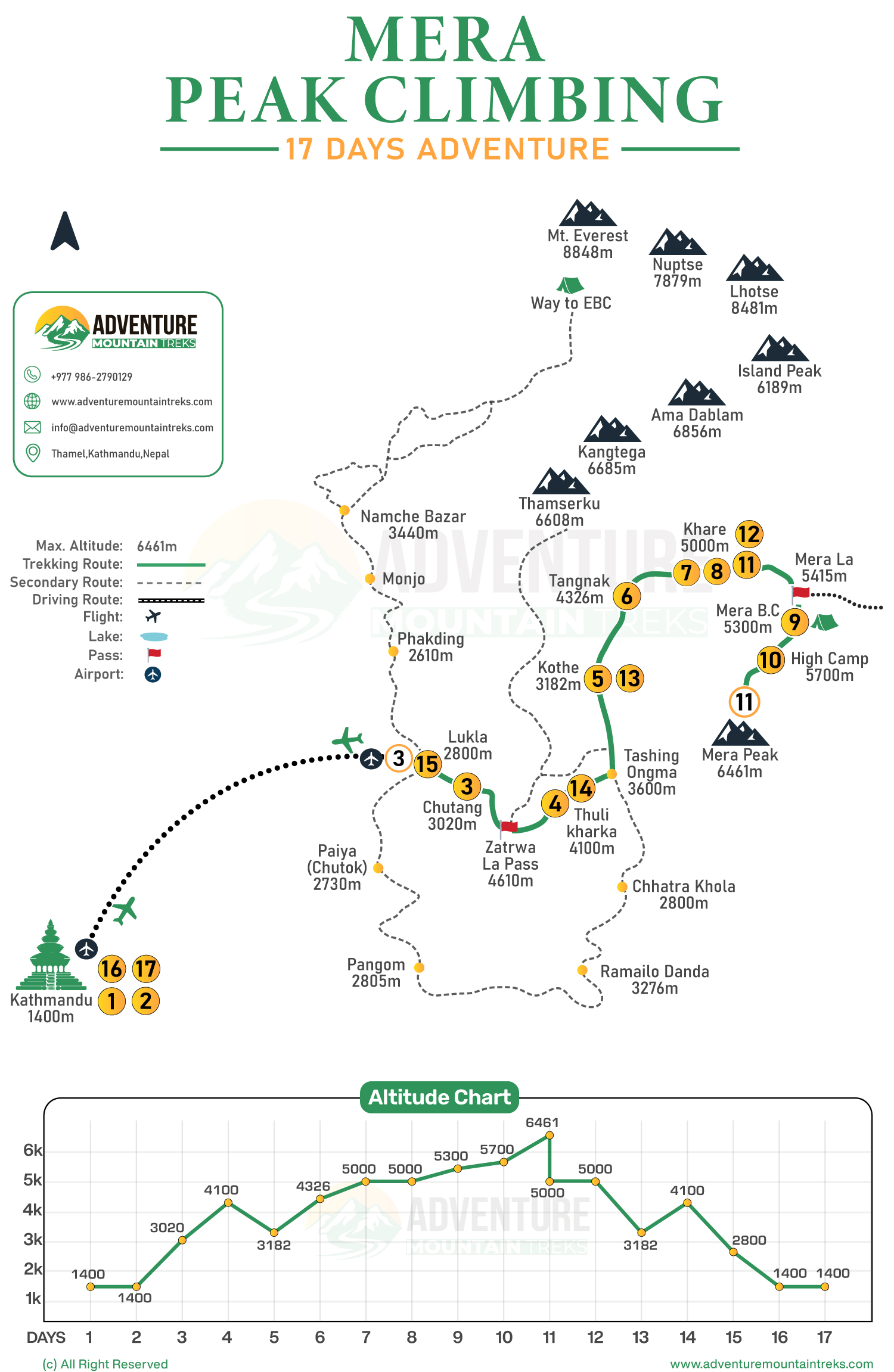
Trekking Map
Detailed Itinerary
PDF ItineraryDuration: Approx. 20-30 minutes drive
Distance: Approx. 7 km
Our company representative will welcome you at Tribhuwan International Airport and drive you by private vehicle to hotel. Preparation and briefing about the trip.
After breakfast in hotel, We will start our city tour in private vechicle from Swyambhu Nath. We will visit Pasupatinath, Patan durbar square, Kathmandu durbar square, Bhaktapur durbar square etc.
Duration: Kathmandu to Lukla flight (30 minute)
: Kathmandu to Manthali Airport (4 hrs drive) and Manthali to Lukla (20 minute flight)
You will either take a direct flight from Kathmandu to Lukla (30 minute flight) or drive about 4 hours to Manthali Airport, followed by a 20-minute flight to Lukla. After landing at the Tenzing-Hillary Airport, the trek begins with a gentle hill walk.
You will clim to Zatrawala pass, view of Numbur Himal. You need to cover 10-11 km distance and 5-6 hrs walking duration.
Walking through scenic forest, rhododendron and glimpses of mera peak, After 6-7 hrs walk (12-13km) we will reach at Kothe.
Trek along the Hinku river valley, view of mera peak reach at Thangnak after 4-5 hrs walk (6-7 km).
To reach at Khare you need to trek 5-6 hrs and around 6-7km.
2-3 hrs short acclimatization hike around Khare.
Gentle climb over Mera Glacier.
Distance: 3–4 km
Duration: 3–4 hrs walk
View of Spectacular sunset over Everest, Lhotse and Makalu.
Distance: 4 km
Duration: 3–4 hrs walk
Distance: 12–13 km (ascent/descent)
Duration: 8–9 hrs climb
After breakfast, you need to start your trek early morning to climb the summit and descent to Khare.
Buffer day for bad weather or extra acclimatization.
Distance: 12–13 km
Duration: 5–6 hrs walk
Descend back.
Distance: 13 km
Duration: 5–6 hrs walk
Back same way along forested trail, mountain view.
Descend to Lukla. We all enjoy last dinner in Lukla with Guest.
Distance: 11 km
Duration: 5–6 hrs walk
Duration: Lukla to Kathmandu flight (30minute)
:Lukla to Manthali (20minute) flight and Manthali Airport to Kathmandu (4hrs drive).
Take a morning flight back to Kathmandu. Your guide will transfer you to your hotel. In the evening, enjoy a farewell dinner at a traditional Nepali restaurant, marking the end of your unforgettable Everest Base Camp Trek.
Duration: Approx. 20-30 minutes drive
Distance: Approx. 7 km
Our representative will drop you at International Airport as per your flight schedule.
Cost Includes / Excludes
Includes
Transport & Flights
- Airport pick-up and drop-off by private vehicle.
- Kathmandu/Ramechhap – Lukla – Ramechhap/Kathmandu both way flight.
Accommodation & Meals
- 3 nights in a 3-star hotel in Kathmandu with breakfast.
- A day guided sightseeing tour in Kathmandu – to explore popular landmarks of Kathmandu with an experienced, highly knowledgeable city tour guide, private vehicle and all entrance fees of UNESCO heritage sites.
- Standard tea house lodge (mountain lodge) and tented camp accommodation during the trek and climb as per availability.
- Three meals per day during the trek (breakfast, lunch, dinner).
- Three cups of tea or coffee per day (instant, not machine-made).
- Farewell dinner in Kathmandu with Cultural Program.
Guides & Trek Support
- An experienced government certified local Trekking Guide / Climbing Sherpa from Kathamdu.
- An experienced climbing Sherpa Guide.
- Assistant guide for groups of 6 or more trekkers.
- Porter service (1 porter for every 2 trekkers, up to 10/12 kg per person).
- All guide and porter expenses (salary, insurance, meals, accommodation, equipment).
Permits & Documentation
- Sagarmatha (Everest) National Park Fee.
- TIMS (Trekkers’s Information Mannual System) permit.
- All necessary trekking and climbing permits (National Park Fees, TIMS permit, local entrance fees and peak. Climbing permit from Nepal Mountaineering Association).
Trekking Gear & Extra
- A duffel bag, Trekking Map.
- Sleeping Bag, Down Jacket, Crampons, Trekking Poles.
- All camping and kitchen equipment that required during the tented camp accommodation.
- A certificate of appreciation (experience certificate) after completing the Trek.
Safety & Preparation
- Pre-arrival information pack and packing guidance.
- Trek briefing meeting in Kathmandu before departure.
- Basic first-aid kit carried by the guide.
- Pulse oximeter for daily oxygen level monitoring.
- 24/7 support from Adventure Mountain Treks Team.
Taxes & Service Charge
- All government taxes and company service charges.
Excludes
- Your personal travel insurance (we highly recommend to make your insurance for any peak climbing adventure trips in Nepal).
- International airfares (we can provide it on request).
- Personal climbing gears (we can arrange your personal climbing gears too on rental basis).
- Cost of personal expenses.
- Tips for trekking and climbing crew.
- Personal expenses (bar, laundry, personal shopping, internet usages during the trek, hot shower during the trek, battery charge during the trek etc.).
- Alcoholic beverage.
- TIPS for Staff.
Photo Gallery


Equipment Checklist
Peak climbing in the Everest region requires careful preparation and the right equipment to navigate the challenging terrain and extreme weather conditions. With elevations reaching above 6,000 meters, climbers face cold temperatures, high winds, and varying surfaces of snow, ice, and rock. Essential gear such as layered clothing, sturdy footwear, and technical climbing equipment helps ensure safety and comfort throughout the ascent. This equipment list covers the basics you'll need for a safe and successful journey to the summit, where preparation and quality gear make all the difference.
1. Clothing
Base Layer: Moisture-wicking thermal tops and bottoms
Insulating Layer: Fleece jacket or down jacket for warmth
Outer Layer: Waterproof, windproof jacket and pants (Gore-Tex or similar)
Climbing Pants: Softshell pants for durability
Down Suit or Heavy down Jacket & Pants: Essential for higher altitudes and cold nights
Gloves: Thin inner gloves, warm insulated gloves, and waterproof outer gloves
Headwear: Warm hat, balaclava, neck gaiter, and sun hat
Socks: Multiple pairs of wool or synthetic trekking socks and thermal socks
2. Footwear
Mountaineering Boots: High-altitude double or triple-layer mountaineering boots for warmth and support
Gaiters: To keep snow and debris out of boots
Camp Shoes: Lightweight footwear for rest periods and around camp
3. Climbing Gear
Ice Axe: Lightweight mountaineering ice axe
Crampons: Compatible with mountaineering boots, for snowy/icy sections
Harness: Alpine harness suitable for glacier travel and technical climbing
Helmet: Mountaineering helmet for protection from falling rocks and ice
4. Other Essentials
Sleeping Bag: Rated for extreme cold, ideally -20°C (-4°F) or lower
Sleeping Pad: Insulated pad for extra warmth and comfort
Backpack: 50–70L backpack for carrying gear; a smaller daypack (20–30L) for day trips
Hydration System: Insulated water bottles and/or a hydration bladder to prevent freezing
Trekking Poles: Adjustable, lightweight poles for support during approach and descent
5. Accessories
Sunglasses: UV-protective, wrap-around glacier glasses
Headlamp: High-lumen, waterproof headlamp with extra batteries
Water Purification: Tablets or filter for clean drinking water
First Aid Kit: Including blister treatments, pain relievers, altitude sickness medication
Personal Hygiene Items: Toothbrush, toothpaste, wet wipes, quick-dry towel
Sun Protection: High-SPF sunscreen, lip balm with UV protection
6. Documents and Money
Passport and Permits: Passport, Visa, TIMS card, Peak Permit & Entry Fee
Cash: ATMs are not reliable in the mountains, so bring enough Nepali cash for personal expenses.
Frequently Asked Questions
Mera Peak stands in the Mahalangur section of the Everest region. At an altitude of 6,476 m (21,247 ft) and it's geographical coordinates are 27°42′33″N 86°52′06″E.
Mera Peak Climbing is considered strenuous peak to climb. This trip is recommended for climbers who have a basic level of mountaineering skills. Although it is a straightforward climb high altitude summit climbing makes this a challenging climb.
The best season for Mera Peak Climbing is during Spring (March, April and May) and Autumn (October and November). During these seasons conditions are safe enough for climbers to try and reach the summit, the weather will be clear, moderate temperature, you will get long sunlight hours, fewer bugs, flowers will bloom on the way, the charm of the atmosphere can be felt by the heart, magnificent views of the Himalayas can be seen and you can escape the crowd and enjoy adventure peak climbing.
The permits required for Mera Peak Climbing are:
- Nepal Mountaineering Association (NMA)
- local area permit
According to the standard itinerary our Mera Peak Climbing is of 18 days from your arrival to Kathmandu to farewell at Airport. If you wish to amend the itinerary you have to contact our booking manager and climbing leaders; they will prepare the best itinerary for you.
Generally for Climbing and Mountaineering we take up to 10 members in a group so that we can guide and coordinate each of them perfectly. If you have a group with more than ten members it’s fine with us. We provide some customizable features however if you are planning to climb solo it is not possible due to the restrictions made by Nepal Mountaineering Association(NMA).
Due to the advancement of the trekking industry, we can find enough lodges and tea houses throughout trip routes. They offer good food and accommodation. There are different options you can choose according to your needs and budget. Also you should know that at high altitude and remote places the service will be limited.
Yes!! It is recommended to have travel insurance during the trip. It is uncertain that you will not feel sick or get into any accidents during the trip. So, for medical emergencies and as precaution against risks and financial losses that could happen while climbing/trekking, insurance is best.
All the equipment/accessories required for climbing will be arranged for you. You will have to pay the amount for equipment. If you personally want to manage any equipment by yourself it’s fine. We have created The Ultimate Climbing Checklist page for your help as It is always better to carry the essential gears and accessories.
Answer is Absolutely Yes!! Adventure Mountain Treks provides Qualified, well experienced, knowledgeable and reliable climbing leaders who have been working in this field professionally for more than a decade will guide you toward the destination and back. You are in safe hands with us, so don’t worry about trekking guides.
Adventure Mountain Trek offers you a lifetime policy through which you can renew your booking amount for another trek although if you want to cancel it then we will refund you as per our trip cancellation terms procedure.
We hire our staff according to their standards. They should have to go through our selection procedure on which we will check their certifications, qualifications and experience. Hence, Our staff are equipped/trained and insured.
Normally, within 12-24 hours after ascending a certain height (1,500 to 2,500 meter above sea level) altitude sickness symptoms like fatigue, loss of appetite, dizziness, sleep problems, shortness of breath, and loss of energy can be seen. In case of any altitude sickness symptoms we will apply medication and descend immediately for acclimatization. Measures for treating Acute Sickness:
- You should stop and rest where you are for at least 24 to 48 hours
- If you feel sick, take an anti-sickness medicine, such as promethazine/diamox
- Make sure you're drinking adequate amount of water
- Smoking, Drinking alcohol, or Exercise will make it worse
Adventure Mountain Treks is well coordinated between various hotels, vehicle companies, domestic and international air services, and other travel and trekking service related companies in Nepal. We are always here to help you to make arrangements according to your needs. Just make sure to contact us for any kind of help.
Yes, Required climbing permits are included on our package cost and are arranged by Adventure Mountain Treks itself.
Customer Reviews




Shey Imad Shah
Iran, Islamic Republic of"We were recently on Island Peak Climbing with EBC Trek with this agency. They took care of everything, for example, we wanted to do the trip only with the trek and climb Sherpa (no..."

Pionner67376382456
India"Oct 2024 I booked EBC with 2 pass (Chola and Renjola Pass) trek. They arranged everything from Kathmandu to Kathmandu in a very efficient way. The guide they allotted Mr. Bhim Ra..."

Jer Van Meirhaeghe
Netherlands"Pralad is the best guide one could ask for! We did EBC trek, beginning of December feels like best period to do this."

Rezwan K
Bangladesh"EBC Trek with Helicopter Return Oct 2022 • Friends A great trip. Well organised, our Guide Shyam had been very helpful. One of us ended up needing a horse and it was promptly ma..."

Mark Jacob Ello
Singapore"We began our Annapurna Base Camp (ABC) trek on April 26, 2025, and it was truly a journey of a lifetime. Huge thanks to Raj, Pralad, and the entire Adventure Mountain Trek team for..."

Albert
Australia"We began our Annapurna Base Camp (ABC) trek on April 26, 2025, and it was truly a journey of a lifetime. Huge thanks to Raj, Pralad, and the entire Adventure Mountain Trek team for..."