Annapurna Circuit Trek
Trip Overview
AMT - TREK - 202
Autumn & Spring
Strenuous
Thorong Phedi (4,600m/15,092ft)
Teahouses/Lodges
Flight/Jeep or Bus
BB/Full Board
Any
Introduction
Walking through the wonderful villages, following the uneven landscapes, mountain passes and the landmass covered by the Himalayas. Annapurna Circuit trek offers the breath taking panorama of sky-scraping mountains and adventurous trekking. Mt. Annapurna, itself is the world's 10th highest peak is the world's difficult mountain to climb and the most fascinating thing is to take a good look by passing through the world's highest mountain pass- Thorang La Pass.
Annapurna Circuit Trek Overview
Beginning through the culturally well off village Chamje. The trekking route proceed with the suspension bridge across the Marsyangdi river, rice paddies and beautiful atmospheric environment. Every step forwards discloses the spectacular view of the mountains above the range of 7,000 meters. The acclimatization in Manang at the altitude of 3,551 meter said in adjusting the altitude and most importantly, it presents the view of cultivation fields with terraces, herding of yaks, culturally predominant gompas & monasteries, a view of Gangapurna lake, Gangapurna glacier resting just above the village that cannot be pass over.
Scenic Annapurna Circuit Trek via Thorong La Pass and Jomsom
Drawing a steps forward, the Annapurna circuit trek leads to the world highest mountain pass (Thorang La Pass) from where the view of the stiking Annapurna Massif, Mt. Dhaulagauri, Mt Machhapuchhre, Mt Manaslu and many other snow-capped peaks appears like a paradise. Then the Journey aheads towards the holy temple which is regarded as the place of liberation in Hindu culture. The Jomsom area is correspondingly the wonderful place where the trekkers wish to pass through. The way back can be made through a scenic mountainous flight from Jomsom to Pokhara and a drive or flight from Pokhara to Kathmandu. However, instead of flight the alternative choice of jeep dive can be made as per the trekkers’ decision.
Moving through the temple situated between Himalayas after the highest mountain pass cross render the gratification of wonderful trek along with the convenience of watching diverse culture and tradition in the dynamic mountain villages, moving through the woodlands covered with Rhododendron flower, sub-tropical forest, this trekking route has the most of the entity to offer.
Trip Features:
- The engrossing Annapurna mountain range offers the fabulous picturesque of enormous mountain peaks over the range of 6,000 and 7,000 meter where the traveller get to cross the 5,416 metres (17,769 ft) elevation of Thorang La pass.
- The world's deepest river- Kali Gandaki Gorge. The first Conservation Area and largest Protected Area in Nepal- Annapurna conservation area. They has adjoined with beauty of this majestic place that has always set its popularity with its breath taking view.
- Inhabitant of different ethnic groups has made diversification in culture and tradition. Each traveler run with great amaze and gets a taste of variety of Nepali culture. This includes the Muktinath temple, which is sacred to both Hindus and Buddhist. Muktinath is one of the world's highest temples (altitude 3,800 m).
- Getting a way back through a scenic mountainous flight from Jomsom to Pokhara adds more charm to a journey. Although it is totally optional with jeep drive.
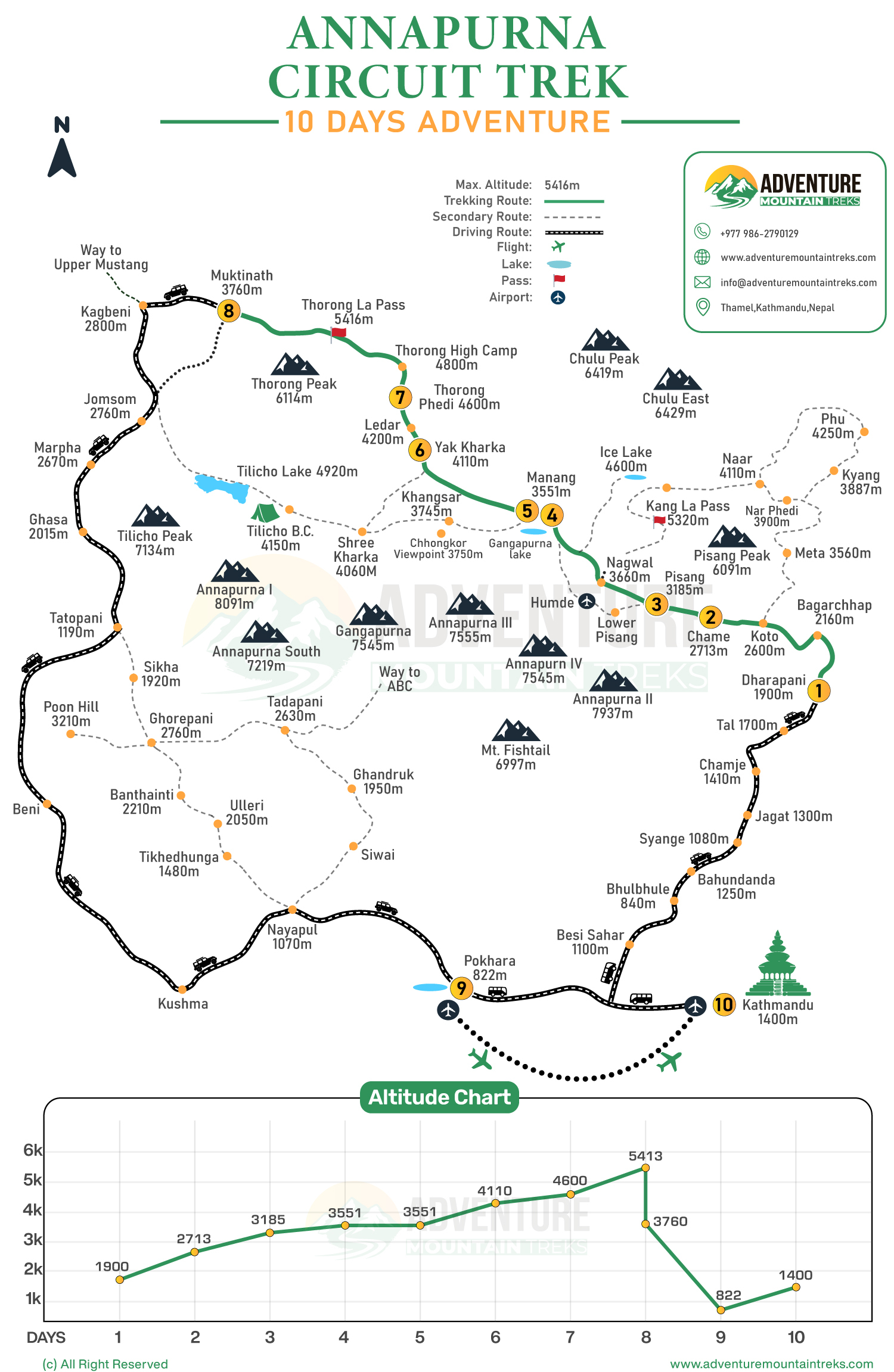
Tour Map
Detailed Itinerary
PDF ItineraryDuration: Approx. 20-30 minutes drive
Distance: Approx. 7 km
Our company representative will welcome you at Tribhuwan International Airport and drive you by private vehicle to hotel. Preparation and briefing about the trip.
Duration: Approx. 9-10hrs drive
Distance: 230 km
After an early morning breakfast, we begin our scenic drive to Dharapani. Along the way, you’ll enjoy views of lush green hills, cascading waterfalls, and the beautiful Marsyangdi River gorge. The drive is long but scenic, offering glimpses into rural Nepal. Overnight stay in Dharapani.
Duration: Approx. 5-6 hrs trek
Distance: Approx. 16 km
Today, we begin our trek after breakfast. The trail passes through picturesque villages like Bagarchhap, Danque, and Timang. On the way, you’ll witness stunning views of Lamjung Himal, walk through dense pine and rhododendron forests, and encounter several waterfalls. Chame, the district headquarters of Manang, lies on the banks of the Marsyangdi River and is surrounded by dramatic cliffs. The area reflects a strong influence of Tibetan Buddhism. Overnight at a comfortable teahouse in Chame.
Duration: Approx. 5-6 hrs trek
Distance: Approx. 14 km
After breakfast, we continue our trek by crossing a suspension bridge and following the Marsyangdi River upstream. The day offers mesmerizing views of Annapurna II, Pisang Peak, pine forests, wildflowers, and more prayer flags and chortens reflecting Tibetan culture. Upper Pisang, is located on a ridge, offers panoramic views of Annapurna II, Annapurna IV, and the Marsyangdi Valley. Overnight stay at a teahouse in Upper Pisang.
Duration: Approx. 7-8hrs trek
Distance: Approx. 17.1 km
We start with a steep uphill climb past a mani wall and chorten to reach the village of Ghyaru, which rewards you with jaw-dropping views of the Annapurna range. After 1–2 hour walk from Ghyaru takes you to Nawal, a beautiful and open village with an ancient monastery – a perfect place for lunch. The trail continues through pine forests and yak pastures until we reach Manang. Overnight at a teahouse in Manang.
Today is a rest and acclimatization day in Manang. You can explore the following nearby attractions:
Gangapurna Lake and Glacier Viewpoint – A short 1-hour hike with beautiful lake and glacier views.
Ice Lake – A challenging 6–7 hour round trip with breathtaking panoramic mountain views.
Milarepa Cave – A 3–4 hour round-trip hike to a sacred Buddhist meditation site.
Overnight at the same teahouse in Manang.
Duration: Approx. 3-4 hrs trek
Distance: Approx. 9.1 km
After breakfast, we leave the main village, cross a stream, and start a gradual uphill trek. Along the way, you’ll see views of Annapurna III, Gangapurna, Tilicho Peak, and the Chulu range. The landscape becomes more alpine and sparse. Overnight at a teahouse in Yak Kharka.
Duration: Approx. 3-4hrs trek
Distance: Approx. 8km
Today’s trek is a gradual ascent through open meadows and yak pastures. You’ll walk past stone walls and scattered shrubs, enjoying stunning views of Chulu East and Chulu West, and the upper Marsyangdi Valley. Thorong Phedi is a rugged, cold, and windy settlement at the base of the Thorong La Pass. Overnight stay at a teahouse.
Duration: Approx. 7-8 hrs trek
Distance: Approx. 16 km
This is the most challenging yet rewarding day of the trek. We start early in the morning with a steep climb to Thorong La Pass (5,416m), the highest point on the route. At the top, you’ll be greeted by prayer flags and breathtaking views of the Himalayas. After celebrating the achievement, we descend to Muktinath. The landscape transforms dramatically into dry, barren terrain. Muktinath is a sacred site for both Hindus and Buddhists, known for its eternal flame and 108 water spouts. Comfortable teahouse accommodation and delicious food await. Overnight stay in Muktinath.
Duration: Approx. 8-9hrs trek
Distance: Approx. 170 km
After breakfast, we begin our drive to Pokhara or fly from Jomsom to Pokhara. The road is rough and bumpy, especially between Muktinath and Beni, but the journey offers spectacular views as we pass through the world’s deepest gorge, the Kali Gandaki Gorge. Arrive in Pokhara by evening. Overnight at a hotel in Pokhara.
Duration: Approx. 8-9hrs trek
Distance: Approx. 170 km
After breakfast, we begin our drive to Pokhara or fly from Jomsom to Pokhara. The road is rough and bumpy, especially between Muktinath and Beni, but the journey offers spectacular views as we pass through the world’s deepest gorge, the Kali Gandaki Gorge. Arrive in Pokhara by evening. Overnight at a hotel in Pokhara.
Duration: Approx. 20-30 minutes drive
Distance: Approx. 7 km
Our representative will drop you at International Airport as per your flight schedule.
Departures
| Trip Name | Departure | Duration | Price | Action |
|---|---|---|---|---|
| Annapurna Circuit Trek | 2026-10-16 | 11 Days | From $ 1170.00 | Book Now |
| Annapurna Circuit Trek | 2026-10-24 | 11 Days | From $ 1170.00 | Book Now |
| Annapurna Circuit Trek | 2026-10-29 | 11 Days | From $ 1170.00 | Book Now |
| Annapurna Circuit Trek | 2026-11-03 | 11 Days | From $ 1170.00 | Book Now |
| Annapurna Circuit Trek | 2026-11-07 | 11 Days | From $ 1170.00 | Book Now |
| Annapurna Circuit Trek | 2026-11-21 | 11 Days | From $ 1170.00 | Book Now |
| Annapurna Circuit Trek | 2026-11-27 | 11 Days | From $ 1170.00 | Book Now |
Cost Includes / Excludes
Includes
Transport & Flights
- Airport pick-up and drop-off by private vehicle.
- Kathmandu to Dharapani and Muktinath to Pokhara to Kathmandu. (Flight/private vehicle/Tourist couch) as per your budget and interest,
Accommodation & Meals
- 2 nights in a 3-star hotel in Kathmandu & 1 night in Pokhara with breakfast.
- Teahouse accommodation during the trek (twin-sharing basis/ Private)
- Three meals per day during the trek (breakfast, lunch, dinner).
- Three cups of tea or coffee per day (instant, not machine-made).
- Farewell dinner in Kathmandu with Cultural Program.
Guides & Trek Support
- An experienced government certified local Trekking Guide.
- Assistant guide for groups of 6 or more trekkers
- Porter service (1 porter for every 2 trekkers, up to 10/12 kg per person)
- All guide and porter expenses (salary, insurance, meals, accommodation, equipment)
Permits & Documentation
- Annapurna Conservation Area (ACAP) permit.
- TIMS (Trekkers’s Information Mannual System) permit.
Trekking Gear & Extra
- A duffel bag, Trekking Map.
- Sleeping Bag, Down Jacket, Crampons, Trekking Poles.
- Adventure Mountain Treks T-shirt & Cap.
- A certificate of appreciation (experience certificate) after completing the Trek.
Safety & Preparation
- Pre-arrival information pack and packing guidance.
- Trek briefing meeting in Kathmandu before departure.
- Basic first-aid kit carried by the guide.
- Pulse oximeter for daily oxygen level monitoring.
- 24/7 support from Adventure Mountain Treks Team.
Taxes & Service Charge
- All government taxes and company service charges.
Excludes
- International Airfare.
- Personal Travel Insurance (essential for high altitude trekking).
- Lunch and Dinner in Kathmandu.
- Personal expenses (bar, laundry, personal shopping, internet usage during the trek, hot shower during the trek, battery charge during the trek, etc.).
- Alcoholic beverage.
- TIPS for Staff.
Photo Gallery


Equipment Checklist
Embarking on the Annapurna circuit trek is a thrilling adventure that requires meticulous preparation. Ensuring you have the right gear can make the difference between a comfortable journey and a challenging one. In this guide, we’ll walk you through the essential equipment needed for the trek, from clothing layers to personal items. Whether you’re a seasoned trekker or a first-timer, our comprehensive packing list will help you get ready for the adventure of a lifetime.
1. Clothing
Base Layers: Thermal tops and bottoms for warmth.
Mid Layers: Fleece jacket for insulation.
Outer Layer: Insulated down jacket (recommended for high altitudes).
Rainproof/Windproof Jacket and Pants: Essential for unpredictable weather.
Trekking Pants: Lightweight, quick-drying pants for daytime trekking.
Warm Hat and Sun Hat: A warm beanie for cold weather, and a wide-brimmed hat or cap for sun protection.
Gloves: Waterproof insulated gloves and lightweight inner gloves.
Socks: Wool socks for cold weather and moisture-wicking socks for trekking.
Gaiters: To keep mud, snow, and debris out of your boots.
2. Footwear
Hiking Boots: Sturdy, waterproof boots with good ankle support.
Camp Shoes/Sandals: For comfort when relaxing in the tea houses or lodges.
3. Sleeping Gear
Sleeping Bag: Rated for -10°C to -20°C to withstand cold nights in higher altitudes.
Sleeping Bag Liner: Adds warmth and keeps your sleeping bag clean.
4. Backpack and Accessories
Daypack (25-30 liters): For carrying essentials like water, snacks, and layers.
Duffel Bag: Large, durable bag for porters to carry; waterproof covers are recommended.
Rain Cover: For protecting your daypack from rain.
Trekking Poles: Helpful for stability and reducing stress on knees.
5. Hydration and Nutrition
Water Bottles and/or Hydration Bladder: With at least 2-3 liters capacity.
Water Purification Tablets or Filter: To treat water on the trail.
Snacks: High-energy snacks like energy bars, nuts, and chocolates.
6. Personal and Miscellaneous Items
Headlamp with Extra Batteries: Essential for early morning treks or dark trails.
Sunglasses: UV-protective, high-quality sunglasses to protect against the intense high-altitude sun.
Sunscreen and Lip Balm: High SPF for sun protection.
Basic First Aid Kit: Include band-aids, blister treatment, antiseptics, painkillers, altitude sickness medication, and any personal medications.
Toiletries: Eco-friendly soap, toilet paper, hand sanitizer, and wet wipes.
Camera and Extra Batteries: Since charging can be costly and unreliable at high altitudes.
7. Documents and Money
Passport and Permits: Passport, visa,TIMS card, and entry permit.
Cash: ATMs are not reliable in the mountains, so bring enough Nepali cash for personal expenses.
Frequently Asked Questions
Annapurna Circuit Trek is a strenuous trekking route. Although There are numerous challenges like the rugged terrain, steep slopes, trekking route through stone stairs and continuous walking of 5 to 6 hours per day. That being said, Annapurna Circuit Trek is doable and can be undertaken by travelers who have the right attitude and are physically fit
The prime time for trekking Annapurna Circuit is during Spring (March, April and May) and Autumn (October and November). During these seasons the weather will be clear, you will get long sunlight hours, fewer bugs, flowers will bloom on the way, the charm of the atmosphere can be felt by the heart, magnificent views of the Himalayas can be seen and you can escape the crowd and enjoy the pleasure of trekking.
Yes!! It is recommended to have travel insurance during the trek. It is uncertain that you will not feel sick or get into any accidents during the trek. So, for medical emergencies and as precaution against risks and financial losses that could happen while traveling, insurance is best.
Essential trekking equipment and accessories, including a down jacket, sleeping bag, trekking poles, a duffel bag, and crampons, will be provided for your trek . If you personally want to manage any equipment by yourself it’s fine. We have created The Ultimate Trekking Checklist page for your help as It is always better to carry the essential gears and accessories.
Qualified, well experienced, knowledgeable and reliable trekking leaders who have been working in this field professionally for more than a decade will guide you toward the destination and back. You are in safe hands with us, so don’t worry about trekking guides.
We will start our trek from Chamje (1,410m/4,626ft) and ascend up to Thorong Phedi (4,600m/15,092ft). We have created Itinerary in proportion to proper accommodation so normally we don’t need oxygen on this trek. In case of altitude sickness we will descend immediately. If any altitude sickness symptoms are seen then we provide Diamox as a medication.
Adventure Mountain Trek offers you a lifetime policy through which you can renew your booking amount for another trek although if you want to cancel it then we will refund you as per our trip cancellation terms procedure.
We hire our staffs according to their standards. They should have to go through our selection procedure on which we will check their certifications, qualifications and experience. Hence, Our staff are equipped/trained and insured.
Due to the advancement of the trekking industry, we can find enough lodges and tea houses throughout Annapurna Region trekking routes. They offer good food and accommodation. There are different options you can choose according to your needs and budget. Also you should know that at high altitude places like Thorong Phedi the service will be limited.
Yes!! The Internet is accessible during the Annapurna Circuit Trek. You can access the 3G network on mobile phones. The mobile internet is fast enough to browse and even make video calls. You will get continuous signal during the whole trek but there will be certain dark spots along the trek where connection may drop. There are limited WiFi hotspots during the trek which will charge for usage only some will let you use it for free. So, for internet access we recommend you to buy a SIM and use 3G.
Normally, Within 12-24 hours after ascending a certain height(1,500 to 2,500 meter above sea level) altitude sickness symptoms like dizziness, fatigue, loss of appetite, sleep problems, loss of energy, and shortness of breath are seen. In case of any altitude sickness symptoms we will apply medication and descend immediately for acclimatization.
Trekking via the local agency is one of the great ideas for trekkers. There are more local trekking organizations in Nepal. The hard part is you need to recognize whether they are authorized businesses and are members of the Trekking Agency Association of Nepal (TAAN).You can view their internet site and profiles commonly all legal organizations will upload their profile along with authorities-legal certificates.
Yes!! You can charge mobile phones and camera batteries during the trek. At most of the places you will get to charge for free but at some places you have to pay some amount to charge. Remember that It is always better to bring your power bank with you which will be helpful.
The permits required for Annapurna Circuit Trek are:
- Trekking Information Management System (TIMS) card
- Annapurna Conservation Area Entry Permit(ANCAP)
According to the standard itinerary our Annapurna Circuit trek is of 15 days from your arrival to Kathmandu to farewell at Airport. Normally on the 10th day of trek we will reach the Thorong Phedi which is at the altitude of (4,600m/15,092ft) from sea level, highest altitude you will be during the trek and descend back. If you wish to amend the itinerary you have to contact our booking manager he will prepare the itinerary according to your needs.
1. Budget Friendly Package
Our Budget Package is designed for travelers who prefer to keep costs as low as possible while still enjoying a professionally organized trek.
This package includes the essential services required to complete your trek safely, such as:
- Experienced and licensed trekking guide
- All necessary trekking permits
- Required ground transportation according to the itinerarBasic logistical support throughout the trek
With this package, meals and accommodation are not included. Guests are free to choose where they would like to stay and what they would like to eat each day. This option offers greater flexibility and allows trekkers to manage their daily expenses according to their own budget and preferences.
It is an excellent choice for experienced trekkers, backpackers, or travelers who prefer to organize their own accommodation and meals while benefiting from the support of a knowledgeable local guide.
2. Standard Package
Our Standard Package is the most popular option and provides excellent value for money. It is suitable for travelers who want comfortable, well-organized trekking experience without having to worry about arranging daily logistics.
The Standard Package generally includes:
- Airport pick-up and airport drop-off
- Comfortable hotel accommodation in Kathmandu before and after the trek
- Experienced, government-licensed trekking guide
- Porter service (where included
- All required trekking permits
- Ground transportation and domestic flights (if applicable)
- Accommodation throughout the tre
- Breakfast, lunch, and dinner during the trekking period
- Government taxes and service charges
With this package, almost all major expenses are covered in advance, allowing guests to focus entirely on enjoying the mountains and the trekking experience.
3. Deluxe Package
Our Deluxe Package is designed for travelers seeking maximum comfort, premium service, and a worry-free holiday from the moment they arrive in Nepal until their departure.
This package includes everything offered in the Standard Package, along with several additional premium services.
Guests can expect:
- Accommodation in high-quality luxury hotels in Kathmandu
- The best available accommodation during the trek wherever possible
- Highly experienced professional trekking guide
- Porter service
- All trekking permits and necessary documentation
- Domestic flights and transportation
- Breakfast, lunch, and dinner throughout the trek
- Unlimited tea, coffee, and hot drinking water during meals
- Fresh fruits whenever available
- Farewell dinner in Kathmandu
- Sleeping bag and down jacket (if required)
- Government taxes, VAT, and service charges
- Complete logistical support throughout the journey
The Deluxe Package is perfect for those who prefer a higher level of comfort and convenience. Every effort is made to provide the best possible accommodation available in the mountains, although facilities in remote Himalayan regions are naturally more basic than in cities.
Conclusion:
The trekking experience itself remains the same across all packages. Our guides and porters are equally experienced, professional, and dedicated regardless of the package you choose. The trekking routes, safety standards, and support are also the same.
Simply choose the package that best matches your preferred level of comfort and budget.
Useful Information
Useful Information
Annapurna Circuit Trek: Journey Through Nepal’s Iconic Himalayan Loop
The Annapurna Circuit Trek is one of Nepal’s most legendary trekking adventures, circling the Annapurna Massif and offering unmatched diversity in culture, climate, and landscape. From lush lowlands to high mountain passes, this trek connects remote villages, ancient monasteries, and awe-inspiring Himalayan peaks. Known for its stunning natural beauty and cultural richness, the Annapurna Circuit is a favorite among both first-time and seasoned trekkers.
Key Highlights
Thorong La Pass (5,416m): One of the world’s highest trekking passes with panoramic views.
Diverse Landscapes: From subtropical forests and rice paddies to alpine terrain and arid plateaus.
Cultural Encounters : Meet Gurung, Thakali, and Tibetan-influenced communities.
Holy Sites: Visit Muktinath, a sacred site for both Hindus and Buddhists.
Hot Springs at Tatopani: Relax and recover in natural hot water pools.
Scenic Villages: Discover Manang, Pisang, Braga, Marpha, Kagbeni, and more.
Annapurna Circuit Trek: A Himalayan Adventure of Contrast and Beauty
More than just a trek, the Annapurna Circuit is a journey through Nepal’s ecological and cultural heart. With each step, you transition through climatic zones and cultural identities—offering endless surprises and unforgettable moments.
Cultural Immersion
Explore centuries-old monasteries in Manang and Braga, observe daily mountain life in Thakali and Gurung villages, and experience traditional
Hospitality along the trail. The trek offers a rich blend of Buddhist and Hindu traditions.
Best Time to Visit
Spring (March–May): Wildflowers bloom, especially rhododendrons, with clear skies.
Autumn (September–November): Stable weather and best mountain visibility.
Winter (Dec–Feb): Cold but possible with preparation. Thorong La may be blocked.
Monsoon (June–August): Risk of landslides and leeches in lower areas; not ideal.
Visa Process at Airport
Available on arrival at Tribhuvan International Airport (TIA), Kathmandu:
USD 30 for 15 days.
USD 50 for 30 days.
Bring USD in cash; card payments may not be reliable.
Airport Welcome
Our team will greet you at the airport holding a sign with your name and our company logo. You’ll be transferred to your hotel via private vehicle.
About SIM Card
Purchase a local SIM card at the airport or in Thamel Market.
Recommended Providers:
Ncell – Best for coverage in most trekking areas.
NTC – Stronger in remote areas like Manang.
Bring your passport and a passport-size photo.
Annapurna Circuit Trek Package Price
Package costs depend on group size, accommodation level, and trip length.
Includes:
ACAP Permit and TIMS Card.
Guide, porter, accommodation, and transport.
Support for ethical tourism and local communities.
Contact us for a tailored quote.
Trip Confirmation
To confirm:
20% deposit or full payment in advance.
Balance on arrival in USD cash or card (4% extra fee for card).
Money Exchange in Nepal
Exchange currency in Thamel (Kathmandu) or Lakeside (Pokhara).
Carry Nepalese Rupees (NPR) for the trek—ATMs are rare beyond Besisahar.
Difficulty Level
Rated: Moderate to Challenging.
Trekking Hours: 5–8 hours daily.
Highest Point: Thorong La Pass (5,416m).
Suitable for trekkers with good fitness and some trekking experience.
Age Restrictions
No official restrictions. Trekkers aged 8 to 70+ complete this trek yearly. Fitness and determination are key.
Physical Fitness
Begin light hiking practice 4–6 weeks before.
Include uphill walking and cardio.
Stay hydrated and maintain a balanced diet.
Consult your doctor if needed.
Weather & Temperature
Day: Mild to warm in lower areas, cool at high altitudes.
Night: Cold above 3,000m (below -10°C at Thorong Phedi).
Tip: Bring a sleeping bag rated to at least -15°C.
Checkpoints
Permits are checked at various points including:
Besisahar, Chame, Pisang, Manang.
Yak Kharka, Thorong Phedi, Muktinath.
Jomsom (if ending trek there).
Bag Weight & Packing
Porter carries: 20–25kg (shared between 2 trekkers).
Daypack: Essentials only.
Weights to Note:
Sleeping Bag: 1.7kg.
Down Jacket: 1.2kg.
Trek Timing
Wake-up: 6:30–7:00 AM.
Start Trek: 8:00 AM.
End Day: 4:00–5:00 PM.
Evenings for rest and briefings.
Accommodation
Kathmandu/Pokhara: 2-star to 5-star hotels (BB or Full Board).
On Trek: Teahouses with basic private/shared rooms.
Tip: Bring a travel towel, hand sanitizer, and wet wipes for extra comfort.
Food on Trek
Teahouses offer varied menus including:
Dal Bhat, thukpa, fried rice, pasta.
Momos, bread, eggs, soup.
Tea, coffee, hot lemon.
Vegetarian options are widely available.
Drinking Water
Avoid tap water.
Use purification tablets or Steripen.
Boiled water available at lodges for a small fee.
Hot Shower
Available at most lodges in lower to mid-altitude.
Higher up, availability may decrease.
Hot showers often come with extra charges.
Laundry
Laundry is difficult due to cold and slow drying. Pack enough clean clothes for the full trek.
Guide Service
Licensed and experienced trekking guides.
First aid and high-altitude trained.
English-speaking and culturally aware.
Ensures safety, comfort, and organization.
Porter Service
Local, strong, and ethical.
Carries 20–30kg shared between two trekkers.
Works in sync with guide for smooth logistics.
Altitude Sickness Prevention
Gradual ascent and acclimatization days (especially in Manang).
Hydration and rest.
Watch for symptoms like headache, nausea, fatigue.
Guides are trained to assist in AMS prevention and response.
Evacuation & Emergency Procedures
In case of emergency: horse, jeep, or helicopter evacuation.
24/7 emergency coordination.
Travel insurance with emergency evacuation is required.
Extra Money
Carry NPR cash for extra service which are not include in itinerary.
Tips (optional, based on service).
Permits Required
ACAP Permit – Annapurna Conservation Area Permit.
TIMS Card – Trekkers’ Information Management System.
Packing Essentials
Layers (base, fleece, down).
Trekking boots and sandals.
Sun hat, sunglasses, gloves.
Sleeping bag (-15°C rating).
Headlamp, water purifier, snacks.
Toiletries and personal medication
For Solo Female Travelers
Nepal is considered safe for solo women travelers.
Female guides available on request.
Shared rooms with same-gender travelers.
Respectful, community-focused trekking environment.
Customer Reviews




Mark Jacob Ello
Singapore"We began our Annapurna Base Camp (ABC) trek on April 26, 2025, and it was truly a journey of a lifetime. Huge thanks to Raj, Pralad, and the entire Adventure Mountain Trek team for..."

Albert
Australia"Excellent trek with Pralad to EBC Dec 2024 I did a 12 day Everest Base Camp trek with Pralad during December 2024. This was an amazing experience both regarding the stunning nat..."

D Z
Canada"I feel like we were extremely lucky on this trip taking into account all help we've got from Pradip and his team. Traveling in Covid times is hard enough on it's own, still we had..."

Pionner67376382456
India"Oct 2024 • I booked EBC with 2 pass(Chola and Renjola Pass) trek. They arranged everything from Kathmandu to Kathmandu in a very efficient way. The guide they allotted Mr. Bhim R..."

Jer Van Meirhaeghe
Netherlands"Pralad is the best guide one could ask for! We did EBC trek, beginning of December feels like best period to do this."

Rezwan K
Bangladesh"EBC Trek with Helicopter Return Oct 2022 • Friends A great trip. Well organised, our Guide Shyam had been very helpful. One of us ended up needing a horse and it was promptly ma..."