Manaslu Circuit Trek: The Complete Guide for 2026/2027
By Pralad Simkhada
TAAN-Certified Senior Guide | 10+ Years Experience
| Quick Facts — Manaslu Circuit Trek (Adventure Mountain Treks) | |
| Trip Code | AMT-TREK-301 |
| Duration | 13 Days |
| Max Altitude | Larkya La Pass — 5,160 m / 16,924 ft |
| Mt. Manaslu Height | 8,163 m / 26,781 ft (World's 8th Highest) |
| Difficulty | Strenuous |
| Best Seasons | Spring (Mar–May) & Autumn (Sep–Nov) |
| Permits Required | RAP + MCAP + ACAP + Local Fee (~USD 168 peak season) |
| Accommodation | Teahouses / Lodges (Full Board) |
| Rating | 4.5 Stars — 150+ Verified Reviews |
| Min. Group Size | 2 trekkers (restricted area regulation) |
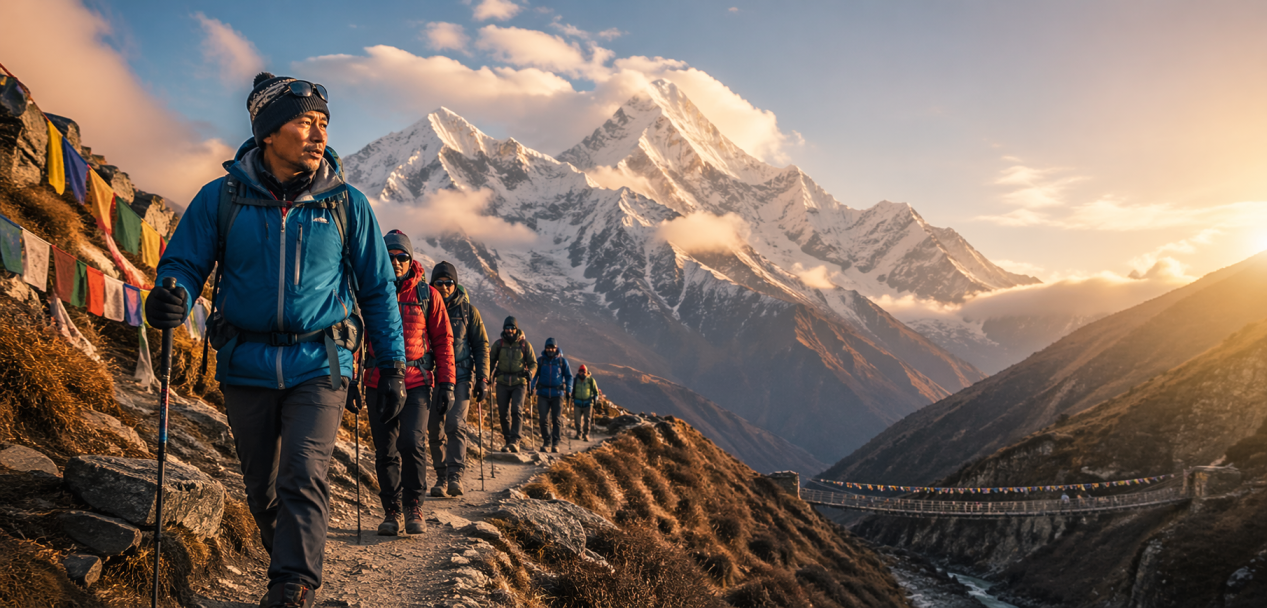
The Manaslu Circuit Trek is Nepal's finest off-the-beaten-path circuit, a 13-day loop around Mt. Manaslu (8,163 m), the world's eighth-highest peak, deep inside the restricted Gorkha District. Less crowded than Everest Base Camp or the Annapurna Circuit, and that is precisely what makes it extraordinary.
You will walk the Budi Gandaki gorge, cross Larkya La Pass (5,160 m), trek through ancient Tamang, Sherpa, and Tibetan-influenced villages, and explore the Manaslu Conservation Area, home to Snow Leopards, Red Pandas, Himalayan Tahr, and 110+ bird species.
In this guide from Adventure Mountain Treks (Government Approved, License No. 2231/073, Kathmandu), every permit cost, altitude, and itinerary detail comes straight from our field operations. We have guided hundreds of trekkers on this circuit since 2008.
In this complete guide, we will share the exact 13-day itinerary with altitude and distance per day, 2026 permit costs itemized to the rupee, a full cost breakdown from budget to mid-range, a detailed AMS/altitude safety strategy, gear lists, connectivity guide, solo trekking rules, and a comparison against the Annapurna Circuit.
1. What Is the Manaslu Circuit Trek?
The Manaslu Circuit Trek is a 13-day teahouse-based loop through the Manaslu region of the Gorkha District, northwestern Nepal. The circuit follows the Budi Gandaki River upstream from Machha Khola, climbs through subtropical forests, alpine meadows, and high-altitude desert, crosses Larkya La Pass at 5,160 m / 16,924 ft, and descends to Dharapani at the edge of the Annapurna region.
The trek encircles Mt. Manaslu — 8,163 m / 26,781 ft above sea level — Nepal's only major eight-thousander located entirely within the country's borders. The word Manaslu is derived from the Sanskrit word 'Manasa', meaning 'mountain of the spirit'.
What separates this trek from all others in Nepal is its designation as a restricted area by the Government of Nepal. Access requires a Special Restricted Area Permit (RAP), a minimum group of two trekkers, and a licensed guide at all times. These regulations keep visitor numbers low and the environment largely intact.
From my experience as a guide at Adventure Mountain Trek, I have guided trekkers on this circuit in every season since 2008. The restricted area status is not a bureaucratic hurdle — it is the single biggest reason the trail still feels wild and authentic. Our permit team handles all the paperwork, so you arrive ready to walk.
Manaslu vs Annapurna Circuit Trek vs Everest Base Camp : Which One Should You Choose?
| Feature | Manaslu Circuit | Everest Base Camp | Annapurna Circuit |
| Duration | 13 days | 12 days | 10 days |
| Highest Point | Larkya La Pass | Kala Patthar | Thorong La Pass |
| Difficulty | Strenuous | Moderate–Challenging | Moderate–Challenging |
| Crowd Level | Very low (restricted permit) | Very high | High |
| Solo Trekking | ✅ Allowed (Insurance Required) | ✅ Allowed | ✅ Allowed |
| Guide Required? | ✅ Mandatory by law | Optional | Optional |
| Key Permit | Restricted Area Permit + MCAP + ACAP | Sagarmatha NP + Khumbu entry | ACAP + TIMS |
| Permit Cost |
USD 168 per person
|
USD 70 per person | USD 50 per person |
| Approx. Trek Cost | ~$1,200–$2,000+ | ~$1,000–$2,500+ | ~$1,100–$1,800 |
| Main Peak Views | Manaslu , Himalchuli, Annapurna II | Everest, Lhotse, Ama Dablam | Annapurna massif, Dhaulagiri, Machhapuchhre |
| Cultural Flavor | Tibetan-influenced Nubri/Tsum, active monasteries | Sherpa villages, Tengboche monastery | Hindu and Buddhist mix, diverse ethnic groups |
| Terrain | River gorges, dense forest, glacial moraine | Alpine meadows, glacial valleys, moraines | Subtropical forest to high-altitude desert |
| Accommodation | Basic teahouses | Well-developed lodges | Good facilities, some luxury lodges |
| Wi-Fi / Amenities | Limited | Good | Good |
| Biodiversity | Snow Leopard, Red Panda, $110+$ bird species | Limited wildlife | Diverse flora, rhododendron forests |
| Best Season | Spring (Mar–May), Autumn (Sep–Nov) | Spring & Autumn | Spring & Autumn |
| Access to Start | $8–10\text{ hr}$ drive from Kathmandu | Flight to Lukla | Drive or flight to Besisahar/Pokhara |
| Ideal For | Experienced trekkers seeking solitude & culture | Iconic bucket-list experience | Beginners to intermediate, varied landscape lovers |
3. Manaslu Circuit Trek Highlights
• Standing atop Larkya La Pass (5,160 m / 16,924 ft) — a 360° panorama of Manaslu, Himlung, Kang Guru, Cheo Himal, and Annapurna II
• Walking the deep gorge of the Budi Gandaki River across suspension bridges — one of the Himalayas' most dramatic valley corridors
• Close, unobstructed views of Mt. Manaslu (8,163 m) — the world's eighth-highest peak — for multiple consecutive days
• Entering the Manaslu Conservation Area — habitat of the Snow Leopard, Red Panda, Himalayan Tahr, and Himalayan Marmot
• Cultural immersion in Tamang, Sherpa, and Tibetan-influenced Nubri villages — working monasteries, chortens, prayer flags at every turn
• Rhododendron forests in bloom during spring (March–May) and crystal-clear mountain panoramas in autumn (September–November)
• Optional extension into Tsum Valley — one of the most sacred and culturally intact hidden valleys in the Himalayas
• Side trips to Birendra Tal (glacial lake, 3,450 m), Manaslu Base Camp (4,800 m), and Pungyen Gompa (~4,050 m)
4. What is the Route of the Manaslu Circuit Trek? Geography, Map & Terrain Explained
The Manaslu Circuit Trek starts with an 8–10 hour drive from Kathmandu to Machha Khola (970 m) via Arughat. The trail follows the Budi Gandaki River upstream, crosses Larkya La Pass, and descends to Besi Shar.
Zone 1 – Subtropical Valley (Days 2–3): Machha Khola → Jagat → Deng
The route passes through lush forests, bamboo groves, and deep gorges. Multiple suspension bridges cross the Budi Gandaki River. Gurung and Tamang villages such as Jagat, Philim, and Deng are surrounded by terraced fields and farmland.
Zone 2 – Mid-Mountain Region (Days 4–6): Deng → Namrung → Lho
Above 2,000 m, pine and oak forests replace subtropical vegetation. Prayer walls and chortens appear along the trail. Namrung (2,630 m) and Lho (3,180 m) offer stunning views of Manaslu, while Lho Monastery is a major highlight.
Zone 3 – High Alpine Zone (Days 6–09): Lho → Samagaon → Samdo → Dharamsala
The landscape becomes alpine with open slopes and yak pastures. Tibetan-influenced villages like Samagaon (3,520 m) and Samdo (3,860 m) feature monasteries and traditional stone houses. Dharamsala (4,460 m) serves as the final stop before the pass.
Zone 4 – Larkya La Pass Crossing (Day 10): Dharamsala → Bimthang
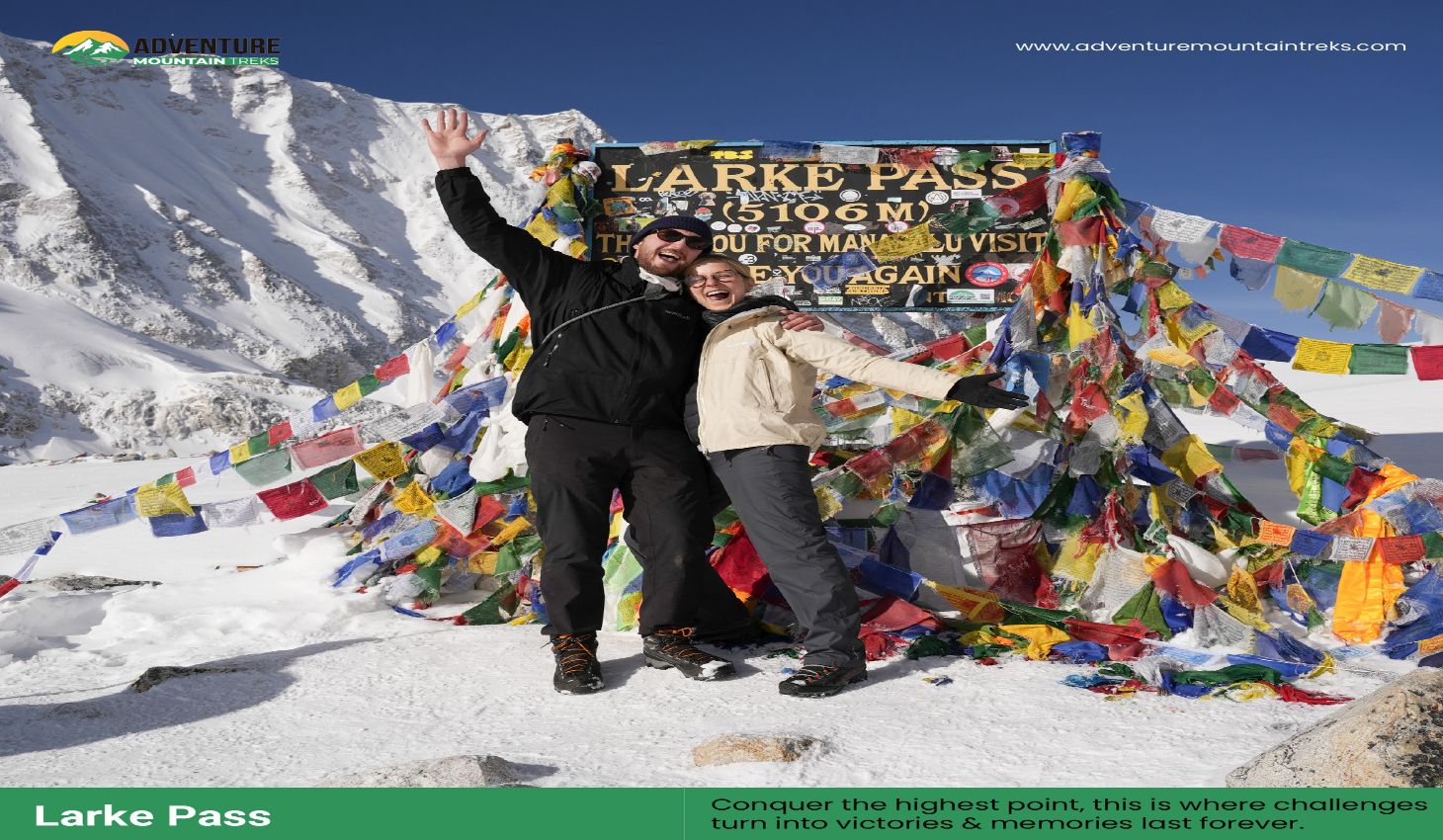
Crossing Larkya La (5,106 m) is the trek’s most demanding section. Surrounded by glaciers and Himalayan peaks, the route descends steeply to Bimthang (3,720 m). Expect 8–9 hours of trekking over rugged terrain.
Zone 5 – Return Journey (Days 11–13): Bimthang → Tilije → Besi Shar → Kathmandu
The trail descends through forests and meadows toward Tilije and Dharapani before reaching Besi Shar. From there, a drive returns trekkers to Kathmandu via the Prithvi Highway.
Explore the full Manaslu Circuit route: Adventure Mountain Treks updates its itinerary every season based on trail conditions, teahouse availability, and road access to ensure the best trekking experience.
5. Day-by-Day Manaslu Circuit Trek Itinerary (14 Days)
| Day | Route | Altitude | Distance | Duration | Highlights |
|---|---|---|---|---|---|
| Arrival | Arrival in Kathmandu | 1,400 m | 7 km | 30 min drive | Airport pickup, hotel transfer, trek briefing |
| 1 | Kathmandu → Machha Khola | 970 m | 165 km | 8–10 hrs drive | Scenic drive via Arughat and Budi Gandaki Valley |
| 2 | Machha Khola → Jagat | 1,410 m | 22 km | 7–8 hrs walk | Suspension bridges and subtropical forests |
| 3 | Jagat → Deng | 1,805 m | 20 km | 7–8 hrs walk | Permit check, bamboo and rhododendron forests |
| 4 | Deng → Namrung | 2,630 m | 17 km | 6–7 hrs walk | Pine forests and first Manaslu views |
| 5 | Namrung → Lho | 3,180 m | 11 km | 5–6 hrs walk | Lho Monastery and panoramic mountain scenery |
| 6 | Lho → Samagaon | 3,520 m | 11 km | 6–7 hrs walk | Tibetan culture and alpine landscapes |
| 7 | Acclimatization at Samagaon | 3,520 m | — | Optional hike | Visit Birendra Tal or Manaslu Base Camp |
| 8 | Samagaon → Samdo | 3,860 m | 10 km | 4–5 hrs walk | High plateau and Tibetan-style village |
| 9 | Samdo → Dharamsala | 4,460 m | 12 km | 5 hrs walk | Final stop before Larkya La Pass |
| 10 | Dharamsala → Larkya La → Bimthang | 5,160 m → 3,720 m | 24 km | 8–9 hrs walk | Pass crossing, glaciers, and Himalayan views |
| 11 | Bimthang → Tilije | ~2,300 m | 16 km | 5–6 hrs walk | Forest trails and alpine meadows |
| 12 | Tilije → Besi Shar | ~760 m | 40 km | 3–4 hrs drive | Drive via Dharapani; trek concludes |
| 13 | Besi Shar → Kathmandu | 1,400 m | 205 km | 7–8 hrs drive | Return drive and farewell dinner |
| Departure | Departure from Kathmandu | 1,400 m | 7 km | As scheduled | Airport transfer and departure |
Note: Day 7 is reserved for acclimatization, helping reduce the risk of altitude sickness before crossing Larkya La Pass.
6. Manaslu Trek Permits and Fees 2026 — Exact Costs
The Manaslu region requires three separate mandatory permits plus one local municipality fee. All permits must be obtained through a government-registered trekking agency before departure — they cannot be purchased at the trailhead. Adventure Mountain Treks handles the full permit process for every client who books with us.
Know more about the 15 Restricted Trekking Permits in Nepal
Restricted Area Permit (RAP / SRAP)
The Restricted Area Permit is the primary authorization required for entering the Manaslu restricted zone, covering the trekking corridor from Jagat through to Bimthang or Dharapani. This permit is regulated by the Government of Nepal and is mandatory for all foreign trekkers in this region.
All permit arrangements are handled in advance through a registered trekking agency in coordination with the relevant government authorities. Adventure Mountain Treks manages the complete documentation process on behalf of trekkers, ensuring compliance with regulations and a smooth, hassle-free trekking experience before the journey begins.
Permit fees are subject to government regulations and may vary depending on the trekking season and the duration spent within the restricted area.
Manaslu Conservation Area Permit (MCAP)
- Cost: NPR 3,000 per person (approximately USD 30)
- Required for all trekkers entering the Manaslu Conservation Area
- No additional daily charge — flat fee regardless of days
TIMS Card
A TIMS card is no longer required for the Manaslu Circuit Trek as of 2025–2026. The three permits above cover the trekking area. If you continue to the Annapurna Circuit via Thorong La Pass, a TIMS card may be required; ask your guide.
7. Best Time to Do the Manaslu Circuit Trek
| Season | Months | Temperature | Visibility | Recommended? |
| Spring | Mar–May | 10–20°C (lower), 0 to -5°C (high) | Clear, occasional PM cloud | ✅ Highly Recommended |
| Summer/Monsoon | Jun–Aug | 15–25°C | Heavy cloud; mountains often hidden | ⚠️ Not Recommended |
| Autumn | Sep–Nov | 10–20°C (lower), cold nights above 3,500 m | Best of the year — crystal clear | ✅ Best Overall |
| Winter | Dec–Feb | 5–15°C (lower), well below -10°C (pass) | Clear but harsh | ⚠️ Experts Only |
Spring — March to May
Spring is one of the two optimal windows. Temperatures are moderate, skies are largely clear, and rhododendron forests bloom from the valley floor up to approximately 3,500 m. Wildlife is active and photogenic. The trail is not yet dusty from summer heat and is free from monsoon washouts.
Manaslu Circuit Trek in Autumn Season September, October & November
Autumn is the single best season for most trekkers. The monsoon clears the atmosphere, producing some of the sharpest mountain views possible. Temperatures are comfortable for walking — 10–20°C in daytime — and the major Nepali festivals of Dashain and Tihar add a vibrant cultural layer, particularly in lower villages.
Winter — December to February
Larkya La Pass can carry deep snow and become impassable in January and February. Temperatures at the pass drop well below -10°C with wind chill. Some high-altitude teahouses close. Only experienced cold-weather trekkers with proper winter gear and a very experienced guide should attempt this window.
Monsoon — June to August
Heavy rainfall makes trails slippery and unstable. Landslide risk is elevated on steep sections above 2,000 m. Mountain views are obscured by clouds most days. Leeches are prevalent below 2,500 m. We do not recommend this season for first-time Manaslu trekkers.
The optimal seasons for the Manaslu Circuit Trek are spring (March–May) and autumn (September–November).
8. Difficulty Level of the Manaslu Circuit Trek
The Manaslu Circuit Trek is classified as Strenuous, meaning it sits firmly in the advanced category of Himalayan trekking. This is not a beginner-friendly route, but it is absolutely achievable for trekkers who approach it with proper preparation, patience, and respect for altitude. The trek combines long daily walking hours, high-altitude exposure, and remote terrain, making it both physically demanding and mentally engaging. If you are consistent with your training and follow proper acclimatisation, the challenge becomes manageable rather than overwhelming.
How Fit Should You Be for the Manaslu Circuit Trek?
To complete the Manaslu Circuit Trek, you should have a solid level of cardiovascular endurance and leg strength. You don’t need to be an athlete, but you should comfortably handle 6–7 hours of walking per day on uneven terrain while carrying a light backpack. The key is stamina over speed. Trekkers who perform best are those who can maintain a steady pace, recover well overnight, and adapt to thinner air as altitude increases. Mental resilience also plays a role, especially during long days and changing weather conditions.
Why Is the Manaslu Circuit Trek Difficult?
Several factors combine to make this trek challenging. The most demanding section is crossing Larkya La Pass (5,160 m), which often requires a very early start around 4:00 AM and can involve up to 9 hours of continuous trekking in a single day. Throughout the journey, trekkers walk on narrow, rocky, and occasionally exposed trails for multiple hours daily.
Another major factor is altitude. You will spend four to five consecutive days above 3,500 meters, which places significant stress on the body and requires careful acclimatisation. The remoteness of the region adds another layer of difficulty. Medical facilities are limited, and in higher sections like above Samagaon, rescue operations depend heavily on weather conditions, meaning assistance is not always immediately available.
Recommended Pre-Trek Fitness Preparation
Preparing your body at least 8 weeks in advance can significantly improve your trekking experience. A structured routine focusing on endurance and strength is essential.
Start with building a strong cardio base by engaging in activities like running, cycling, or swimming for 45–60 minutes, 4–5 times a week. This helps your body efficiently use oxygen, which becomes critical at higher altitudes. Alongside cardio, include weekly hikes carrying a 6–8 kg backpack on uneven terrain to simulate actual trail conditions.
Incorporate stair climbing sessions for 20–30 minutes, three times a week, to develop the specific leg strength needed for steep ascents and long descents. Strength training exercises such as squats, lunges, and step-ups will further support your knees and reduce the risk of injury, especially during the long descent from Larkya La.
While prior high-altitude trekking experience above 3,000 meters is beneficial, it is not mandatory. What truly matters is your overall fitness, your ability to pace yourself, and your willingness to listen to your body and communicate with your guide throughout the journey.
9. Manaslu Altitude Sickness Guide: Symptoms, Prevention & Safety Tips
Altitude sickness is the most serious and common medical risk on the Manaslu Circuit Trek. The itinerary spends four to five consecutive days above 3,500 m, culminating in a pass crossing at 5,160 m. This section is not optional reading.
Acute Mountain Sickness (AMS) — Recognise These Symptoms
- Headache — the most common and earliest warning sign; do not dismiss it
- Nausea or loss of appetite
- Fatigue disproportionate to effort — feeling exhausted despite walking slowly
- Dizziness or lightheadedness
- Poor sleep — disturbed breathing or waking repeatedly during the night
HACE — High Altitude Cerebral Edema
HACE is severe AMS. Fluid accumulates around the brain. Symptoms include confusion, inability to walk a straight line, loss of coordination, and a severe headache that does not respond to ibuprofen. HACE requires immediate descent and emergency evacuation. This is a medical emergency.
HAPE — High Altitude Pulmonary Edema
HAPE causes fluid to accumulate in the lungs. Symptoms include breathlessness at rest, a persistent cough that may produce pink frothy mucus, and bluish discolouration of the lips. HAPE is also a medical emergency requiring immediate descent.
Our Acclimatisation Protocol at Adventure Mountain Treks
- We build a mandatory acclimatisation rest day at Samagaon (3,520 m) — this is non-negotiable on all our departures
- 'Climb high, sleep low' — on the acclimatisation day we recommend hiking to Birendra Tal or toward Manaslu Base Camp before returning to sleep at Samagaon
- Drink 3–4 litres of water daily — dehydration significantly worsens AMS symptoms and is very common at altitude
- No alcohol above 3,000 m — alcohol masks AMS symptoms and accelerates dehydration
- Never ascend with a headache — if you have a headache at Samdo, you do not move to Dharamsala the next day
- Descent is the only cure for serious AMS — our guides carry pulse oximeters and are trained to make descent decisions immediately
From our experience at Adventure Mountain Treks: In over a decade of guiding the Manaslu Circuit, 100% of the AMS incidents we have seen were preventable. They happened when trekkers ignored a headache, pushed on despite their guide's advice, or underestimated the altitude's effects on their specific physiology. The rule is simple: if in doubt, descend. We make that call with you, not for you.
10. Accommodation and Food on the Manaslu Circuit Trek
Teahouse Accommodation
All accommodation on the Manaslu Circuit is in teahouses (bhattis) or small guesthouses. These are locally owned, simple establishments providing a bed, blanket, and access to a shared bathroom. Private rooms with attached bathrooms exist in lower-altitude villages but are increasingly rare above Samagaon (3,520 m).
Expect twin rooms with basic beds and quilts. At Samdo (3,860 m) and Dharamsala (4,460 m), rooms are small, cold, and minimally furnished. A sleeping bag rated to at least -15°C is essential — teahouse blankets are insufficient at these altitudes.
Hot showers are available at most teahouses in lower and mid-altitude villages for an extra charge of USD 1–3. Above Samagaon, hot showers become limited or unavailable. Carry wet wipes and dry shampoo for the high sections.
Teahouse Food — What to Expect
• Dal Bhat (lentil soup, rice, vegetable curry, pickle): The best trekking food available on the circuit. Hot, filling, high-calorie, and almost always refillable. Costs USD 5–10 per serving. Eat dal bhat twice daily, and your energy levels will noticeably outperform those of trekkers relying on snack bars.
• Tibetan dishes (above Samagaon): Tsampa (roasted barley porridge), Thukpa (noodle soup), Tingmo (steamed bread), and butter tea. These become the standard menu at Samdo and Dharamsala.
• Western options (lower villages, up to Lho): Pasta, pizza, pancakes, porridge, muesli, omelettes, and sandwiches. Quality is reasonable in Samagaon and below. Above Samagaon, the menu simplifies significantly.
• Beverages: Black tea, milk tea, ginger tea, lemon honey tea, instant coffee, and hot chocolate are widely available. Canned soft drinks (Coke, Fanta) are available at lower altitudes. Carry your own electrolyte tablets for the high sections.
Water safety: Do not drink untreated water from taps or springs anywhere on the trek. Carry water purification tablets (iodine or chlorine) or a UV filter pen. Teahouses will boil water for a small fee. Stay hydrated; dehydration worsens AMS faster than almost any other factor.
11. How is the Internet, Mobile Signal, and Electricity on the Manaslu Circuit Trek?
• Mobile signal: 3G coverage (NCell and Nepal Telecom) is accessible throughout most of the circuit. Signal is strong enough for browsing and video calls in most villages, with occasional dead zones in narrow gorges and above 4,500 m.
• Wi-Fi: Limited Wi-Fi is available at teahouses in lower and mid-altitude villages. Expect slow speeds. Access fees range from NPR 200–500. Above Samagaon, Wi-Fi is largely unavailable — do not rely on it above this point.
• Electricity and charging: Most teahouses have solar or hydro electricity for basic lighting. Device charging costs NPR 100–300 per session and becomes less reliable above 4,000 m. Carry a portable power bank of at least 20,000 mAh. This is not optional — it is essential.
• Cash: There are no ATMs on the Manaslu Circuit. Withdraw all necessary NPR in Kathmandu before departure. Budget NPR 20,000–30,000 for on-trail expenses beyond your package.
12. Important Gears to Carry While Going for Manaslu Circuit Trek
The following gear list is based on our field experience at Adventure Mountain Treks. Pack smart, your porter carries a maximum of 15–18 kg, and your daypack should remain under 8–10 kg while trekking.
Clothing — Layering System
• Moisture-wicking base layer (top and bottom) — 2 sets
• Mid-layer fleece or down jacket — 1
• Waterproof and windproof outer shell (Gore-Tex or equivalent) essential above 3,500 m
• Trekking pants — 2 pairs (one convertible to shorts for lower sections)
• Thermal leggings — 1 pair (for Samdo, Dharamsala, and pass day)
• Warm hat / beanie, sun hat or cap, neck buff and/or balaclava
• Inner liner gloves and insulated waterproof outer gloves both essential above 4,000 m
Footwear
• Waterproof trekking boots with ankle support (break them in before arriving in Nepal)
• Gaiters are essential for snow and ice on the Larkya La pass day
• Merino wool trekking socks, minimum 3 pairs
• Sandals or flip-flops for teahouse use
Sleeping
• Four-season sleeping bag rated to at least -15°C (we offer rental bags for USD 35)
• Sleeping bag liner optional but useful for extra warmth and hygiene
Equipment
• Main pack 40–60L with rain cover
• Daypack 25–30L for daily use while porter carries main bag
• Trekking poles are strongly recommended for all trekkers, especially on long descents
• A headlamp with spare batteries is essential for the 4:00 AM pass day start
• Portable power bank (20,000 mAh minimum)
• Water bottles (2 × 1L) or hydration bladder plus water purification tablets or UV filter
• Polarized UV-protection sunglasses essential on snow and glacial terrain
Health and Safety
• Sunscreen SPF 50+ and lip balm with SPF UV radiation is intense above 4,000 m
• Personal first aid kit: blister pads, bandages, antiseptic wipes, ibuprofen
• Diamox (Acetazolamide) if prescribed by your doctor before the trip
• Insect repellent essential below 2,500 m
• Hand sanitizer and biodegradable wet wipes
Documents and Money
• Passport (original) required at every permit checkpoint
• Travel insurance documents showing helicopter evacuation coverage (see Section 17)
• NPR 20,000–30,000 in cash withdrawn in Kathmandu before departure
13. Solo Trekking and Group Joining on the Manaslu Circuit
The most common question we receive from solo travellers planning the Manaslu Circuit is: Can I go alone? The answer is no, and understanding why is important.
Nepal's government classifies the Manaslu region as a restricted area because of its proximity to the Tibetan border. Two simultaneous regulations apply: (1) you must be accompanied by a licensed guide at all times, and (2) the Restricted Area Permit requires a minimum group of two trekkers to be issued.
At Adventure Mountain Treks, solo trekkers can join our scheduled group departures throughout the spring and autumn seasons. You share the circuit with other trekkers of similar interests from around the world, receive the same licensed guide service and safety support, and meet all permit requirements automatically. This is the simplest, safest, and most sociable way to complete the Manaslu Circuit as a solo traveller.
Group joins for Manaslu Circuit Trek: Contact us at info@adventuremountaintreks.com to view our current group departure calendar for 2026 and 2027. We match solo trekkers by experience level and language preference where possible.
14. Side Trips Worth Adding to Your Manaslu Circuit
Birendra Tal — Glacial Lake (3,450 m / 11,319 ft)
A one-hour easy walk from Samagaon, Birendra Tal is a turquoise glacial lake fed directly by the Manaslu glacier. The lake reflects the surrounding peaks on calm mornings. This is the ideal acclimatisation hike on Day 8 — easy enough to rest the legs while still moving at altitude.
Manaslu Base Camp (4,800 m / 15,748 ft)
A 4–5 hour steep return hike from Samagaon. Views of the Manaslu massif and glacier are extraordinary. Only attempt this in clear weather after the acclimatisation day. The trail can be blocked by snow in early spring and late autumn — always check conditions with your guide first.
Pungyen Gompa / Manaslu Glacier Viewpoint (~4,050 m / 13,287 ft)
A monastery set against the Manaslu Glacier, accessible via a detour from Samagaon. The setting is one of the most photogenic on the circuit. Resident monks offer a rare cultural encounter at high altitude.
Tsum Valley Extension (7–9 additional days)
The Tsum Valley is a hidden sacred valley inhabited by the Tsumba community, branching off the main Manaslu route near Philim. It is one of the most culturally intact areas in the Himalayas — ancient Buddhist monasteries, butter lamp offerings, and a way of life unchanged for centuries.
• Requires an additional Tsum Valley Restricted Area Permit: USD 40 for the first week in peak season, USD 7 per day thereafter
• Adds 6–8 days to the main circuit itinerary
• Adventure Mountain Treks offers this as a combined Manaslu Circuit + Tsum Valley package
15. Insurance and Emergency Evacuation
Travel insurance for the Manaslu Circuit Trek is not optional — it is a fundamental safety requirement. An uninsured helicopter evacuation from the Manaslu region costs USD 3,000–6,000 or more, depending on the pickup altitude and weather. This is a recurring situation, not a theoretical risk.
What Your Policy Must Cover — Non-Negotiable
• Trekking above 5,000 m:
Many standard travel policies cap helicopter evacuation at 4,000 m. Read the fine print. The Larkya La pass sits at 5,160 m.
• Helicopter evacuation in Nepal:
The policy must explicitly name helicopter rescue and medical evacuation as covered benefits, not exclusions.
• Trip cancellation and curtailment:
Weather closures, flight delays, and medical emergencies can cut a trek short. Cancellation cover is essential.
Reputable providers offering Nepal trekking-appropriate policies include World Nomads, True Traveller, and Battleface. Always compare based on altitude coverage, ceiling, and evacuation coverage — not purely on price.
Adventure Mountain Treks policy: We require all trekkers on our Manaslu Circuit departures to hold valid helicopter evacuation insurance before permits are issued. Our guides carry a communication device linked directly to Kathmandu-based helicopter operators. The helicopter flies when your insurance is confirmed. Please do not arrive without coverage.
16. Most Popular Queries About the Manaslu Circuit Trek
How long is the Manaslu Circuit Trek?
Our standard itinerary at Adventure Mountain Treks is 13 days (Trip Code AMT-TREK-301), starting and ending in Kathmandu. Extended versions of 15, 17, and 18 days are available, incorporating the Tsum Valley extension or additional acclimatisation days.
Do I need a licensed guide for the Manaslu Circuit Trek?
Yes. A licensed guide is legally mandatory. The Manaslu region is a restricted area, and government checkpoints at Jagat, Philim, and other points along the trail verify compliance. You cannot obtain the Restricted Area Permit without a government-registered trekking agency and a licensed guide.
What is the maximum altitude on the Manaslu Circuit Trek?
Larkya La Pass at 5,160 m / 16,924 ft is the highest point. It is crossed on Day 10 of our 13-day itinerary, requiring a 4:00 AM start and 8–9 hours of walking.
Is the Manaslu Circuit harder than the Annapurna Circuit?
Generally, yes. The Manaslu Circuit has rougher trail conditions, greater remoteness, fewer support facilities above 4,000 m, and longer daily walking hours on the pass day. The Annapurna Circuit's Thorong La Pass (5,416 m) is technically higher, but the surrounding infrastructure is far more developed.
Can solo trekkers do the Manaslu Circuit Trek?
You cannot trek the Manaslu Circuit alone. A licensed guide is mandatory, and a minimum group of two trekkers is required for the Restricted Area Permit. Adventure Mountain Treks runs regular group join departures where solo trekkers are welcome and fully supported throughout the circuit.
What permits do I need and how do I obtain them?
You need the Restricted Area Permit (RAP), the Manaslu Conservation Area Permit (MCAP), the Annapurna Conservation Area Permit (ACAP), and the Chumnubri Rural Municipality local fee. All permits must be arranged through a government-registered agency in Kathmandu before the trek begins. Adventure Mountain Treks handles all permit logistics for every booking.
Is Wi-Fi and mobile data available on the trek?
3G mobile data (NCell and Nepal Telecom) works on most of the circuit and is reliable enough for browsing and video calls in most villages. Wi-Fi is available at teahouses in lower and mid-altitude villages for NPR 200–500. Above Samagaon, connectivity becomes limited. Carry a 20,000 mAh power bank.
When is the best time for the Manaslu Circuit Trek?
Autumn (September to November) is the best overall season — clearest skies, most stable weather, most comfortable walking temperatures. Spring (March to May) is equally recommended for rhododendron blooms and excellent visibility. Avoid the monsoon (June–August) unless you are an experienced all-conditions trekker.
How much does the Manaslu Circuit Trek cost in total?
The Manaslu Circuit Trek is available in three tiers: Budget (USD 1,000), Standard (USD 1,350), and Deluxe (USD 1,900) per person, all inclusive of permits, guide, porter, accommodation, meals, and transport. Contact us for a group-size quote.
What should I do if I get altitude sickness in Manaslu Circuit Trek?
Tell your guide immediately. Never conceal symptoms. Our guides carry pulse oximeters and are trained to assess AMS severity. For mild AMS, the protocol is rest and hydration at the same altitude without ascending further. For moderate or severe AMS, HACE, or HAPE, the only safe intervention is immediate descent. Helicopter evacuation is arranged through our emergency network for trekkers with valid insurance coverage.
Conclusion
The Manaslu Circuit Trek is a high-altitude journey that rewards preparation, patience, and awareness. With multiple days above 3,500 m and a demanding pass at Larkya La (5,160 m), success on this trail depends less on speed and more on acclimatisation, steady pacing, and informed decision-making. For trekkers who value fewer crowds, strong cultural presence, and a raw Himalayan landscape, this route remains one of the most complete trekking experiences in Nepal.
From our experience at Adventure Mountain Treks, the difference between a difficult trek and a meaningful one comes down to preparation and guidance. Every itinerary, safety protocol, and acclimatisation plan in this guide reflects real field operations, not assumptions.
If this trek aligns with your goals, you can explore the Manaslu Circuit Trek package for updated itineraries and departures. You may also review our About Us page to understand how we operate on the ground.
Last Updated on: 14 AUgust, 2026