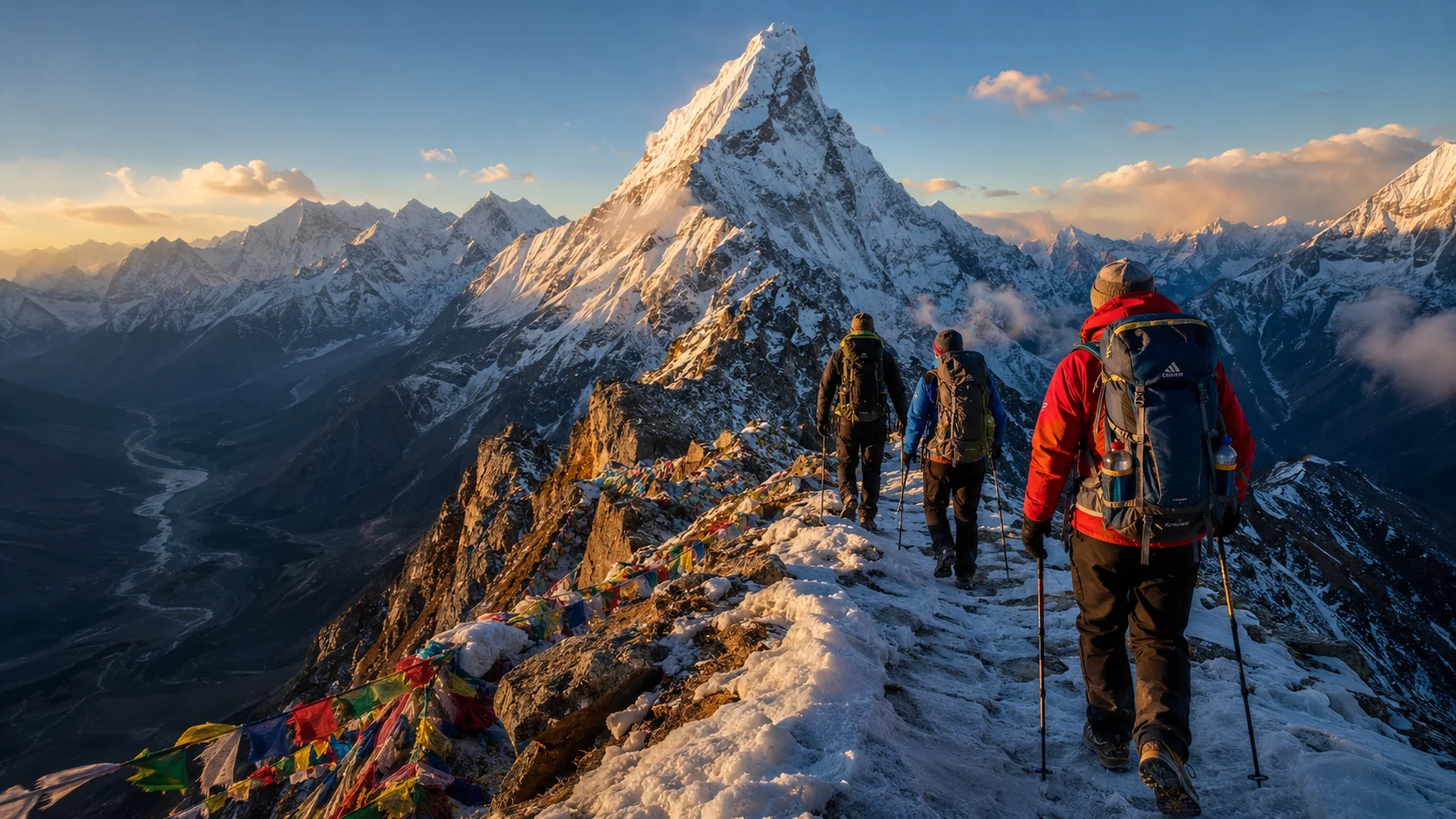
Ama Dablam Guide: 2026 Expedition, Cost & Itinerary
Written by: Pradeep Simkhada | Updated on: 22nd May
The Ama Dablam Expedition via Island Peak is a specialized 30-day mountaineering package in Nepal’s Khumbu region operated by Adventure Mountain Treks. This strategic itinerary pairs a warm-up climb of Island Peak (6,189 m) with the main ascent of Mount Ama Dablam (6,812 m). Achieving a full summit push on Island Peak first ensures critical high-altitude conditioning and gear mastery, dramatically lowering Acute Mountain Sickness (AMS) risks before tackling Ama Dablam’s technical terrain of steep ice, rocks, snow walls, and exposed ridges.
Designed for optimal safety and success, the expedition features an elite 1:1 Sherpa-to-climber ratio and strict medical monitoring during a 12-day climbing window. The journey includes trekking through Sagarmatha National Park, exploring Sherpa culture, and enjoying panoramic views of Everest, Lhotse, and Makalu. Operating in the peak Spring and Autumn seasons, the company offers three tailored service tiers to meet diverse needs: Budget (USD $5,200), Standard (USD $6,000), and Deluxe (USD $7,200) per person.
What Is the Ama Dablam Expedition via Island Peak?
The Ama Dablam Expedition via Island Peak is a 30-day full-service Himalayan expedition in the Khumbu region of Nepal, combining two iconic climbs: a warm-up ascent of Island Peak (6,189 m) for acclimatization, followed by the main objective of Mount Ama Dablam (6,812 m / 22,349 ft) — the most technically demanding and visually striking mountain in the Everest region. This combined itinerary is specifically designed to maximise acclimatization, build climbing confidence, and dramatically improve summit success rates on Ama Dablam.
As the senior content writer at Adventure Mountain Treks, I have documented this expedition across multiple seasons and can confirm: the Island Peak warm-up approach is one of the most intelligent itinerary structures available for Ama Dablam, and it is what sets this package apart from standard Ama Dablam expedition operators in Nepal.
Trip at a Glance — Key Facts Table
|
Detail |
Information |
| Trip name | Ama Dablam Expedition via Island Peak |
| Trip code | AMT-EXP-102 |
| Operated by | Adventure Mountain Treks Pvt. Ltd, Kathmandu |
| Duration | 30 days |
| Maximum altitude | 6,812 m / 22,349 ft (Ama Dablam summit) |
| Warm-up climb | Island Peak — 6,189 m / 20,305 ft |
| Location | Khumbu Region, Sagarmatha National Park, Nepal |
| Trip grade | Challenging |
| Best season | Spring (April–May) and Autumn (October–November) |
| Accommodation | Teahouses / lodges (trek) + tented camps (expedition) |
| Meals | BB / Full Board depending on stage |
| Transportation | Flight / Jeep or Bus |
| Group size | Any — flexible |
| Sherpa ratio | 1 Sherpa guide per 1 climber |
| Reviews | ⭐ 4.5 / 5 — 150+ verified reviews |
| Budget package | USD $5,200 per person |
| Standard package | USD $6,000 per person |
| Deluxe package | USD $7,200 per person |
| Contact | +977-9862790129 / info@adventuremountaintreks.com |
Why Climb Island Peak Before Ama Dablam? The Acclimatization Strategy Explained
This is the single most important question climbers ask when comparing Ama Dablam itineraries. Here is the honest, experience-based answer.
|
Acclimatization Benefit |
Without Island Peak |
With Island Peak (AMT Approach) |
| Maximum altitude before Ama Dablam | ~5,500 m at ABC | 6,189 m — full summit experience |
| Climbing gear familiarity | Practiced at BC (cliffs) | Practiced on a real summit push |
| Physical conditioning | Trekking only to BC | Full summit day effort at altitude |
| AMS risk on Ama Dablam | Higher | Significantly reduced |
| Confidence level entering Ama Dablam | Moderate | High — one summit already achieved |
| Overall summit success rate | Lower | The body has already adapted |
Key informational point: The main reason for altitude sickness is rapid ascent. By first climbing Island Peak (6,189 m), a full summit attempt at altitude, the body regenerates physical strength, develops altitude adaptation, and builds genuine familiarity with the use of climbing gear in real Himalayan conditions. This is not just a warm-up; it is a structured physiological preparation that directly improves your chances of standing on the summit of Ama Dablam.
Understanding Ama Dablam — The Mountain
|
Mountain Fact |
Detail |
| Name meaning | Ama = Mother; Dablam = Necklace — "Mother's Necklace" in Sherpa |
| Main summit | 6,812 m / 22,349 ft |
| Lower western peak | 6,170 m |
| Distance from Everest | Approximately 7 miles / 12 km |
| Region | Everest region (Khumbu), Sagarmatha National Park |
| Visibility | Visible from the Everest Base Camp and Kala Patthar trekking trails |
| Technical character | Challenging ice rocks, snow walls, steep narrow ridges, hanging glacier |
| Compared to Everest | Lower in altitude than Everest (8,848 m) but comparatively more technical and difficult climb relative to its height |
Even trekkers on the Everest Base Camp and Kala Patthar trails can feel Ama Dablam dominating the blue sky. The mountain has two separate peaks — the main peak at 6,812 m and the lower western peak at 6,170 m — and its iconic hanging glacier (the "dablam") is one of the most photographed features in all of Himalayan mountaineering.
Ama Dablam Altitude & Camp Structure — Full Breakdown
|
Camp |
Elevation (m) |
Elevation (ft) |
Key Notes |
| Ama Dablam Base Camp | 4,570 m | 14,993 ft | 10–12 days spent here and higher during expedition phase |
| Camp I | ~5,700 m | ~18,701 ft | Above difficult saddle ridges; rocky terrain |
| Camp II | ~6,000 m | ~19,685 ft | Via fixed lines on severe rocks and ridges |
| Camp III | ~6,400 m | ~20,997 ft | Final push camp; approached through rocky bowls on ridge |
| Summit — Ama Dablam | 6,812 m | 22,349 ft | Via hanging glacier; steeper rock, ice and snow above Camp III |
| Island Peak Summit (warm-up) | 6,189 m | 20,305 ft | Climbed on Day 9 before Ama Dablam approach |
Ama Dablam Route Description — What You Will Actually Climb
Above Ama Dablam Base Camp, four progressive stages take to the summit:
|
Stage |
Terrain |
Technical Challenge |
| Base Camp → Camp I | Difficult saddle ridges | Steep rocky approach; fixed lines begin |
| Camp I → Camp II | Rocky bowls and ridge via fixed lines | Severe rock and ridge climbing; high exposure |
| Camp II → Camp III | Ridge continuation on fixed lines | Increasingly technical; narrow, steep sections |
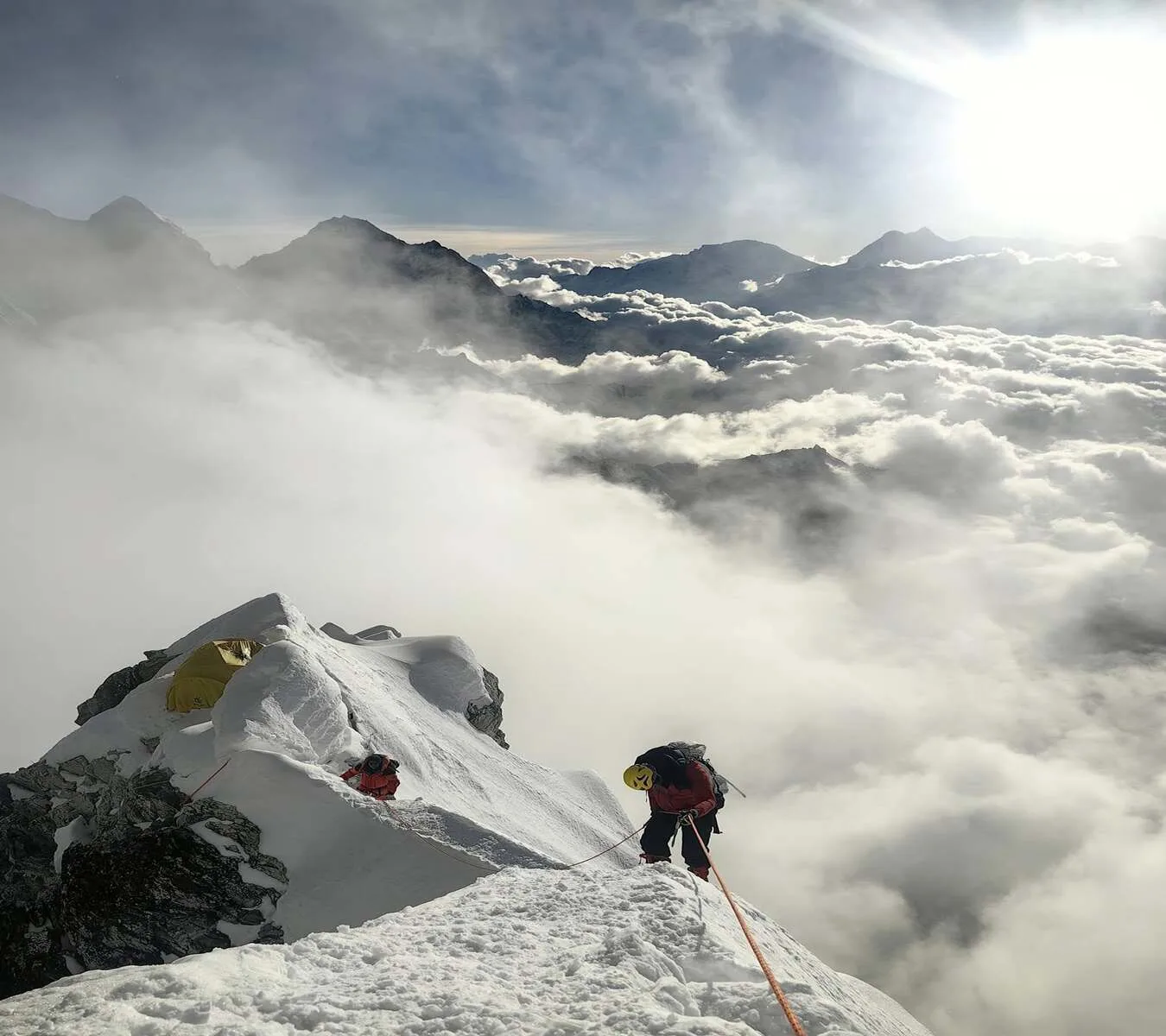
| Camp III → Summit | Massive hanging glacier — steep rock, ice, and snow | Steeper climbing through hanging glacier section; most demanding push |
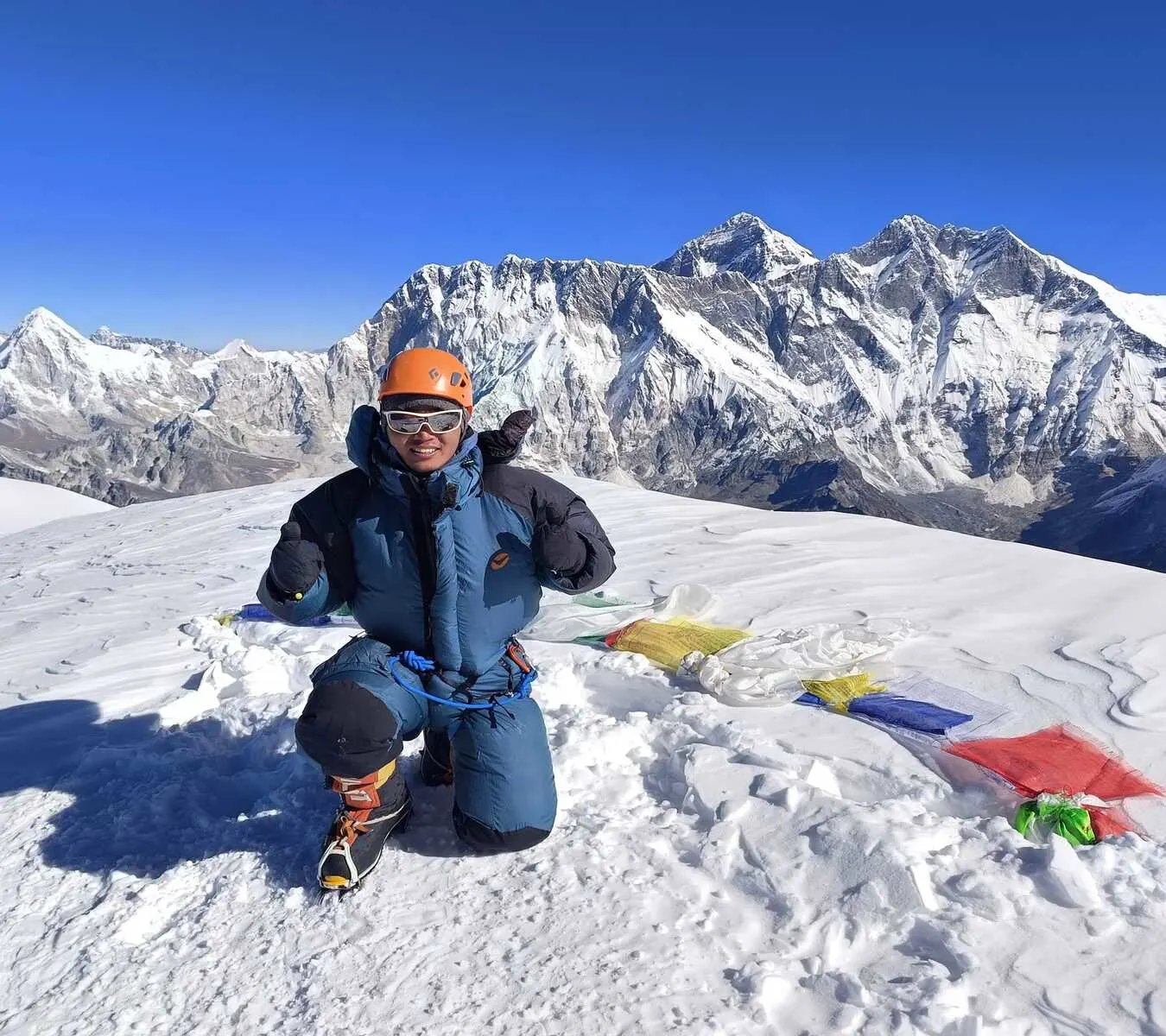
From the Ama Dablam summit, you will see:
- Mount Everest — 8,848 m (only 7 miles / 12 km away)
- Lhotse — 8,516 m
- Makalu — 8,463 m
- Nuptse — 7,861 m
- Pumori — 7,161 m
- Countless other snowcapped Himalayan peaks
Difficulty — Honest Assessment for Prospective Climbers
|
Factor |
Assessment |
Detail |
| Official trip grade | Challenging | Set by Adventure Mountain Treks based on multi-season experience |
| Technical terrain | High | Ice rocks, snow walls, steep, narrow ridges, hanging glacier |
| Fixed rope use | Extensive | Fixed lines used from Camp I to summit |
| Altitude exposure | High | 10–12 days at Base Camp (4,570 m) and higher |
| Island Peak warm-up value | Critical | Builds real-world altitude experience at 6,189 m before Ama Dablam |
| AMS risk | Managed | Gradual itinerary with rest days; medication protocols in place |
| Prior experience needed | Recommended | Climbing gear familiarity essential; trained at Base Camp before ascent |
Altitude Sickness — What You Need to Know
Altitude sickness symptoms typically appear within 12–24 hours of ascending above 1,500–2,500 metres. Symptoms include fatigue, loss of appetite, dizziness, sleep problems, shortness of breath, and loss of energy.
Key prevention measures followed on all Adventure Mountain Treks expeditions:
|
Measure |
Why It Matters |
| Avoid rapid ascent | The primary cause of AMS — our itinerary builds altitude gradually |
| Stop and rest 24–48 hours at symptom onset | Prevents escalation to HAPE or HACE |
| Avoid strenuous exercise between camps | Conserves energy and aids adaptation |
| Anti-sickness medication (Diamox / promethazine) | Carried by all guides; administered when needed |
| Adequate hydration — consistent water intake | Dehydration accelerates AMS |
| No smoking or alcohol during the expedition | Both significantly worsen altitude adaptation |
| High-calorie, light diet | Sustains energy without burdening digestion at altitude |
Safety policy: In case of any altitude sickness symptoms, Adventure Mountain Treks guides will initiate immediate descent for acclimatization and apply medication. Climber safety is non-negotiable.
30-Day Itinerary — Day by Day
|
Day |
Location |
Altitude |
Activity |
| 1 | Kathmandu | 1,400 m / 4,592 ft | Airport arrival; private transfer to hotel (~7 km / 20–30 min); trip briefing |
| 2 | Kathmandu | 1,400 m | Guided tour of Kathmandu's UNESCO World Heritage sites; climbing preparation |
| 3 | Lukla → Phakding | 2,860 m → 2,550 m | Scenic flight Kathmandu–Lukla; trek to Phakding |
| 4 | Phakding → Namche Bazaar | 3,446 m | Trek through Khumbu valley; crossing suspension bridges |
| 5 | Namche Bazaar | 3,446 m | Acclimatization rest day; sightseeing in the Sherpa capital |
| 6 | Namche → Tengboche | 3,867 m | Trek past rhododendron forests; Ama Dablam views open up |
| 7 | Tengboche → Dingboche | 4,360 m | Trek with Himalayan wilderness views; lush forests give way to open valleys |
| 8 | Dingboche → Island Peak BC | ~5,100 m | Branch toward Chhukung valley; establish Island Peak Base Camp |
| 9 | Island Peak BC → Summit → Chhukung | 6,189 m | Full summit day on Island Peak; views of Everest, Nuptse, Lhotse, Baruntse, Ama Dablam; return to Chhukung |
| 10 | Chhukung → Ama Dablam BC via Dingboche | 4,800 m / 15,744 ft | Trek to Ama Dablam Base Camp; meet full expedition team |
| 11–24 | Ama Dablam BC and higher camps | 4,570 m–6,812 m | Full expedition phase: acclimatization rotations, Camp I–II–III establishment, summit push and return to Base Camp (10–12 days at BC and above) |
| 25 | Base Camp → Tengboche | 3,867 m | Begin descent; pack all equipment and rubbish |
| 26 | Tengboche → Monjo via Namche | ~2,800 m | Trek down through Namche Bazaar |
| 27 | Monjo → Lukla | 2,860 m | Final trekking day; arrive Lukla |
| 28 | Fly Lukla → Kathmandu | 1,400 m | Return flight to Kathmandu |
| 29 | Kathmandu | 1,400 m | Free day — celebration, rest, shopping, valley tour |
| 30 | Kathmandu | 1,400 m | Final departure; airport transfer as per flight schedule |
Trek Highlights Along the Approach
|
Highlight |
What to Expect |
| Khumbu Valley scenery | Green terraced villages, rushing rivers, lush forests, cascading waterfalls |
| Flora | Rhododendron, oak, pine, magnolia forests at lower elevations |
| Wildlife | Snow leopard, red panda, yaks — Sagarmatha National Park wildlife |
| Sherpa culture | Traditional teahouse hospitality, Buddhist monasteries, local customs |
| Mountain views en route | Everest, Lhotse, Nuptse, Baruntse, Pumori, Ama Dablam — growing larger each day |
| Accommodation | Teahouses and lodges with BB/Full Board meals on trekking stages |
| Scenic flight | Kathmandu–Lukla — one of the world's most scenic mountain approaches |
Equipment Checklist — What to Bring
1. Clothing
|
Item |
Specification |
| Base layers | Thermal tops and bottoms — moisture wicking |
| Mid layers | Fleece or wool jackets and pants |
| Outer shells | Waterproof and windproof jacket and pants (Gore-Tex or similar) |
| Down suit / heavy down jacket and pants | Essential for extreme cold at high camps |
| Gloves | Inner liner gloves + heavy insulated gloves + waterproof over-gloves |
| Headwear | Warm hat, balaclava, sun hat, neck gaiter |
| Socks | Multiple pairs wool/synthetic + insulated socks for higher altitude |
2. Footwear
|
Item |
Specification |
| High-altitude boots | Double or triple-layered boots for cold and high altitude |
| Gaiters | Protect boots and legs from snow and debris |
| Camp shoes | Lightweight footwear for comfort at Base Camp |
3. Climbing Gear
|
Item |
Purpose |
| Ice axe | Essential for steep sections |
| Crampons | Compatible with your boots; traction on snow and ice |
| Harness | Lightweight alpine harness with gear loops |
| Carabiners | Both locking and non-locking |
| Jumar (ascender) | For fixed ropes on steep sections |
| Belay device | ATC or similar for rappelling and belaying |
| Helmet | Protection from falling debris or rockfall |
4. Sleeping Equipment
|
Item |
Specification |
| Sleeping bag | Rated to at least −20°C (−4°F); lower rating preferred for high camps |
| Sleeping pad | Insulated; prevents cold from ground |
| Sleeping bag liner | Adds warmth; keeps sleeping bag cleaner |
5. Backpacks and Bags
|
Item |
Capacity |
| Large expedition backpack | 60–80L for major gear carries |
| Small daypack | 20–30L for essentials on shorter trips from Base Camp |
| Duffel bag | For packing and storing gear at Base Camp |
6. Hydration and Nutrition
|
Item |
Notes |
| Insulated water bottles | Prevents water from freezing at altitude |
| Water purification | Tablets, drops, or small filter |
| High-calorie snacks | Energy bars, nuts, chocolate, dried fruits |
7. Safety and First Aid
|
Item |
Purpose |
| First aid kit | Altitude sickness medication, blister care, basic medications |
| Altitude sickness medication | Diamox or equivalent — consult your doctor before travel |
| Thermal blanket | Emergency exposure protection |
| Personal locator beacon (PLB) | Emergency signal in remote locations |
8. Navigation and Communication
|
Item |
Purpose |
| GPS device | Route tracking and safety |
| Compass and map | Essential backup navigation |
| Satellite phone or radio | Communication in remote areas |
| Whistle | Emergency signalling |
9. Other Essentials
|
Item |
Notes |
| Glacier sunglasses | High UV protection — mandatory above 5,000 m |
| Sunscreen | High SPF for intense high-altitude sun |
| Lip balm | With UV protection |
| Trekking poles | Collapsible for stability on uneven terrain |
| Headlamp | High-lumen, waterproof + spare lithium batteries |
| Repair kit | Duct tape, sewing kit, small tools |
| Multi-tool or knife | Repairs and adjustments |
Note: Personal climbing gear can be arranged on a rental basis through Adventure Mountain Treks. Please contact us in advance to confirm availability.
Expedition Cost
|
Package |
Price Per Person |
| Budget Friendly | USD $5,200 |
| Standard | USD $6,000 |
| Deluxe | USD $7,200 |
Every traveller has unique needs. The services included in each package — Budget, Standard, and Deluxe — are best confirmed directly with the Adventure Mountain Treks team to ensure you receive accurate and transparent details matched to your requirements.
What Is Excluded (All Packages)
|
Excluded Item |
Notes |
| Personal travel insurance | Strongly recommended; must cover helicopter evacuation for peak climbing |
| International airfares | Available on request from Adventure Mountain Treks |
| Personal climbing gear | Rental arrangement available through us |
| Personal expenses | Bar, laundry, internet, hot shower, battery charging during trek |
| Alcoholic beverages | Not covered under any package |
| Tips for the trekking and climbing crew | Standard practice; at climber's discretion |
Frequently Asked Questions — Ama Dablam via Island Peak
Q: What makes the Ama Dablam Expedition via Island Peak different from a standard Ama Dablam expedition?
The Island Peak (6,189 m) warm-up climb before Ama Dablam is the defining difference. Climbing Island Peak first regenerates physical strength, builds genuine altitude adaptation, and gives every team member real experience using climbing gear in Himalayan conditions — before the far more demanding Ama Dablam ascent begins. This directly reduces AMS risk and improves summit success rates. Adventure Mountain Treks has built this combined itinerary specifically to maximise safety and summit probability.
Q: How long is the Ama Dablam Expedition via Island Peak?
The full expedition is 30 days, including arrival in Kathmandu, the approach trek via the Everest Base Camp trail to Dingboche, Island Peak summit day, trek to Ama Dablam Base Camp, 10–12 days at Base Camp and higher camps for the Ama Dablam expedition, and return to Kathmandu.
Q: What is the Ama Dablam expedition cost with Adventure Mountain Treks?
Adventure Mountain Treks offers three packages: Budget at USD $5,200 per person, Standard at USD $6,000 per person, and Deluxe at USD $7,200 per person. Exact inclusions vary by package — contact the team directly at +977-9862790129 or info@adventuremountaintreks.com for a personalised breakdown.
Q: What is the maximum altitude on this expedition?
The maximum altitude is 6,812 m / 22,349 ft — the summit of Mount Ama Dablam. Island Peak (6,189 m / 20,305 ft) is the intermediate summit climbed during the acclimatization phase.
Q: What is the Sherpa-to-climber ratio on Adventure Mountain Treks expeditions?
Adventure Mountain Treks provides a 1:1 ratio — one dedicated Sherpa guide per climber. This is a premium safety and support standard that ensures every climber has dedicated technical guidance throughout the ascent.
Q: What altitude sickness prevention measures does Adventure Mountain Treks follow?
Our expedition follows strict AMS prevention protocols: gradual ascent itinerary, mandatory rest days at Namche Bazaar (3,446 m) and Dingboche (4,360 m), Island Peak warm-up climb at 6,189 m, hydration monitoring, dietary guidance, and carrying Diamox and promethazine on all climbing days. Immediate descent is initiated at any symptom onset — no exceptions.
Q: What is the best season for the Ama Dablam Expedition via Island Peak?
The best seasons are Spring (April–May) and Autumn (October–November). These windows offer the most stable weather, clearest skies, and safest snow conditions for both Island Peak and Ama Dablam. Adventure Mountain Treks operates fixed departures in both seasons — contact us for available dates.
About Adventure Mountain Treks
Adventure Mountain Treks Pvt. Ltd is Nepal's licensed trekking and expedition company headquartered in Thamel-26, Kathmandu. Affiliated with the Nepal Tourism Board, the Department of Tourism, the Trekking Agencies Association of Nepal (TAAN), and the Village Tourism Promotion Forum (VITOF) Nepal, the company has been operating Himalayan expeditions, peak climbing, and trekking packages across Nepal, Tibet, and Bhutan since 2007.