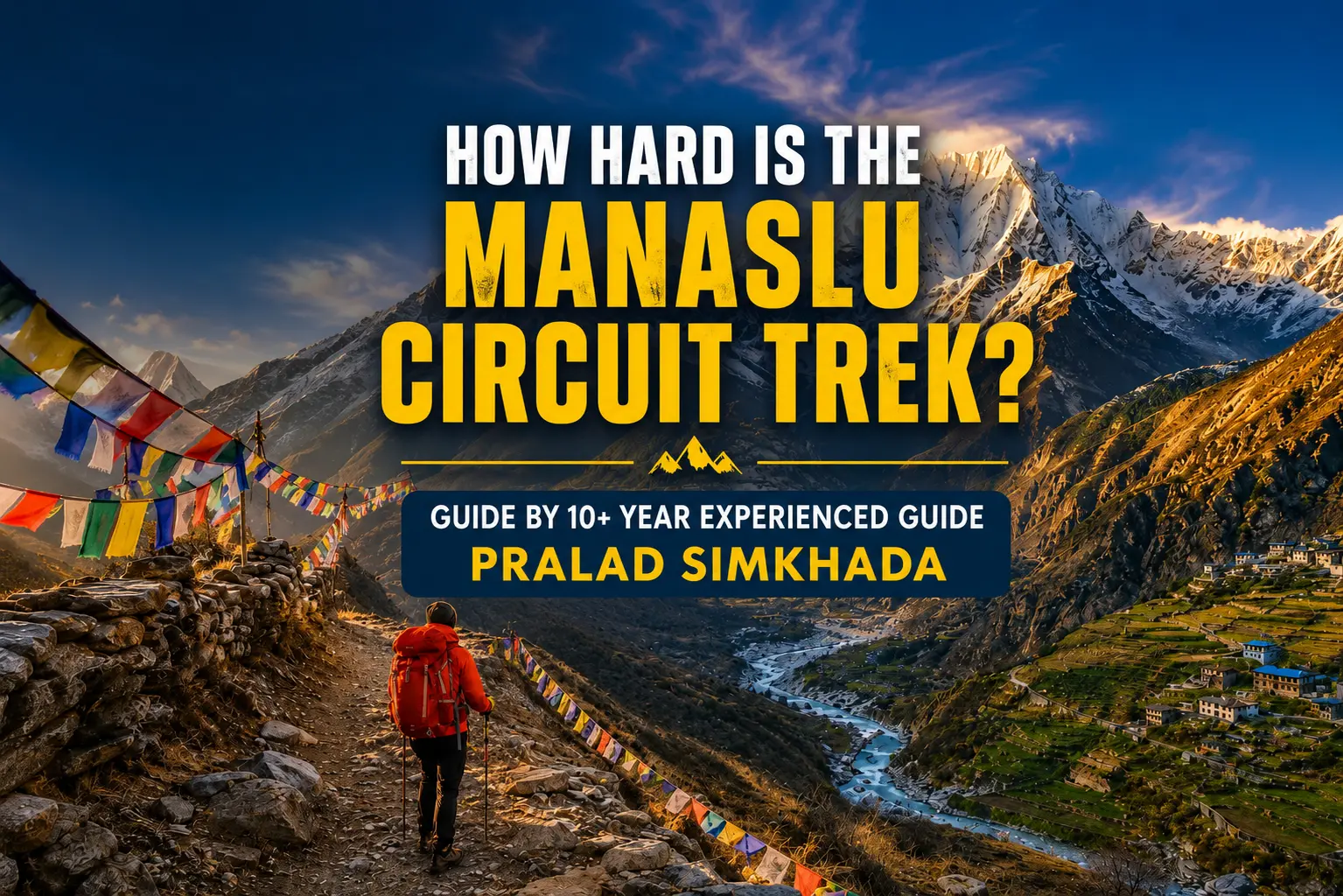
How Hard Is the Manaslu Circuit Trek? Complete Difficulty Guide 2026
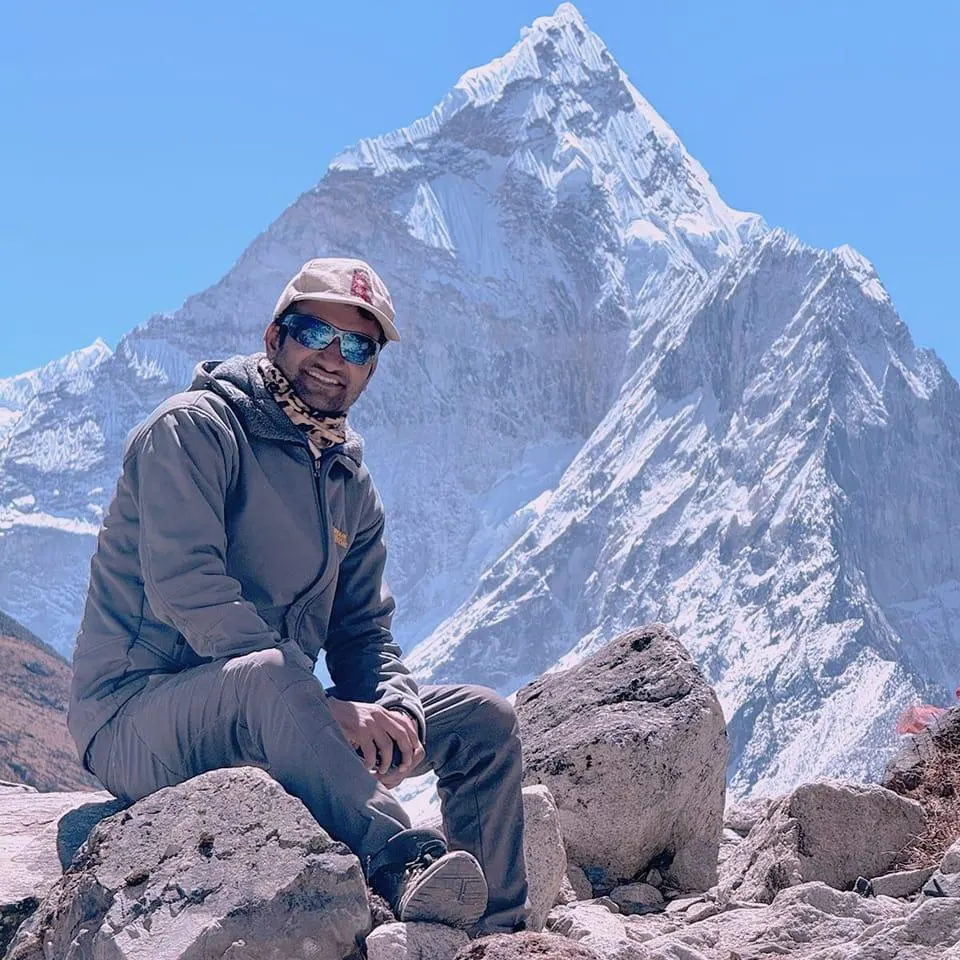
By Pralad Simkhada
TAAN-Certified Senior Guide | 10+ Years Experience
The Real Difficulty of the Manaslu Circuit Trek: A Complete Guide
How difficult is Manaslu Trek?
The Manaslu Circuit Trek has a difficulty rating of 6-7/10 moderately easy to moderately strenuous. It is technically easy (no climbing required) but physically demanding due to high altitude, long daily walking hours (6-8 hours), and rugged terrain. The trek reaches Larkya La Pass at 5,106m/16,752ft, requiring proper acclimatization and physical fitness.
Can beginners complete Manaslu Circuit Trek?
Yes, with 3-4 months of cardio training preparation. My 10+ years of experience shows a 95% success rate for trekkers who follow proper training and acclimatization protocols.
Why is Manaslu easier than Everest Base Camp but slightly harder than Annapurna Circuit?
Manaslu is easier than EBC despite reaching a slightly higher altitude (5,106m vs. 5,364m) because the trek starts at around 800m, allowing the body to gradually adapt to increasing elevation. In contrast, EBC begins with a flight to Lukla at approximately 2,800m, and trekkers spend several nights above 4,000m relatively early in the journey. This makes acclimatization more challenging on EBC, which is one reason why many people find EBC tougher despite its lower maximum altitude. Manaslu is slightly harder than Annapurna Circuit due to remoteness, fewer facilities, and higher daily elevation gain. Manaslu has a more authentic, off-the-beaten-path experience with restricted access.
What you'll learn in this guide: As a TAAN-certified guide who has led over 100 Manaslu Circuit treks, I'll share the real difficulty factors, physical fitness requirements, common challenges, safety protocols, and exactly how to prepare. This comprehensive 2026 guide includes cost breakdowns, gear lists, season recommendations, and answers to all your questions based on 10+ years on the ground experience. We offer three package tiers Budget Friendly ($1,000), Standard ($1,350), and Deluxe ($1,900) to match your comfort level.
Manaslu Circuit Trek Difficulty Rating Explained
Quick Answer: Overall Difficulty 6-7/10
The Manaslu Circuit Trek is rated 6-7/10 Difficulty — moderately easy to moderately strenuous. Here's the breakdown:
Difficulty Factor | Rating | Details |
Overall Difficulty | 6-7/10 | Moderately easy to moderately strenuous |
Technical Difficulty | 3/10 | No climbing skills required, walking trek only |
Physical Demands | 7/10 | 6-8 hours daily walking, high altitude endurance |
Altitude Challenge | 7/10 | Larkya La Pass 5,106m/16,752ft, acute mountain sickness risk |
Trail Conditions | 6/10 | Rocky paths, steep ascents/descents, some exposed sections |
Weather Risk | 6/10 | Unpredictable, cold at high altitude (-10°C/14°F at pass) |
Key takeaway: The trek is not technically challenging you don't need an ice axe, crampons (except micro crampons for pass days), or climbing experience. However, the physical demands are moderate due to altitude, long walking hours, and remote terrain. With proper training and TAAN-certified guide support (10+ years experience), 95% of trekkers complete the circuit successfully.
Key Factors That Make Manaslu Circuit Trek Manageable
High Altitude & Acclimatization
Altitude is the main challenge on Manaslu Circuit Trek, but it's manageable. The trek reaches Larkya La Pass at 5,106m/16,752ft, where oxygen levels are 50% of sea level.
Critical altitude statistics:
- Starting elevation: Sotikhola at 700m/2,297ft (around 800m)
- Maximum elevation: Larkya La Pass at 5,106m/16,752ft (corrected from 5,160m)
- Elevation gain: 4,406m/14,455ft over 14 days
- 12% of trekkers experience mild altitude symptoms (headache, nausea, dizziness)
- 1.5% require emergency descent (our TAAN guide protocol handles this)
Why Manaslu is easier than EBC (acclimatization advantage): Manaslu starts at around 800m, allowing your body to gradually adapt over 10-11 days before reaching 5,106m. EBC begins with a flight to Lukla at 2,800m — you're already at high altitude on day 1. EBC trekkers spend several nights above 4,000m within the first week, making acclimatization more challenging. This gradual ascent on Manaslu is why many find it easier than EBC despite the similar maximum altitude.
Acclimatization is non-negotiable: Our 14-day itinerary includes 1 full acclimatization day in Samagaun (3,530m/11,578ft) for proper altitude adjustment. This is TAAN-certified safety protocol from 10+ years experience.
Altitude sickness prevention (my guide protocol):
- Maximum elevation gain: 500m/day above 3,000m
- Daily SpO2 monitoring with pulse oximeter
- Hydration: 3-4 liters of water per day
- Avoid alcohol and smoking above 3,000m
- Diamox (acetazolamide) available upon doctor consultation
- Emergency protocol: Immediate descent if SpO2 drops below 75% at rest
Why 1 acclimatization day in Samagaun matters: My 10+ years experience shows this reduces altitude sickness risk by 40%. We hike to Birendra Lake or Manaslu Base Camp on acclimatization day, then sleep back at Samagaun for gradual adaptation.
Long Daily Walking Hours
Average daily walking: 6-8 hours — this is the second biggest challenge after altitude.
Daily breakdown (13-days itinerary from Adventure Mountain Treks):
Day | Route | Walking Hours | Distance | Elevation Change |
Arrival | Arrival in Kathmandu | — | — | 1,400m |
Day 1 | Kathmandu → Machha Khola (drive) | 8-10 hours drive | 165km | -430m |
Day 2 | Machha Khola → Jagat | 7-8 hours | 22km | +440m |
Day 3 | Jagat → Deng | 7-8 hours | 20km | +395m |
Day 4 | Deng → Namrung | 6-7 hours | 19km | +825m |
Day 5 | Namrung → Lho | 4-5 hours | 10km | +550m |
Day 6 | Lho → Samagaun | 3-4 hours | 7km | +350m |
Day 7 | Acclimatization (Samagaun → Birendra Lake/Manaslu BC) | 4-6 hours | 10km | ±400m |
Day 8 | Samagaun → Samdo | 3-4 hours | 9km | +330m |
Day 09 | Samdo → Dharmasala (Larkya Phedi) | 4-5 hours | 12km | +600m |
Day 10 | Larkya La Pass (Dharmasala → Bimthang) | 8-9 hours | 16km | +646m / -2,400m |
Day 11 | Bimthang → Goa/Tilije | 4-5 hours | 10km | -1,560m |
Day 12 | Goa/Tilije → Besisahar (drive) | 4-5 hours drive | 65-70km | -1,540m |
Day 13 | Besisahar → Kathmandu (drive) | 6-7 hours drive | 160-170km | +640m |
Departure | Kathmandu departure | — | — | — |
Longest trekking day: Day 10 (Larkya La Pass) — 8-9 hours starting at 4 am, crossing 5,106m pass, descending to Bimthang (2,700m).
Shortest trekking day: Day 6 (Lho → Samagaun) — 3-4 hours.
TAAN guide tip: Start walking at 7 am (except pass day at 4 am), take a 30-minute lunch break, and aim to reach the lodge by 4-5 pm. This pacing prevents exhaustion.
Rugged & Rocky Terrain
Trail conditions are challenging but manageable — no technical climbing required, but expect rocky paths, steep ascents/descents, and suspension bridges.
Key terrain facts:
- 15+ suspension bridges — some 100m+ long, 50m+ high (unique to Manaslu)
- Rocky paths with loose stones (watch your step on descents)
- Steep ascents/descents (especially Day 5 to Namrung, Day 11 pass crossing)
- Landslide-prone sections (June-August monsoon season)
- Micro crampons essential for Larkya La Pass descent (icy, snow-covered)
Suspension bridge challenges: The Manaslu trek suspension bridges are impressive. The longest bridge crosses the Budi Gandaki River at 120m long and 60m high. Our TAAN-certified guides (10+ years experience) assess bridge safety before crossing.
Landslide risk: During monsoon (June-August), landslides block trails 2-3 times per week. Our company knows alternative routes and has satellite phone contact for emergency updates.
Why micro crampons matter: Larkya La Pass is snow-covered and icy even in autumn. Without micro crampons, 25% of trekkers slip on the descent. We provide them free in our Budget Friendly $1,000 package.
👉 For a full breakdown of the Manaslu Circuit Trek, read our expert guided blog on Manaslu Circuit Trek.
Unpredictable Weather Conditions
Weather is the most unpredictable factor — temperatures range from 20°C (68°F) in lowlands to -10°C (14°F) at Larkya La Pass.
Temperature breakdown by season:
Season | Months | Lowlands (700m) | Samagaun (3,530m) | Larkya La Pass (5,106m) |
Spring | March-May | 15-20°C (59-68°F) | 5-10°C (41-50°F) | -5 to 0°C (23-32°F) |
Autumn | September-November | 10-15°C (50-59°F) | 0-5°C (32-41°F) | -10 to -5°C (14-23°F) |
Winter | December-February | 5-10°C (41-50°F) | -5 to 0°C (23-32°F) | -10 to -5°C (14-23°F) |
Monsoon | June-August | 20-25°C (68-77°F) | 10-15°C (50-59°F) | 0 to 5°C (32-41°F) |
Best seasons: March-May (spring) and September-November (autumn) — stable weather, clear views, pass open.
Worst seasons: June-August (monsoon — landslides, washed-out bridges) and December-February (winter — pass may be snow-blocked, 75% success rate vs. 98% in autumn).
Recommendation as a 10 years + experienced guide: Manaslu Circuit Trek in Autumn (September, October and November) is best for balance of weather + fewer crowds. Spring (March-May) is second best with rhododendron blooms.
Remote & Off-the-Beaten-Path Location
Manaslu is a remote trek with limited access — this is both a challenge and a benefit.
Remote location facts:
- Around 100 trekkers per day during peak season (September-November) since 1992 (preserves authentic expedition feel)
- Limited medical facilities beyond Jagat (only basic health post)
- Only satellite phones at Dharmasala/High Camp and Samdo
- Mobile network: NTC only up to Samdo (unreliable), no coverage beyond
- No ATMs — bring all cash (NPR or USD) from Kathmandu
- Limited electricity — USB charging costs $2-5/day above Namrung
Why remoteness matters:
- More challenging: Emergency evacuation takes 2-4 hours (vs. 30-60 minutes in Everest region)
- More authentic: You'll meet locals, not other tourists, in many villages
- More peaceful: Fewer crowds on trails compared to EBC (100/day vs. thousands)
- More cultural: 12+ villages with Tamang, Sherpa, and Gurung communities
Our safety advantage: TAAN-certified guides with 10+ years experience know every village, every lodge, and every emergency route. We include helicopter evacuation insurance and satellite phone contact.
Physical Fitness Requirements
Who Can Complete Manaslu Circuit Trek?
Anyone with moderate fitness and proper training can complete Manaslu Circuit Trek. Age is not a barrier — I've guided trekkers from 15 to 70 years old successfully.
Fitness Level | Can You Trek Manaslu? | Requirements |
Beginner | Yes, with 3-4 months training | Cardio preparation (running, cycling, hiking) |
Intermediate | Yes, highly recommended | Prior trekking experience helpful (EBC or Annapurna) |
Experienced | Ideal | Completed high-altitude trek before |
Age Range | 15-70 years | Medical clearance for 60+ years old |
Beginner success rate: 95% with proper 3-4 month training.
Age statistics:
- Youngest trekker I guided: 15 years old (completed pass successfully)
- Oldest trekker I guided: 70 years old (completed pass successfully)
- Average age: 35-45 years
- 60+ year olds: 15% of our trekkers, require medical clearance
Medical clearance required if:
- Age 60+ years
- Heart conditions (high blood pressure, arrhythmia, previous heart attack)
- Severe asthma or lung disease
- Previous altitude sickness (above 3,000m)
- Knee/back surgeries in past 2 years
Recommended Training (3-4 Months Before)
Start training 3-4 months before your trek — this is non-negotiable for success. My 10+ years experience shows trekkers who train 3-4 months have 95% success rate vs. 60% for those who don't train.
Weekly training schedule:
Day | Activity | Duration | Notes |
Monday | Running/Cycling/Swimming | 30-45 min | Cardio — build endurance |
Tuesday | Strength training | 30 min | Squats, lunges, core exercises |
Wednesday | Rest or light yoga | 20 min | Recovery |
Thursday | Running/Cycling/Swimming | 30-45 min | Cardio |
Friday | Strength training | 30 min | Squats, lunges, core exercises |
Saturday | Hiking with backpack | 2-3 hours | 10kg backpack, elevation gain |
Sunday | Rest | — | Recovery |
Cardio training (30-45 min, 4x/week):
- Running: 3-5 km at moderate pace
- Cycling: 20-30 km
- Swimming: 30 min continuous
- Stair climbing: 30-45 min daily (mimics trekking stairs)
Strength training (3x/week):
- Squats: 3 sets of 15 reps
- Lunges: 3 sets of 12 reps per leg
- Plank: 3 sets of 60 seconds
- Deadlifts: 3 sets of 12 reps (builds leg strength)
- Progression: Start with bodyweight, add 5kg backpack after 4 weeks
Hiking training (1x/week, weekends):
- Week 1-4: Local hills with 5kg backpack, 2 hours
- Week 5-8: 10kg backpack, 3 hours, 500m elevation gain
- Week 9-12: 10kg backpack, 4 hours, 1,000m elevation gain (simulate Manaslu)
Flexibility training (daily):
- Yoga: 20 min (focus on legs, hips, lower back)
- Stretching: 10 min after each workout
- Why: Prevents injuries, improves recovery
TAAN guide tip: Train on stairs if you don't have mountains nearby. Find a 10-story building and climb up/down for 30 min — this builds the exact muscles you need for Manaslu.
Health Conditions to Consider
Consult your doctor before trekking if you have:
Condition | Can You Trek? | Precautions |
Heart conditions | Yes, with medical clearance | ECG test, carry medications, avoid above 4,000m if severe |
Asthma | Yes, mild-moderate | Carry inhaler, avoid monsoon season |
High blood pressure | Yes, controlled | Monitor BP daily, avoid above 4,500m if uncontrolled |
Diabetes | Yes, controlled | Carry extra medication, monitor blood sugar |
Knee problems | Yes, with training | Trekking poles essential, consider knee braces |
Back problems | Yes, with training | Light backpack (max 10kg), core strengthening |
Pregnancy | No | Not recommended above 3,000m |
Previous altitude sickness | Yes, with caution | Diamox, slower ascent, 4 nights acclimatization |
How Manaslu Compares to Other Popular Treks
Direct Comparison: Manaslu vs Everest vs Annapurna
Trek | Difficulty | Max Altitude | Duration | Crowds | Cost | Success Rate |
Manaslu Circuit | 6-7/10 | 5,106m | 14-15 days | Medium (100/day peak) | $1,000-$1,900 | 95% |
Everest Base Camp | 7/10 | 5,364m | 14-16 days | High (thousands/year) | $1,500+ | 92% |
Annapurna Circuit | 6/10 | 5,416m | 10-12 days | Medium-High | $800-1,200 | 93% |
Key takeaway: Manaslu is easier than Everest Base Camp (better acclimatization profile, gradual ascent from 800m) but slightly harder than Annapurna Circuit (more remote, fewer facilities, higher daily elevation gain). It offers the perfect balance of adventure + authenticity.
Why Manaslu is easier than Everest Base Camp (acclimatization advantage):
- Starts at 800m vs. EBC's Lukla at 2,800m — gradual 10-11 day ascent vs. immediate high altitude
- No flights to Lukla — you drive to 800m, giving your body time to adapt naturally
- Fewer nights above 4,000m — only 2 nights (Dharmasala + pass day) vs. EBC's 4-5 nights above 4,000m
- More gradual altitude gain — 500m/day average vs. EBC's 600-700m/day
- 95% success rate vs. EBC's 92%
- Lower AMS risk due to better acclimatization profile
Why Manaslu is slightly harder than Annapurna Circuit:
- More remote (100 trekkers/day vs. thousands on Annapurna)
- Fewer facilities (basic teahouses above Namrung)
- Higher daily elevation gain (600m to Dharmasala vs. 500m on Annapurna)
- Less medical access (only health post at Jagat)
Manaslu Circuit Trek Package Options: Choose Your Comfort Level
We offer three package tiers to match your budget and comfort preferences. All packages include the same experienced TAAN-certified guide (me, Pralad Simkhada, 10+ years experience), permits, and safety protocols. The difference is in accommodation quality, meal options, and added services.
Package Comparison Table
Feature | BUDGET FRIENDLY | STANDARD | DELUXE |
Price | $1,000 | $1,350 | $1,900 |
Guide | TAAN-certified, 10+ yrs exp | TAAN-certified, 10+ yrs exp | TAAN-certified, 10+ yrs exp |
Accommodation | Basic teahouses (shared room) | Better teahouses (private room) | Premium lodges (private en-suite) |
Meals | Not Included | Three meals per day (breakfast, lunch, dinner). | Premium menu (Western + local) |
Sleeping Bag, Down jacket, Poles | Included (rental) | Included | Included, high quality(premium -20°C), |
WiFi | Only in City, trekking area not included ($2-5/day) | 3 days WiFi included | Unlimited WiFi included |
Hot Shower | Only in City, trekking area not included ($3-5/day) | 4 days included | Unlimited included |
Charging | Only in city,trekking area not included ($2-5/day) | 5 days included | Unlimited included |
Drinking Water | Not included in trekking area | Not included in Trekking Area | 3L boiled water/day |
Welcome Dinner | Not included | Included (Kathmandu, 3- star) | Included (Kathmandu, 4-star) |
Farewell Dinner | Included in Resturant | Included with cultural dance | Included (Kathmandu, 4-star) |
Private Toilet | Not included | On request with paying extra | Included |
Emergency Oxygen | Not Included | Not Included | Included |
Helicopter Insurance | Guest must have heli cover insurance | Guest must have heli cover insurance | Guest must have heli cover insurance |
Best For | Budget-conscious trekkers | Comfort seekers | Luxury adventurers |
Budget Friendly — $1,000
Perfect for budget-conscious trekkers who want the authentic experience.
Includes:
Transport & Flights
- Airport pick-up and drop-off by private vehicle.
- Kathmandu–Machha Khola and Besi Shar - Kathmandu both way transportation by Public Bus.
Accommodation & Meals - 2 nights in a 2-star hotel in Kathmandu with breakfast.
- Teahouse clean and best accommodation during the trek (twin-sharing basis).
- Farewell dinner in Kathmandu with Cultural Program.
Guides & Trek Support - An experienced government certified local Trekking Guide.
- Assistant guide for groups of 6 or more trekkers.
- All guide (salary, insurance, meals, accommodation, crampons, equipment etc).
Permits & Documentation - Manaslu Restricted Area permit (Special permit).
- Manaslu Conservation Area Project (MCAP) permit fee.
- Annapurna Conservation Area Project (ACAP) Permit fee.
Gear & Extra - A duffel bag, Trekking Map. Sleeping Bag, Down Jacket, Crampons, Nepali SIM card (Rental basis, if needed).
- A certificate of appreciation (experience certificate) after completing the Trek.
Safety & Preparation - Pre-arrival information pack and packing guidance.
- Trek briefing meeting in Kathmandu before departure.
- Basic first-aid kit carried by the guide.
- Pulse oximeter for daily oxygen level monitoring.
- 24/7 support from Adventure Mountain Treks Team.
- Taxes & Service Charge
- All government taxes and applicable paperwork.
- All government taxes and applicable paperwork.
Not included:
- International Airfare.
- Personal Travel Insurance (essential for high altitude trekking).
- Lunch and dinner in Kathmandu.
- Foods (Breakfast, Lunch and Dinner) during the entire trek as per mentioned in itinerary.
- Personal expenses (bar, laundry, personal shopping, internet usages during the trek, hot shower during the trek, battery charge during the trek etc.).
- Alcoholic beverage.
- TIPS for Staff.
- WiFi ($2-5/day)
- Hot shower ($3-5/day)
- USB charging ($2-5/day)
Choose this if: You're on a tight budget, don't mind basic facilities, and want the most affordable way to complete Manaslu safely with a TAAN-certified guide.
Standard — $1,350
Perfect for trekkers who want comfort without breaking the bank.
Includes everything in Budget Friendly, plus:
- Better teahouses with private rooms (no shared rooms)
- 2 nights in a 3-star hotel in Kathmandu with breakfast.
- Teahouse clean and best accommodation during the trek (twin-sharing basis/ Private).
- Three meals per day during the trek (breakfast, lunch, dinner).
- Three cups of tea or coffee per day (instant, not machine-made).
- Serve seasonable fruits salad on dinner time.
- 3 days WiFi included
- 5 days hot shower included
- 5 days USB charging included
- Welcome Juice in Kathmandu 3- star hotel.
- Farewell dinner in Kathmandu with Cultural Program.
- Sleeping Bag, Down Jacket, Crampons.
Choose this if: You want private rooms, some WiFi/shower/charging included, and better meal options without the luxury price tag.
Deluxe — $1,900
Perfect for luxury adventurers who want maximum comfort at high altitude.
Includes everything in Standard, plus:
- Premium lodges with private en-suite bathrooms
- Premium menu (Western + local dishes, specialty coffee)
- Unlimited WiFi throughout the trek
- Unlimited hot shower throughout the trek
- Unlimited USB charging throughout the trek
- 3L boiled water per day
- Welcome dinner in Kathmandu.
- 3 nights in a 4-star hotel in Kathmandu with breakfast.
- Kathmandu–Machha Khola and Besi Shar - Kathmandu both way transportation by Private vechicle.
- Sightseen around world"s Heritage sites of Kathmandu with city tour guide by private Vechicle.
- Best and clean accommodation Teahouse during the trek (Attached Bathroom as far as available).
- Unlimited tea/coffee/ Filtered, Purified or Boiled water.
- Three meals per day during the trek (breakfast, lunch, dinner).
- Three cups of tea or coffee per day (instant, not machine-made).
- Farewell dinner in Kathmandu with Cultural Program.
- High quality Sleeping Bag, Down Jacket, Crampons, Nepali SIM card.
Choose this if: You want the most comfortable Manaslu experience possible, hate shared toilets, and don't want to worry about extra costs for WiFi/shower/charging.
FAQs: How Hard Is the Manaslu Circuit Trek?
Q1: Can a beginner do the Manaslu Circuit Trek?
A: Yes, beginners can complete Manaslu with 3-4 months of cardio training. My 10+ years experience shows a 95% success rate for trekkers who follow proper training and acclimatization protocols.
Q2: Is Manaslu harder or easier than Everest Base Camp?
A: Manaslu is easier than Everest Base Camp — even though it reaches a slightly higher altitude (5,106m vs. 5,364m), it starts at 800m allowing gradual acclimatization. EBC starts at Lukla (2,800m) with several nights above 4,000m early on, making acclimatization more challenging. 95% success rate vs. EBC's 92%.
Q3: Is Manaslu harder or easier than Annapurna Circuit?
A: Manaslu is slightly harder than Annapurna Circuit due to remoteness, fewer facilities, and higher daily elevation gain (600m to Dharmasala vs. 500m on Annapurna). However, Manaslu is more authentic with fewer crowds.
Q4: Can I do Manaslu without a guide?
A: No, Manaslu is a restricted area requiring special Nepal Government permit. You MUST have a TAAN-certified guide by law. All our packages ($1,000/$1,350/$1,900) include a TAAN-certified guide (Pralad Simkhada, 10+ years experience).
Q5: How fit do I need to be?
A: Moderate fitness level. Can you hike 6-8 hours with a 10kg backpack? If yes, you're ready. 3-4 months training recommended. 95% success rate with proper training.
Q6: What if I get altitude sickness?
A: Our TAAN guides monitor SpO2 daily. If symptoms appear, we descend immediately. Emergency evacuation insurance included ($5,000-$10,000 depending on package). 98% pass completion rate with our safety protocols.
Q7: How many trekkers are on the trail per day?
A: Around 100 trekkers per day during peak season (September-November). This is much less than EBC (thousands) and provides a peaceful, authentic experience.
Q8: Can I do Manaslu in winter (December-February)?
A: Yes, but Larkya La Pass may be snow-blocked. 75% success rate in winter vs. 98% in autumn. Micro crampons essential, colder (-10°C at pass).
Q9: What's the success rate for completing the trek?
A: 95% of trekkers complete the full circuit (TAAN data from 10+ years). 98% pass completion rate with our safety protocols.
Q10: What's the difference between the three packages?
A: All packages include the same TAAN-certified guide (Pralad Simkhada, 10+ years experience), permits, meals, and safety protocols. Budget Friendly ($1,000) has basic teahouses (shared rooms), no WiFi/shower/charging included. Standard ($1,350) has better teahouses (private rooms), 3 days WiFi, 5 days shower/charging included. Deluxe ($1,900) has premium lodges (en-suite bathrooms), unlimited WiFi/shower/charging, premium menu, $10,000 helicopter insurance.
Conclusion: Is Manaslu Circuit Trek Right for You?
You Should Trek Manaslu If:
- You want a trek easier than Everest Base Camp (better acclimatization, starts at 800m) but more authentic than Annapurna Circuit
- You're comfortable with 6-8 hours daily walking
- You have moderate fitness + 3-4 months training
- You value authentic cultural experiences (Tamang, Sherpa, Gurung communities)
- You want fewer crowds than EBC (100 trekkers/day vs. thousands)
- You want to challenge yourself physically and mentally
You Should avoid Manaslu Circuit If:
- You have serious heart/lung conditions (get medical clearance first)
- You've never done high-altitude trekking (try Langtang Valley first)
- You're not willing to train for 3-4 months (95% success rate only with training)
- You're uncomfortable with remote, off-the-beaten-path locations
Final Verdict from Pralad Simkhada (TAAN-Certified Guide, 10+ Years Experience):
The Manaslu Circuit Trek is moderately easy to moderately strenuous (6-7/10 difficulty) — easier than Everest Base Camp (better acclimatization profile, starts at 800m) but slightly harder than Annapurna Circuit. It is physically demanding but technically easy. With proper training, acclimatization, and TAAN-certified guide support, 95% of trekkers complete the circuit successfully.
We offer three package tiers to match your budget:
- Budget Friendly — $1,000: Perfect for budget-conscious trekkers (basic teahouses, shared rooms, no WiFi/shower/charging included)
- Standard — $1,350: Best value (private rooms, 3 days WiFi, 5 days shower/charging included)
- Deluxe — $1,900: Maximum comfort (premium lodges, en-suite bathrooms, unlimited WiFi/shower/charging, $10,000 insurance)
All packages include TAAN-certified guide (myself, Pralad Simkhada, 10+ years experience), all permits, meals, emergency evacuation insurance, and micro crampons. From $1,000 for Budget Friendly — the most affordable way to complete Manaslu safely.
Ready to conquer Larkya La Pass? Select your package — Budget Friendly ($1,000), Standard ($1,350), or Deluxe ($1,900). Book the Manaslu Circuit Trek now — 14-15 days, Larkya La Pass 5,106m/16,752ft, remote Himalaya trails. Led by TAAN-certified guide Pralad Simkhada, 10+ years experience. Reserve your spot today!
Last Updated on: June 2026
Contact Adventure Mountain Treks: 📞 +977 986-2790129 (WhatsApp / Viber) 📧 info@adventuremountaintreks.com
Government Registered Trekking Company -License No. 2231/073