Complete Guide to Everest Base Camp
Written by TAAN Certified Guide | Updated on September 23
Everest Base Camp Trek: The Complete Guide (2026/2027)
The guide draws on practical trekking knowledge to explain what travelers can expect in the Khumbu region. It covers route planning, acclimatization, altitude, weather, permits, accommodation, transportation, packing, fitness, insurance, and emergency preparation. It also addresses the realities of long trekking days, changing conditions, mountain villages, and high-altitude terrain. Common questions about difficulty, duration, costs, guides, preparation, and safety are explained clearly, helping travelers prepare responsibly and approach the journey with realistic expectations.
Quick Facts
| Trip Code | AMT-TREK-101 |
| Duration | 13 Days |
| Region | Everest Region, Nepal |
| Everest Base Camp Altitude | 5,364 m / 17,598 ft |
| Highest Point | Kala Patthar, 5,600 m / 18,373 ft |
| Grade | Moderate to Challenging |
| Best Seasons | Spring (Mar–May) & Autumn (Sep–Nov) |
| Permits Required | Sagarmatha National Park Entry Permit + Khumbu Pasang Lhamu Rural Municipality Permit |
| Accommodation | Teahouses/Lodges (twin-sharing, private on request) |
| Transportation | Flight to Lukla (via Ramechhap during peak season) |
| Meals | Breakfast / Full board options |
| Group Size | 2–12 |
| Standard Package Price | USD $1,450 per person |
| Rating | 4.5 / 5, 150+ reviews |
| License | Government Approved, License No. 2231/073 |
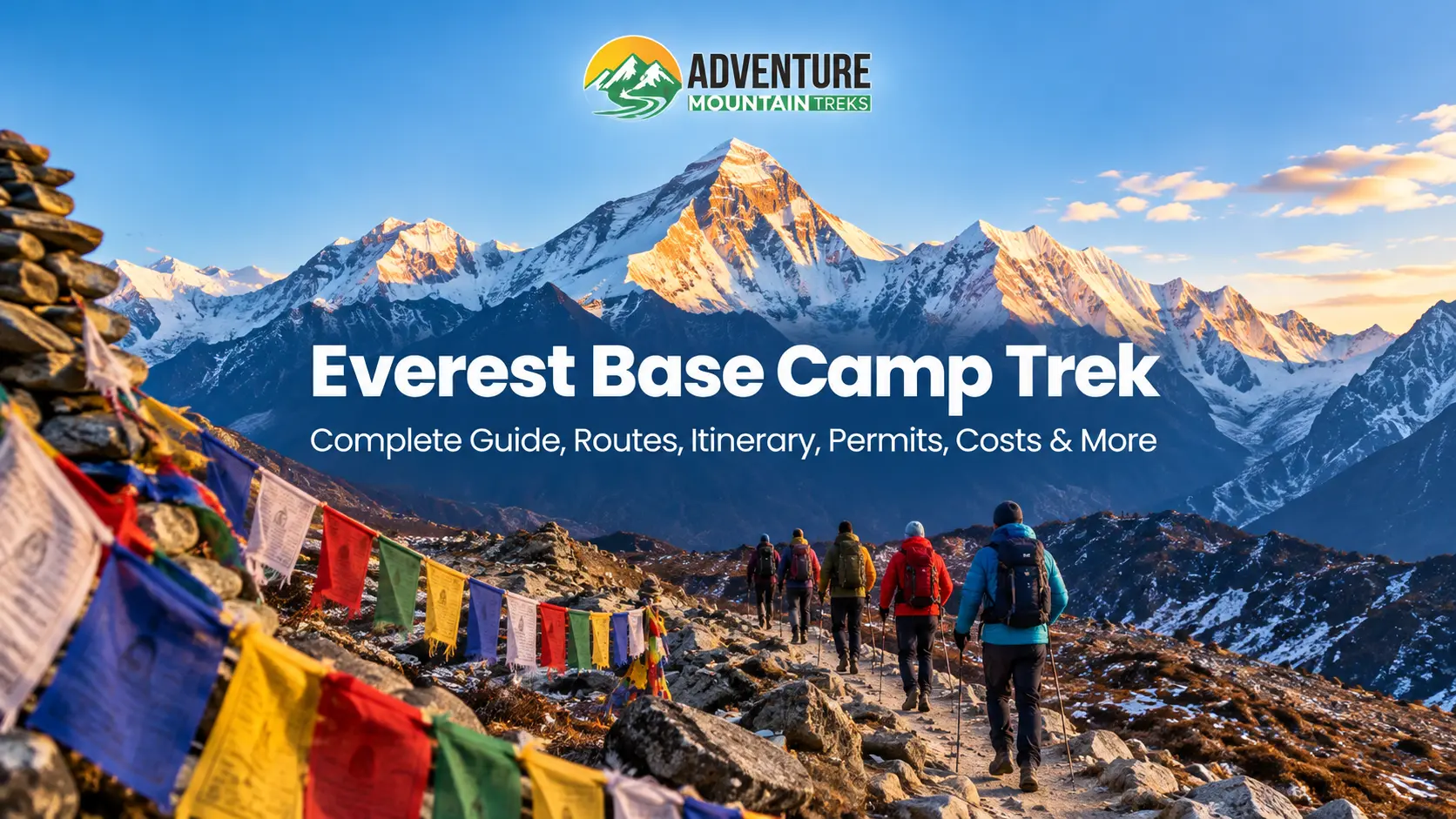
The Everest Base Camp (EBC) trek is one of the most walked routes in the Himalaya. Over 13 days, the trail climbs through the Khumbu region of northeastern Nepal, passing Sherpa villages, suspension bridges and Buddhist monasteries before reaching the foot of the Khumbu Icefall. Most itineraries, including this one, also include a climb to Kala Patthar, the trek's highest point and the best accessible viewpoint of Everest's summit — Everest itself is not visible from Base Camp.
Based on our experience and expertise this article provides the complete guidance.
What Is the Everest Base Camp Trek?
The EBC trek is a teahouse-based route through Sagarmatha National Park, a UNESCO World Heritage Site. It starts with a flight to Lukla (2,846 m), follows the Dudh Koshi river to Namche Bazaar, then climbs through Tengboche, Dingboche and Lobuche. From Gorak Shep, the last permanent settlement on the route, trekkers walk to Everest Base Camp (5,364 m) and, typically before dawn, climb Kala Patthar for the best available view of Everest, Nuptse and Lhotse.
Sagarmatha is Nepal's name for Everest; Tibetans call the mountain Chomolungma.
There are no technical sections; no rope work, no glacier travel skills required. What the trek does demand is sustained fitness over many days, patience with slow acclimatization, and a willingness to turn back or descend if altitude symptoms appear.
EBC vs Manaslu Circuit vs Annapurna Base Camp
| Feature | Everest Base Camp | Manaslu Circuit | Annapurna Base Camp |
|---|---|---|---|
| Duration | ~13–14 days | ~13–14 days | ~9–10 days |
| Highest Point | Kala Patthar (~5,600 m) | Larkya La (~5,160 m) | ABC (4,130 m) |
| Difficulty | Moderate–Challenging | Strenuous | Moderate |
| Crowd Level | High in peak season | Low (restricted area) | High |
| Guide Required? | Not legally required, strongly recommended | Mandatory (restricted area) | Not legally required, recommended |
| Main Views | Everest, Lhotse, Nuptse, Ama Dablam | Manaslu, Himalchuli | Annapurna massif, Machhapuchhre |
| Culture | Sherpa villages, Tengboche Monastery | Tibetan-influenced Nubri villages | Gurung and Magar villages |
| Access | Flight to Lukla | Multi-hour drive | Drive from Pokhara |
Trekkers weighing a longer, quieter route through the same region often look at the Everest Three Passes Trek, while those working with a tighter schedule tend toward the Everest Short Trek.
Highlights of the Route
- Kala Patthar at sunrise — the trek's highest point and its best Everest viewpoint
- Everest Base Camp (5,364 m) — beside the Khumbu Glacier and the foot of the Khumbu Icefall
- Namche Bazaar — the Sherpa hub of the Khumbu, with a visitor museum and mountain-view lodges
- Tengboche Monastery (3,860 m) — the region's principal monastery, framed by Ama Dablam
- Sagarmatha National Park — rhododendron and juniper forest at lower altitude, giving way to alpine terrain that supports Himalayan tahr, musk deer, and Himalayan black bear, along with high-altitude bird species including the danphe (Himalayan monal), Nepal's national bird
- Sherpa culture — prayer flags, mani stones and chortens throughout the villages en route
- Everest View Hotel viewpoint — reached on the Namche acclimatization day
- Suspension bridges — including the high bridge above the Dudh Koshi near Namche
The Route
The trail runs north from Lukla along the Dudh Koshi valley into the high Khumbu.
Lukla → Phakding → Namche Bazaar. Pine forest and Sherpa villages, with the Sagarmatha National Park checkpoint near Monjo. The final climb into Namche is steep.
Namche → Tengboche. Forest trail with the first clear views of Everest and Ama Dablam, ending at Tengboche Monastery.
Tengboche → Dingboche. The tree line ends and the terrain opens into wide alpine pasture.
Dingboche → Lobuche → Gorak Shep. Glacial moraine and increasingly thin air; pace slows noticeably above 4,500 m.
Base Camp and Kala Patthar. Everest Base Camp itself, then the climb to Kala Patthar.
Return: Pheriche → Namche → Lukla. A faster descent, with oxygen levels improving each day.
Itineraries do vary between operators — some add a Gokyo Lakes or Three Passes extension, and acclimatization days can be scheduled differently. The sequence above describes the classic route followed on this itinerary.
Day-by-Day Itinerary
| Day | Route | Altitude | Approx. Distance* | Highlights |
|---|---|---|---|---|
| 1 | Arrive Kathmandu | 1,300 m | — | Airport pickup, trek briefing |
| 2 | Fly to Lukla, trek to Phakding | 2,846 m → 2,610 m | ~8 km | Mountain flight, first suspension bridges |
| 3 | Phakding → Namche Bazaar | 3,440 m | ~11 km | Sagarmatha National Park checkpoint |
| 4 | Acclimatization, Namche Bazaar | 3,440 m | Optional hike | Everest View Hotel, Sherpa museum |
| 5 | Namche → Tengboche | 3,860 m | ~10 km | Tengboche Monastery |
| 6 | Tengboche → Dingboche | 4,410 m | ~11 km | Tree line ends |
| 7 | Acclimatization, Dingboche | 4,410 m | Optional hike | Nangkartshang Hill |
| 8 | Dingboche → Lobuche | 4,940 m | ~8 km | Khumbu Glacier moraine |
| 9 | Lobuche → Gorak Shep → EBC → Gorak Shep | 5,164 m / EBC 5,364 m | ~15 km | Everest Base Camp |
| 10 | Gorak Shep → Kala Patthar → Pheriche | 5,600 m → 4,371 m | ~15 km | Sunrise over Everest, descent |
| 11 | Pheriche → Namche Bazaar | 3,440 m | ~20 km | Fast descent |
| 12 | Namche → Lukla | 2,846 m | ~19 km | Final trekking day |
| 13 | Fly to Kathmandu | 1,300 m | — | Farewell dinner |
Distances and times are approximate and vary with weather, trail conditions and pace.
Days 4 and 7 are acclimatization days built into the schedule to reduce altitude-sickness risk. The full pacing and altitude breakdown for this itinerary is covered on the Everest Base Camp Trek package page.
Cost
The Standard package for this 13-day trek is USD $1,450 per person (group size 2–12). Higher-service tiers with additional inclusions may also be available, with current pricing and departure dates listed on the Everest Base Camp Trek page.
Cost is generally made up of:
| Component | Notes |
|---|---|
| Permits | Sagarmatha National Park entry + Khumbu Pasang Lhamu Rural Municipality permit |
| Flights | Kathmandu–Lukla (via Ramechhap in peak season) |
| Accommodation | Teahouse lodging along the route, hotel nights in Kathmandu |
| Meals | Full board on the trek; breakfast in Kathmandu |
| Guide and porter | Wages, insurance, meals and accommodation |
| Personal equipment | Clothing, sleeping bag, daypack and related gear |
| Insurance | Personal travel insurance with high-altitude and evacuation cover |
Typically included in the package:
- Airport transfers in Kathmandu Kathmandu–Lukla flights (Ramechhap–Lukla during peak season).
- Kathmandu hotel nights with breakfast
- Teahouse accommodation and full board during the trek
- Government-registered guide and porter service
- Sagarmatha National Park and municipality permit fees
- Core trekking equipment where specified in your booking
Typically not included:
International airfare Personal travel insurance Meals in Kathmandu outside what's specified Personal expenses (hot showers, charging, Wi-Fi, laundry, alcohol) Tips for guide and porter
A full breakdown of what's included at each stage of the trip is available on the Everest Base Camp Trek page.
Permits and Regulations
Three things apply on this route:
| Requirement | Who needs it | Approximate cost | Notes |
|---|---|---|---|
| Sagarmatha National Park Entry Permit | All trekkers | ~NPR 3,000 (≈USD 22) for foreign nationals; reduced rates for SAARC/Nepali citizens | Checked at the Monjo checkpoint |
| Khumbu Pasang Lhamu Rural Municipality Permit | All trekkers | ~NPR 2,000–3,000 (≈USD 14–21) | Local trekking-corridor fee |
| TIMS Card | Not currently required on this route | — | Dropped for the Khumbu/Everest region; the municipality permit above replaced its function here |
Restricted-area permits (used for routes like Upper Mustang or Manaslu) do not apply to the standard EBC route. Fees are set by the Nepal Tourism Board and local authorities and can change, so treat exact figures as approximate and confirm current rates closer to your travel date. You'll need your original passport at checkpoints regardless of who arranges your permits.
Best Time to Trek
| Season | Months | Conditions | Recommended? |
|---|---|---|---|
| Spring | Mar–May | Warmer days, rhododendrons in bloom, occasional afternoon cloud | Yes — also Everest expedition season |
| Autumn | Sep–Nov | Clearest air and mountain views of the year | Yes — most popular season |
| Winter | Dec–Feb | Very cold at altitude, some teahouses close | Experienced cold-weather trekkers only |
| Monsoon | Jun–Aug | Rain, cloud, leeches at lower elevation, flight delays | Not generally recommended |
Spring and autumn are both well-suited to this trek; they differ mainly in crowd levels and vegetation rather than trail difficulty.
Difficulty
Graded moderate to challenging. Not technical, but long and high.
Fitness expectations: most days involve 5–7 hours of walking on uneven terrain with a light daypack, with early starts and afternoon arrivals. Pacing and consistency matter more than raw speed.
Why it's demanding:
Extended time above 3,500 m, with several nights above 4,900 m Long days, particularly the Base Camp day and the Kala Patthar/descent day Significant day-to-night temperature swings Genuinely unpredictable Khumbu weather
Suggested preparation, 8–12 weeks out:
Cardio: 45–60 minutes, 4–5 times weekly Weighted hiking on uneven ground, weekly Stair or incline training, several sessions weekly Leg strength work to protect knees on descents A pre-trip medical check-in, especially with any cardiac or respiratory history
Altitude Sickness: Symptoms, Prevention and Response
Altitude illness is the most serious medical risk on this trek. Fitness does not prevent it — it results from ascending faster than the body can adapt, and it affects trekkers of all fitness levels.
Acute Mountain Sickness (AMS). Common early symptoms: headache (often the first sign, and never one to dismiss), nausea or appetite loss, unusual fatigue, dizziness, poor sleep.
HACE (High Altitude Cerebral Edema). A severe, life-threatening progression involving fluid around the brain. Warning signs: confusion, loss of coordination, inability to walk a straight line, severe headache. Requires immediate descent — this is a medical emergency.
HAPE (High Altitude Pulmonary Edema). Fluid in the lungs. Warning signs: breathlessness at rest, a persistent cough (sometimes with frothy sputum), blue-tinged lips. Also a medical emergency requiring immediate descent.
Prevention principles:
Built-in acclimatization days, with a "climb high, sleep low" pattern where possible Ascending slowly, particularly above 4,000 m Staying well hydrated Avoiding alcohol at altitude Never ascending with a worsening headache or other developing symptoms Descent is the definitive treatment for worsening AMS, HACE or HAPE
This section is informational and isn't a substitute for a pre-trip consultation with a travel medicine provider or a diagnosis of any symptoms you're experiencing. If you're planning this trek with underlying health conditions, discuss altitude risk with a doctor beforehand.
If you're reading this because you or someone with you is currently experiencing symptoms, altitude illness can escalate quickly — descend and seek medical help rather than waiting to see if it improves.
Accommodation and Food
Accommodation. Kathmandu hotels are arranged with breakfast included. On the trail, teahouses offer simple twin-share rooms; Lukla, Phakding and Namche often have attached bathrooms, while higher villages typically have shared facilities. Solo trekkers are usually roomed with someone of the same gender.
Food. Dal bhat (rice, lentils, vegetables) is the trail staple and usually offered with refills. Western options — pasta, eggs, potatoes, pancakes, soup — are widely available, along with vegetarian choices at essentially every teahouse.
Water. Buy boiled water at teahouses or treat stream/tap water with purification tablets or a filter. Avoid drinking untreated water.
Showers and charging. Available for a fee at most teahouses, with cost generally increasing with altitude; both become less reliable above Dingboche.
Connectivity
Mobile signal: Ncell and Nepal Telecom (NTC) both have coverage along much of the route, thinning out at higher elevation. SIM cards are available at the airport and in Thamel.
Wi-Fi: Available at many teahouses for a fee; slower and less reliable at higher altitude.
Power: Bring a power bank (10,000–20,000 mAh) and spare batteries; charging costs increase with altitude.
Cash: ATMs on the trail are unreliable. Withdraw Nepali rupees in Kathmandu for showers, charging, drinks and tips.
Packing List
Your package may include some core gear — confirm what's provided at booking. Beyond that, plan for:
| Category | Essentials |
|---|---|
| Layering | Thermal base layers, fleece mid-layer, insulated jacket, waterproof/windproof shell |
| Lower body | Quick-dry trekking pants, waterproof pants, thermal leggings |
| Extremities | Warm hat, sun hat/cap, buff, liner gloves, insulated outer gloves, wool + moisture-wicking socks, gaiters |
| Footwear | Broken-in waterproof boots with ankle support, camp shoes |
| Sleep | A four-season sleeping bag suited to sub-zero nights, optional liner |
| Pack & gear | 25–30 L daypack with rain cover, duffel bag, trekking poles, headlamp with spare batteries, UV sunglasses, 2–3 L water capacity, purification tablets, power bank |
| Health | High-SPF sunscreen, lip balm, personal first-aid kit, any prescribed altitude medication, wet wipes, hand sanitizer, energy snacks |
| Documents | Passport, visa, travel insurance documents (with evacuation cover explicitly named), cash |
Lukla flight weight limits are generally around 15 kg total (roughly 10 kg checked, 5 kg carry-on), with excess-baggage fees applying above that. Confirm current limits with your airline before packing.
Getting to Lukla
During peak trekking seasons (roughly late March–May and late September–November), Lukla flights are rerouted through Ramechhap (Manthali) Airport, about a 4–5 hour drive from Kathmandu, rather than departing directly from Kathmandu — a Civil Aviation Authority of Nepal traffic-management measure. Outside peak season, flights generally operate directly from Kathmandu. Weather delays are common either way, so build a buffer day into your schedule before any international connection.
Solo Trekking and Guides
Nepal does not currently require a guide for the standard Everest Base Camp route (this differs from restricted areas like Manaslu, where a guide is mandatory by law). A guide still adds real value here: route-finding in poor visibility, altitude monitoring, language support at checkpoints, and faster decision-making if something goes wrong.
Solo trekkers regularly do this route, often joining scheduled group departures to share costs and company; current departure dates are listed on the Everest Base Camp Trek page. A female guide can be arranged on request for solo female travelers.
Everest Region Packages at Adventure Mountain Treks
The classic 13-day Everest Base Camp Trek covered above is the core Everest-region product, but the region offers several other ways to trek it.
| Package | Duration | Standard Price (USD) | Group Size | Max Altitude |
|---|---|---|---|---|
| Everest Base Camp Trek (this guide) | 13 Days | $1,450 | 2–12 | Kala Patthar, 5,600 m / 18,373 ft |
| Everest Short Trek | 7 Days | $950 | 2–12 | Tengboche, 3,867 m / 12,684 ft |
| Jiri to Everest Base Camp Trek | 14 Days | $1,450 | 2–12 | Kala Patthar, 5,600 m / 18,373 ft |
| Everest Base Camp with Heli Return | 10 Days | $2,300 | 2–12 | Kala Patthar, 5,600 m / 18,373 ft |
| EBC via Gokyo Lake and Cho La Pass | 16 Days | $1,550 | 2–12 | Kala Patthar, 5,600 m / 18,373 ft |
| EBC via Renjo La and Cho La Pass | 16 Days | $1,650 | 2–12 | Kala Patthar, 5,600 m / 18,373 ft |
| Everest Three Passes Trek | 17 Days | $1,899 | 2–12 | Kongma La Pass, 5,535 m / 18,159 ft |
| Everest Advanced Base Camp Trek | 15 Days | $3,500 | Any | Kala Patthar, 5,600 m / 18,373 ft* |
| Mt. Everest Expedition | 32 Days | $55,000 | Any | Summit, 8,849 m / 29,032 ft |
| Everest View Mountain Flight | 1 Day | $240 | 2–12 | N/A (scenic flight, no trekking) |
| Rolwaling Tashi Lapcha Pass Trek | 14 Days | $2,700 | 2–12 | Kala Patthar, 5,600 m / 18,373 ft |
You can check whichever trek based upon your trip requirements.
- Those wanting the classic route in the shortest reasonable time typically choose the standard 13-Day Everest Base Camp Trek.
- Trekkers short on time, or wanting a lower-altitude taste of the region, often pick the 7-Day Everest Short Trek, which turns around at Tengboche, well below the altitudes where sickness risk becomes significant.
- For those wanting to walk more of the classic approach route, the Jiri to Everest Base Camp Trek adds the traditional overland start used before Lukla's airstrip existed.
- Trekkers tight on vacation days but still wanting Base Camp and Kala Patthar often choose the Everest Base Camp with Heli Return, which trims the descent by flying out from near Base Camp instead of walking back to Lukla.
- Those wanting lakes and a high pass added to the classic route can look at the Gokyo Lake/Cho La and Renjo La/Cho La variants, which extend the standard route through the Gokyo valley.
- Trekkers after the most complete high-altitude circuit of the Khumbu tend toward the Everest Three Passes Trek, which links Kongma La, Cho La and Renjo La for a longer, higher, more demanding version of this trip.
- Those with no interest in walking at all can get an aerial look at Everest in a single day on the Everest View Mountain Flight.
- Acclimatization-day side trips within the standard itinerary include the Everest View Hotel hike, usually part of the Namche acclimatization day, and Nangkartshang Hill, a common Dingboche acclimatization hike.
Insurance and Emergency Evacuation
Travel insurance is not optional on this route. An uninsured helicopter evacuation from the Khumbu can cost thousands of dollars.
Your policy needs to explicitly cover:
Trekking to at least 5,600–6,000 m (many standard policies cap out around 4,000 m) Helicopter rescue and medical evacuation, named specifically Trip cancellation and curtailment for weather, flight delays or medical issues
Valid insurance should be arranged before arriving in Nepal, not after.
Frequently Asked Questions
How long is the Everest Base Camp trek?
The itinerary is 13 days, starting and ending in Kathmandu, with about 9–10 days of trekking.
How difficult is the Everest Base Camp trek?
Moderate to challenging. Not technical, but long days, thin air and cold nights make it demanding.
Do I need previous trekking experience?
No. Fitness, preparation and pacing matter more than prior experience.
What is the best time to trek to Everest Base Camp?
Autumn (September–November) and spring (March–May) are both well-suited; they differ mainly in crowd levels and vegetation, not trail difficulty.
How much does the trek cost?
The Standard package is USD $1,450 per person. Group rates and current departure pricing are listed on the Everest Base Camp Trek page.
Do I need a guide?
Not legally required on this route, but strongly recommended for safety, navigation and altitude monitoring.
Is there an age limit?
No official limit. Healthy, well-prepared trekkers across a wide age range complete this trek; check with a doctor if you have any underlying health conditions.
How high is Everest Base Camp?
5,364 m / 17,598 ft. The trek's highest point, Kala Patthar, is approximately 5,600 m / 18,373 ft.
Is there a road to Everest Base Camp?
No. Access starts with a flight to Lukla, followed by trekking.
What permits do I need?
The Sagarmatha National Park Entry Permit and the Khumbu Pasang Lhamu Rural Municipality Permit. A TIMS card is not currently required for this route.
What happens if I get altitude sickness?
Tell your guide immediately. Mild symptoms often resolve with rest and no further ascent; worsening symptoms require descent.
Conclusion
The Everest Base Camp trek rewards preparation and pacing more than raw fitness. Two acclimatization days, a slow ascent rate and a guide you trust matter more than how fast you can walk. For trekkers drawn to Sherpa culture, high-altitude scenery and a genuinely demanding multi-day route, it remains one of the most walked treks in Nepal for good reason.