Manaslu Circuit Trek Suspended After Flash Floods: Latest 2026 Update
Manaslu Circuit Trek Suspended After Flash Floods in Gorkha
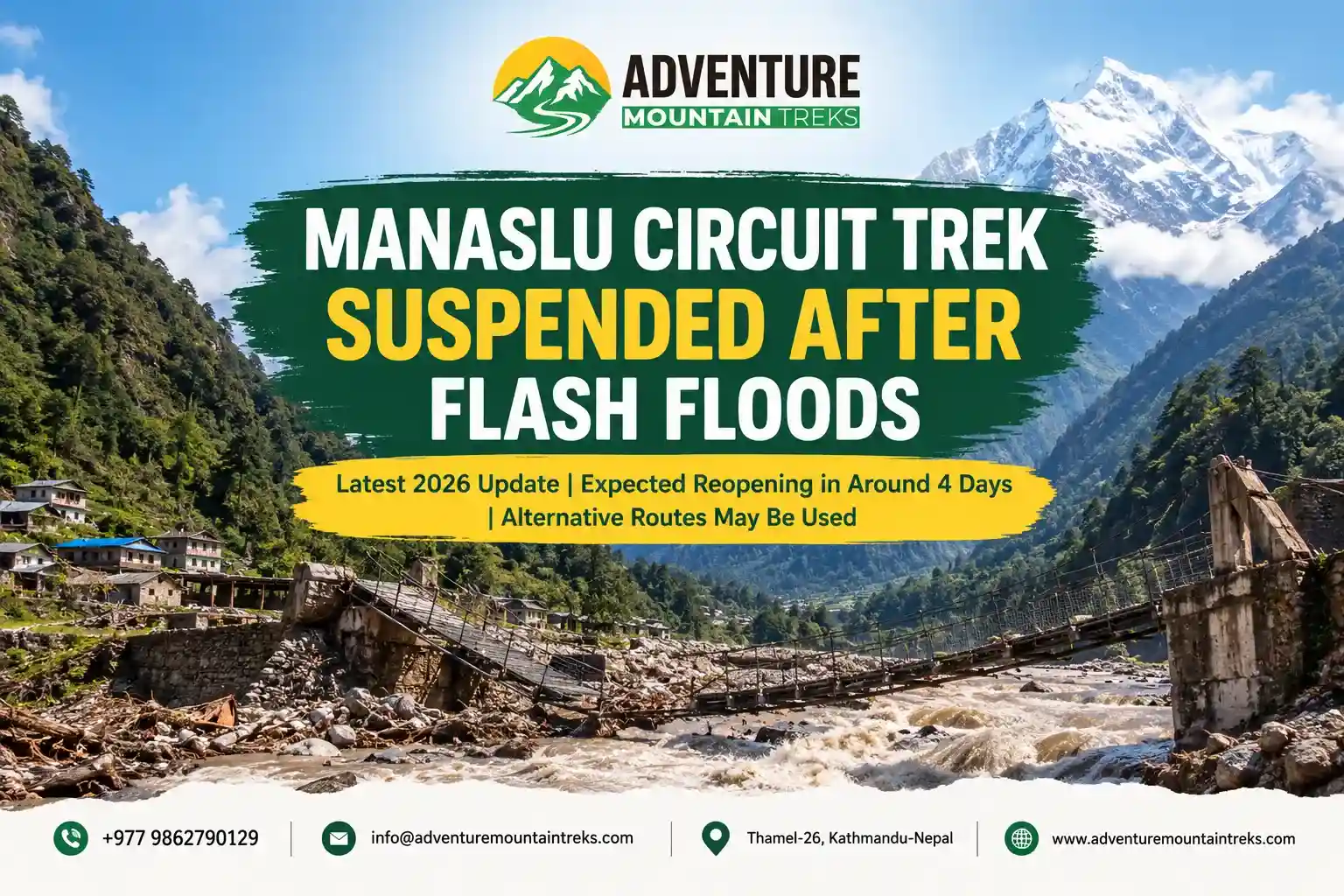
The Manaslu Circuit Trek has been temporarily suspended following a sudden flash flood in northern Gorkha, after the powerful surge damaged important bridges and disrupted movement along one of Nepal's most popular Himalayan trekking routes. The incident occurred in the early morning of September 6, 2026, in the Therang Stream area of Chumnubri Rural Municipality, affecting infrastructure used by both local communities and trekkers. According to Nepal News, the flood swept away four houses and a vital pedestrian suspension bridge, bringing movement along the affected section of the Manaslu Circuit to a standstill. Fortunately, no human casualties were reported in the incident, as residents moved toward higher ground after noticing the rapidly rising water.
The latest situation is important for anyone planning a Manaslu Circuit Trek in 2026, particularly travelers preparing for the autumn trekking season. The suspension does not mean that Manaslu has permanently closed, nor does it mean that trekking in the whole of Nepal has stopped. Instead, the current restriction is focused on the affected Manaslu and Larkya Pass corridor, where damaged crossings and unstable conditions need to be assessed before normal trekking can safely continue. The District Administration Office in Gorkha has asked trekkers who are preparing to travel, as well as those already on the route, not to undertake or continue their journey until another notice is issued.
For trekkers, the key message is simple: do not attempt to cross damaged bridges, swollen rivers or unstable trail sections independently. Mountain conditions can change quickly, and a route that was completely accessible one day can become dangerous after a flash flood. The current disruption is expected to be temporary, with restoration work and alternative access being considered so that trekking can resume once the affected sections are considered safe.
What Happened on the Manaslu Trekking Route?
The flash flood struck the Therang Khola in Namrung, Chumnubri Rural Municipality-4, Gorkha, at around 3:30 a.m. on September 6. The sudden rise in water damaged key infrastructure along the trekking corridor, including bridges that connect communities and provide access for trekkers moving through the Manaslu region. The Tourism Times reported that an iron bridge connecting wards and a suspension bridge toward the Namrung forest were swept away by the flood.
Nepal News reported that four houses were also washed away in the incident. The affected homes belonged to residents in the Chumnubri-4 area, while the primary pedestrian suspension bridge was destroyed, effectively interrupting movement along the Manaslu Circuit. Local residents were able to move toward safer, higher ground after noticing the rapidly increasing water, which helped prevent loss of life.
The cause of the sudden surge was also unusual. According to the District Administration Office, debris temporarily blocked the stream near its source before the blockage eventually broke and released a large volume of water downstream. Because the Therang Stream flows directly into the Budhigandaki River, authorities also issued high-alert warnings for communities farther downstream.
For trekkers, this explains why the situation cannot be judged simply by looking at the weather in Kathmandu or checking whether the main Manaslu trail appears on a trekking map. A flash flood can damage a bridge or trail section within minutes, while the effects can continue for days afterward. Riverbanks can become unstable, trails can be undermined, and temporary crossings may not immediately be suitable for organized trekking groups.
Why Has the Manaslu Circuit Trek Been Suspended?
The Manaslu Circuit Trek suspension is a temporary safety measure following significant infrastructure damage. The District Administration Office, Gorkha, has asked trekkers preparing to travel toward Manaslu and Larkya Pass, as well as those already traveling in the region, not to undertake or continue their journeys until another official notice is issued. The Trekking Agencies' Association of Nepal, or TAAN, has also advised trekkers to delay trips to the Manaslu region following the heavy rainfall and flooding.
The suspension is particularly important because the Manaslu Circuit is a remote Himalayan trek. Trekkers depend on bridges, mountain trails and local settlements to move from one section of the route to another. If one critical crossing is destroyed, simply walking around the damaged point is not necessarily a safe solution. The surrounding terrain may contain additional risks, including strong river currents, loose ground, landslides and damaged trail approaches.
Tourism Info Nepal reported that the Manaslu Conservation Area Project issued a safety advisory following the flooding and specifically urged visitors not to attempt crossing damaged bridges, swollen rivers or other hazardous sections. Trekkers already in the region have been advised to follow instructions from local authorities, security personnel and MCAP officials rather than attempting to bypass damaged areas on their own.
This is why the current Manaslu trek flood update should be treated as a route-specific safety issue rather than simply a tourism inconvenience. The priority during the immediate recovery period is to assess damage, restore safe access and make sure that trekkers can move through the region without taking unnecessary risks.
Bridges and Infrastructure Damaged by the Flood
The destruction of bridges is one of the biggest concerns for the Manaslu trekking route. The Tourism Times reported that the flood washed away an iron bridge over the Therang Khola and a suspension bridge along the route toward Namrung from Ghap. These crossings are important because they connect settlements and sections of the trekking trail in a remote part of Gorkha.
Tourism Info Nepal similarly reported significant damage to bridges along the trekking corridor, including a steel bridge and a suspension bridge leading toward Namrung Jungle. The publication warned that the loss of these crossings could expose trekkers to strong currents, unstable ground, damaged trails and other hazards.
The flood has also affected local homes and infrastructure. Nepal News reported that four houses were destroyed, while other reporting highlighted damage affecting local infrastructure in the Namrung area. This means the region's recovery is not solely about reopening tourism. Local residents also need safe access, functioning infrastructure and time to recover from the disaster.
For that reason, trekkers should approach the current situation with patience. A temporary crossing may help local movement, but that does not automatically mean the entire trekking route is ready for international visitors. A professional trekking operator needs to consider the condition of the complete route, not just whether one river can technically be crossed.
How the Flood Has Affected the Manaslu Circuit Trek
The Manaslu Circuit Trek follows the Budhigandaki valley through a series of remote settlements before eventually reaching the high-altitude Larkya Pass. The route depends heavily on mountain foot trails and suspension bridges, particularly in the lower and middle sections. Damage around Namrung therefore creates a significant interruption even if many other parts of the circuit remain physically intact.
The current problem is not necessarily that every kilometer of the Manaslu Circuit has been destroyed. Instead, critical access points have been damaged, creating a break in the normal trekking connection. This is similar to having a long road where one major bridge is washed away: most of the road may still exist, but vehicles cannot continue normally until an alternative crossing is established.
The situation is also complicated by the possibility of additional hazards following heavy rainfall. When water moves through a steep Himalayan valley, it can remove soil from trail edges, expose rocks and weaken riverbanks. A section that looks safe from a distance may therefore require a closer inspection before trekking groups are allowed through.
Namrung Access Has Been Disrupted
Namrung is a major settlement on the Manaslu Circuit Trek and an important stop for trekkers traveling toward the higher sections of the route. The destruction of a suspension bridge on the route toward Namrung forest has disrupted normal movement and created a significant obstacle for trekkers approaching from the lower trail.
The Tourism Times reported that the suspension bridge from Ghap toward Namrung was destroyed, while the iron bridge over Therang Khola was also affected.
This makes Namrung one of the key areas that trekking agencies need to monitor before restarting regular departures. Even if an alternative crossing is prepared, guides need to confirm that the approach and exit trails are stable and that the route beyond the crossing is accessible.
Larkya Pass Treks Are Also Affected
The Larkya Pass is one of the highlights of the Manaslu Circuit, but reaching it requires trekkers to pass through the lower and middle sections of the circuit first. Therefore, disruption around Namrung can affect the entire Larkya Pass itinerary.
TAAN has recommended postponing journeys toward Manaslu Base Camp and Larkya Pass while the current situation is being assessed.
Trekkers should therefore avoid thinking that they can simply skip the damaged bridge and continue toward Larkya Pass. The route needs to be assessed as a connected trekking system, and the safest alternative should be selected by local authorities and experienced trekking professionals.
Is It Safe to Trek Manaslu Right Now?
As of September 7, 2026, trekkers should wait before starting or continuing the affected Manaslu and Larkya Pass routes. The District Administration Office has asked travelers not to proceed until another notice is issued, while MCAP and TAAN have also advised trekkers to delay their journeys.
This does not mean that the Manaslu Circuit will remain closed for a long period. The current expectation is that recovery and route-management efforts will take place over the coming days, with around four days being the expected timeframe for access to improve, provided that weather conditions remain stable and safe alternative routes or temporary crossings can be established.
The four-day period should be understood as an expected recovery window rather than a guaranteed official reopening date. Himalayan conditions can change quickly, and the final decision should depend on actual trail conditions, bridge safety, weather and instructions from the authorities responsible for the area.
For travelers who already have a Manaslu trek booked, the best approach is therefore not to panic or immediately cancel the entire trip. Instead, communicate with your trekking agency, monitor the latest local information and allow the route team to determine whether your itinerary can safely continue through an alternative access point.
Manaslu Circuit Trek Expected to Resume in Around Four Days
The current disruption is expected to be temporary, with the Manaslu Circuit Trek potentially resuming in around four days if restoration and safety assessments progress as expected. During this period, local authorities and communities can focus on assessing the damaged bridges, improving temporary crossings and identifying practical alternative routes around the affected sections.
This expected timeframe is particularly relevant for trekkers who are already planning their autumn journey. Rather than assuming that every booking must be cancelled, travelers should remain in close contact with their trekking agency. If safe access can be established, trekking groups may be able to continue their planned journeys using an alternative route around the damaged crossing.
The important distinction is that reopening does not necessarily mean every damaged bridge will have been permanently rebuilt. In remote mountain areas, safe temporary access can sometimes allow movement to resume while longer-term infrastructure repairs continue. However, any alternative route should be assessed locally and used only after the relevant authorities and experienced guides confirm that it is suitable.
Expected Four-Day Recovery Timeline
|
Period |
Expected Situation |
|
Days 1–2 |
Damage assessment, river and trail monitoring, and preparation of temporary access |
|
Days 3–4 |
Continued restoration work and evaluation of alternative trekking routes |
|
Around Day 4 |
Trekking may begin to resume through safe alternative access if conditions permit |
|
After reopening |
Permanent bridge repairs and further trail improvements may continue |
This timeline is an expected operational timeframe, not an official guaranteed reopening announcement. Weather, river levels, trail stability and the condition of temporary crossings will remain the deciding factors.
Trekkers May Continue Through Alternative Routes
One of the most practical possibilities for the reopening of the Manaslu Circuit is the use of alternative routes around the damaged sections. Instead of waiting for every permanent bridge to be completely reconstructed, local authorities and trekking professionals may establish temporary or alternative pedestrian access where it can be done safely.
This can help reduce the disruption to the autumn trekking season while also giving local communities time to repair the permanent infrastructure. However, an alternative route should never be treated as an unofficial shortcut. It must be evaluated for river crossings, trail stability, elevation, walking time, emergency access and accommodation availability.
For trekkers, this could mean that an itinerary originally planned before the flood may need small adjustments. A walking day could become longer, a village overnight stay could change, or a particular crossing could be approached from another direction. These are normal forms of itinerary management in Himalayan trekking and are much preferable to attempting to cross an unsafe bridge simply to keep the original schedule.
What Should Trekkers With 2026 Bookings Do?
If you have already booked the Manaslu Circuit Trek 2026, the best first step is to contact your trekking agency. Ask for the latest route assessment rather than relying on an itinerary created before the September 6 flood. Your agency should be able to explain whether your departure date needs to be adjusted, whether an alternative route is expected to be available and whether local authorities have cleared the relevant section.
Trekkers already inside the Manaslu region should follow instructions from local authorities, security personnel, MCAP representatives and their guides. Tourism Info Nepal specifically advised people already in the region not to attempt to bypass damaged sections independently.
If your departure falls within the next few days, flexibility is especially valuable. A responsible trekking company should be prepared to modify the itinerary according to the latest conditions rather than treating the original itinerary as fixed at all costs.
Contact Adventure Mountain Treks for the Latest Update
If you are planning to trek the Manaslu Circuit, Larkya Pass or another Himalayan route in Nepal, Adventure Mountain Treks can help you monitor the latest situation and plan your journey responsibly.
Adventure Mountain Treks
Thamel-26, Kathmandu, Nepal
WhatsApp: +977 9862790129
Email: info@adventuremountaintreks.com
Before starting your journey, contact the team for the latest information regarding route accessibility, alternative trekking arrangements and expected travel conditions.
What Happens During the Recovery Period?
The next few days will be important for the Manaslu region. Local authorities, communities and tourism stakeholders need to determine which sections can be safely restored first and whether temporary access can support normal trekking movement.
The immediate priority is likely to be the establishment of safe pedestrian connectivity. Once temporary crossings or alternative routes are available, the condition of the surrounding trail needs to be checked as well. There is little value in repairing one bridge if trekkers then encounter another unsafe river crossing or unstable section only a short distance farther along the trail.
This is why the expected four-day recovery period should not be interpreted as a countdown that automatically makes the route safe on the fourth day. The four-day timeframe is an expectation based on recovery efforts, while actual reopening should depend on conditions on the ground.
Permanent Repairs May Continue After Trekking Resumes
Even if trekking resumes through an alternative route after approximately four days, permanent infrastructure work may continue afterward. The damaged bridges will still need proper reconstruction, and local communities may require additional repairs to homes, trails and other infrastructure.
This is common in disaster recovery: getting people moving again is the first stage, while restoring everything to its original condition takes longer. Trekkers may therefore encounter temporary arrangements even after the route officially becomes usable again.
For visitors, this simply means that flexibility should remain part of the itinerary. A slightly modified route can still provide the complete Manaslu experience while supporting the region's gradual recovery.
What About the Tsum Valley Trek?
The current flood situation has also affected another trekking route in the region. The Tourism Times reported that the Tsum Valley route has been affected by a landslide in the Chaurikharka area, and TAAN has advised trekkers to wait a few days before planning trips there as well.
This is another reason why trekkers should seek route-specific information before heading into the Manaslu region. Conditions can vary significantly between valleys and trail sections. An experienced local trekking operator can assess the current situation and recommend the safest practical itinerary.
Does the Manaslu Flood Mean Nepal Is Unsafe for Travel?
No. The current situation should not be interpreted as meaning that all of Nepal is unsafe for travel. The issue described in this update is concentrated around specific sections of the Manaslu trekking corridor in northern Gorkha.
Nepal is a geographically diverse country, and conditions can vary dramatically between different trekking regions, cities and highways. A flash flood affecting a particular mountain valley does not automatically mean that every tourism destination in Nepal has been affected in the same way.
For trekkers, however, the lesson is clear: check the specific destination and route rather than making a general assumption about Nepal. The safest decision depends on current local conditions.
Why Choosing a Local Trekking Agency Matters
A mountain trek is not just a line drawn between two points on a map. It is a constantly changing journey through rivers, forests, villages, suspension bridges, mountain slopes and high-altitude terrain. That is why having a local trekking agency becomes especially valuable when unexpected events occur.
When a flood damages a bridge, a local operator can communicate with guides, porters, communities and authorities to understand what is happening on the ground. They can also modify the itinerary, arrange alternative accommodation and determine whether a particular trail section is genuinely accessible.
This is especially important after a natural disaster. Information on social media can travel quickly, but it may not always reflect the latest condition of a remote trail. A photograph showing a temporary crossing does not necessarily tell you whether that crossing is safe for a trekking group.
Manaslu Circuit Trek: What Trekkers Should Keep in Mind
If you are planning Manaslu in the coming weeks, there is no need to abandon your dream of completing the circuit simply because of this temporary disruption. Instead, build some flexibility into your plans and remain ready to adjust your itinerary if necessary.
The Manaslu region remains one of Nepal's most spectacular trekking destinations, known for dramatic mountain landscapes, remote villages, Tibetan-influenced Buddhist culture and the challenging crossing of Larkya Pass. Once the affected routes are confirmed safe, trekkers can continue exploring the region with appropriate guidance and preparation.
The current flood is a reminder that responsible trekking means respecting nature. The mountains do not operate according to our calendars, and sometimes the smartest trekking decision is to wait.
Final Update: Manaslu Trekking Should Resume After the Recovery Period
The Manaslu Circuit Trek is temporarily suspended following the September 6, 2026 flash flood in northern Gorkha, which destroyed important bridges and damaged homes and infrastructure around the Therang Khola and Namrung area. Local authorities, MCAP and TAAN have advised trekkers to postpone journeys toward Manaslu and Larkya Pass until safe access is confirmed.
The positive news for trekkers is that the disruption is expected to be temporary. Around four days is the expected recovery timeframe, during which local teams can assess the damage, establish temporary access and prepare alternative routes. If weather and trail conditions remain favorable, trekking is expected to begin resuming through safe alternative routes after this recovery period, while permanent bridge repairs can continue in parallel.
However, trekkers should not treat the four-day period as an automatic reopening guarantee. The actual restart should depend on official guidance and a professional assessment of the trail, bridges, river crossings and surrounding terrain.
If you have a Manaslu trek coming up, stay in contact with your trekking agency and remain flexible. At Adventure Mountain Treks, safety comes before maintaining a fixed itinerary. Once the route is confirmed safe, the Manaslu Circuit will be ready to welcome trekkers again.
Adventure Mountain Treks
Thamel-26, Kathmandu, Nepal
WhatsApp: +977 9862790129
Email: info@adventuremountaintreks.com
FAQs About the Manaslu Circuit Trek Flood Update
1. Is the Manaslu Circuit Trek currently open?
As of September 7, 2026, the affected Manaslu and Larkya Pass routes have been temporarily suspended following flash-flood damage in northern Gorkha. Authorities have asked trekkers not to begin or continue journeys until further notice.
2. When is the Manaslu Circuit Trek expected to reopen?
The route is expected to begin reopening in around four days, provided that weather conditions remain stable and safe access can be restored. Trekking may resume through alternative routes or temporary crossings where these have been assessed as safe. The four-day period is an expected timeframe rather than a guaranteed official reopening date.
3. Can trekkers use alternative routes after the flood?
Yes, alternative routes may be used once they have been assessed and confirmed safe by the relevant authorities and experienced local trekking professionals. Trekkers should never create their own route around a damaged bridge or swollen river.
4. What happened to the Manaslu trekking route?
A flash flood in the Therang Khola area of Chumnubri Rural Municipality in Gorkha damaged important bridges and disrupted movement along the Manaslu Circuit. Nepal News reported that four houses and a vital pedestrian suspension bridge were washed away.
5. Should I cancel my Manaslu Circuit Trek 2026?
Not necessarily. If your trek is scheduled in the coming days, contact your trekking agency and ask for the latest route assessment. Depending on the recovery progress, your itinerary may be postponed briefly or adjusted to use a safe alternative route. Travelers with later departure dates should continue monitoring updates rather than assuming that the entire trekking season is cancelled.
Latest information checked: September 7, 2026. This article is based on current reporting from Nepal News, The Tourism Times and Tourism Info Nepal. The four-day reopening timeframe is presented as an expected recovery window, not as an officially confirmed reopening date.