
Stories of Thamel: Most Iconic Tourist Hub | Adventure Mountain Treks
A Place That Defies a Single Description
There is no single sentence that captures Thamel.
Not because it is complicated — because it is everything simultaneously. It is the narrow alley where a monk walks past a reggae bar. The rooftop restaurant where a Nepali family shares dal bhat, three tables from a group of European mountaineers comparing gear. The bookshop is so crammed with yellowing paperbacks and hand-drawn maps that the owner sits, surrounded by them like an island in a literary sea.
Thamel is the heart of Kathmandu — not the historic heart (that belongs to Basantapur and the Durbar Squares) but the living, breathing, perpetually awake heart of the modern city. The place where Nepal meets the world and the world meets Nepal, and somehow, both parties leave changed.
If you are planning a trek in Nepal, whether to Everest Base Camp, the Annapurna Circuit, or any of the dozen other routes that fan out from Kathmandu into the Himalayas, your journey begins and ends in Thamel. Understanding it before you arrive makes the experience richer. This guide is your starting point.
How Thamel Became What It Is — The History Behind the Hustle
The story of Thamel as a tourist destination begins not with a government plan or a developer's vision, but with history's most unexpected catalyst: the Vietnam War.
In the early 1970s, as the war in Southeast Asia reached its brutal peak, American soldiers on rest-and-recreation leave began travelling to Nepal — a country that had only recently opened its borders to international visitors in 1950. What they found in the lanes of Basantapur and the nascent streets of Thamel was something their war-exhausted minds desperately needed: genuine warmth. Locals who smiled without an agenda. A pace of life that the anxieties of the modern world had not yet touched. Food cooked with patience. Tea offered without expectation.
The message passed between travellers, the way important messages always do — person to person, quietly and reliably. Nepal is different. Go to Kathmandu. Find Thamel.
The tourism boom of the 1970s followed. Nepal, already blessed with eight of the ten highest peaks in the world, became the trekking capital of the planet almost overnight. The mountain routes — previously walked only by local communities and the occasional scientific expedition — opened to adventurous travellers from Europe, North America, Japan, and Australia. Every one of them passed through Thamel on their way to the trailhead.
The neighbourhood grew to meet them. Guesthouses appeared in the narrow lanes. Restaurants adapted their menus. Trekking shops opened — at first selling basic equipment, then expanding into the full spectrum of gear that serious mountain travel requires. The infrastructure of international trekking tourism, which today serves hundreds of thousands of visitors per year, was built organically in Thamel one shopfront at a time across five decades.
What remains extraordinary is that despite this growth — the boutique hotels, the international brands, the ATMs, WiFi and satellite television — Thamel has never fully lost the soul that those first visitors recognised in the 1970s. The welcome is still there. The warmth is still genuine. The lanes are still narrow enough that strangers walking in opposite directions must briefly acknowledge each other's existence.
The Streets of Thamel — What You Will Actually Find
Walking into Thamel for the first time is an experience of complete sensory immersion. The organised mind wants to categorise what it is seeing. Thamel resists categorisation at every turn.
The Trekking Shops
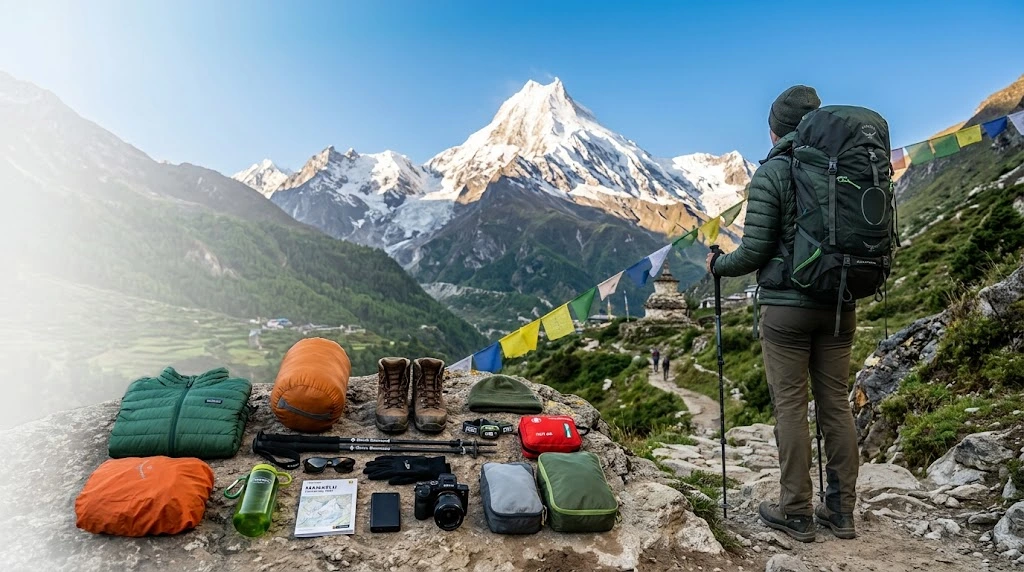
They are everywhere — and the variety is extraordinary. Shops selling every piece of equipment a Himalayan trekker might need: down jackets, trekking poles, sleeping bags rated to minus twenty, crampons, harnesses, headlamps, waterproof boots, Gore-Tex shells, thermal base layers. International brands sit alongside Nepali-made alternatives of genuinely high quality. Replica and counterfeit gear also exists — sometimes clearly, sometimes less so — and learning to distinguish quality from imitation is one of Thamel's essential skills.
The honest advice: buy from established, reputable shops, ask questions about the materials and construction, and do not be afraid to take your time. The right gear for your specific trek matters enormously. A city tour with an experienced local guide before your trek begins is the best way to understand which shops are trustworthy and which products are worth the investment.
The Food — From Dal Bhat to Dim Sum
Thamel's restaurants could sustain a traveller for weeks without repetition. Mexican, Italian, Japanese, Korean, Israeli, German, Indian, Tibetan, and Nepali cuisines are all available within a ten-minute walk in any direction. Rooftop restaurants with mountain views. Underground cafés with candlelit tables. Bakeries that open before dawn for early-departing trekkers who need something in their pack.
But do not let the international options distract you from the essential Nepali experience. Dal Bhat, lentil soup, rice, vegetable curry, and pickles — is not just a meal. It is a philosophy. Eaten twice a day by most Nepalis, it is the fuel that powers every Sherpa on every Himalayan route, every porter on every pass, every trekking guide across every valley. Order it once. Order it again. By the third time, you will understand why it has sustained Nepal for centuries.
Gundruk Dhido — fermented leafy greens with buckwheat porridge — is the other dish that separates the curious traveller from the tourist. It is an acquired taste that rewards the acquisition. Ask for it at any traditional Nepali restaurant in Thamel and watch the owner's expression change to something approaching respect.
For those moments between meals, and Thamel is full of them, between a gear shop and a bookstore and a conversation with a stranger — street food fills every gap. The aromas alone are a form of navigation: fried bread here, grilled corn there, steaming momos (dumplings) around the next corner, where the stray dogs have also gathered, with the patient optimism of creatures who have learned that good things come to those who wait near food.
The Bookshops
Thamel's bookshops deserve their own essay. They are among the finest in Asia — not in scale but in curation. Decades of travellers passing through have left their books behind: novels finished on overnight buses, guidebooks completed and no longer needed, trekking diaries, philosophical texts, histories of Nepal, photography collections, mountaineering accounts from expeditions spanning a century.
The result is a secondhand book market of extraordinary depth. You will find accounts of the first Everest summit sitting beside contemporary Nepali fiction. Colonial-era maps of the Himalayas next to modern satellite photography. Translations of Sanskrit texts alongside paperback thrillers in six languages.
Antique lovers find their own parallel world in Thamel's art and craft shops — wood carvings, stone sculptures, metalwork, thangka paintings, handmade paper products, and bronze figures of deities. The craftsmanship connects directly to Nepal's artistic traditions, stretching back to the Licchavi period over a thousand years ago. These are not souvenirs. They are cultural artefacts, and the best shops will explain their provenance and significance with genuine pride.
Thamel After Dark — The City That Does Not Sleep
When the sun drops behind the Himalayan foothills and the mountains disappear into evening haze, Thamel transforms. The trekking shops close their shutters. The restaurants light their candles. The lanes fill with a different energy — slower, warmer, more alive to conversation.
The Live Music Scene
Western musical culture has taken deep root in Nepal's cities, and nowhere more visibly than in Thamel's bars and live music venues. Local bands — playing everything from Nepali folk fusion to blues to jazz to post-rock to reggae — perform every night across a dozen venues within walking distance of each other.
The quality is consistently high and occasionally extraordinary. Nepal produces musicians of genuine international calibre, and Thamel's stages are where many of them first found their audience. Walking into a Thamel bar on a random Tuesday and discovering a band that makes you stay for three more hours than you planned is not an unusual experience. It is practically a rite of passage.
For the rock lover: several venues host heavy and alternative acts that would not be out of place in the clubs of London or Seoul. For the jazz enthusiast: intimate candlelit bars where skilled musicians improvise late into the night. For those who simply want atmosphere: outdoor terraces where acoustic performers provide the soundtrack to a Kathmandu evening under stars that emerge as the city's smoke clears.
The Night That Keeps Going
Thamel does not have a closing time, exactly. The official bars have their hours. The restaurants wind down. But the lanes themselves continue, tea stalls open past midnight, small convenience shops serving everything a late-night traveller might need, the occasional conversation between strangers that extends from one chai to the next until someone notices it is already 2 am.
For those who prefer the quieter version of a late evening — a bottle opened in a hotel room, a drink on a rooftop with the city spread below, late-night liquor delivery services now operate across Kathmandu, ensuring that the spirit of Thamel's nightlife reaches wherever you choose to experience it. Services like offer 24-hour late-night liquor delivery in Kathmandu, bringing the celebration directly to your doorstep when the bars close earlier than your evening does.
Thamel as a Starting Point — The Gateway to Nepal's Mountains
For Adventure Mountain Treks, Thamel represents more than a neighbourhood. It is the threshold.
Every trekking journey in Nepal begins here — with the pre-trek gear check in Thamel's shops, the final meal before the trailhead, the conversation with a guide over dal bhat about what the next three weeks will look like. And every trek ends here too — with the post-summit celebration, the equipment returned or repacked, the stories that need to be told over dinner before they are committed to memory.
Treks that begin in Thamel include:
Everest Base Camp Trek — The most iconic Himalayan journey. Fourteen to sixteen days of extraordinary landscape, Sherpa culture, and altitude challenge. The preparation begins in Thamel's gear shops and ends with tea at 5,364 metres with the world's highest mountain visible above.
Annapurna Circuit Trek — Circumnavigating the Annapurna massif through diverse terrain: subtropical forests, alpine meadows, high desert plateau, and the famous Thorong La pass at 5,416 metres. One of the great walking journeys of the world.
Langtang Valley Trek — Nepal's closest major trekking destination to Kathmandu, offering access to stunning valley scenery, Tamang culture, and Himalayan landscapes without the crowds of the more famous routes.
Manaslu Circuit Trek — For the experienced trekker seeking a less-travelled route around Nepal's eighth-highest mountain. Remote, demanding, and deeply rewarding.
All of them begin with a meeting in Thamel — with your guide, your gear, your fellow trekkers, and the anticipation of what lies ahead.
The Culture Thamel Created — Something Entirely Its Own
Here is what makes Thamel unlike any other tourist district in the world: it has developed a culture that belongs neither entirely to Nepal nor entirely to the international travellers who move through it, but is genuinely its own.
The shopkeeper who speaks English, Japanese, Hebrew, and functional Korean because those are the languages his customers speak. The restaurant owner who serves mo: mo alongside wood-fired pizza because both are what his neighbourhood needs. The young Nepali musician whose influences are equally Newari folk music and American blues, because both have shaped the city where he grew up.
This cultural layering is not dilution. It is addition. Thamel has absorbed fifty years of international influence, and Nepali creativity has together produced something that cannot be found anywhere else — a neighbourhood that is simultaneously ancient and contemporary, local and international, chaotic and deeply comfortable.
It never truly rests. At any hour — early morning as the first trekkers depart for the airport, late afternoon as the shops reach their busiest hour, midnight as the last bars wind down — Thamel is alive with the movement of people who have come from everywhere and are going somewhere extraordinary.
Some of them are going to the mountains. Some are returning from them. Some are simply passing through, giving themselves twenty-four hours before a connecting flight, and discovering that twenty-four hours is both too little and somehow enough to feel the weight of what this city is.
Before You Go — Practical Thamel Information
Getting to Thamel: Approximately 6km from Tribhuvan International Airport. Taxi fare is NPR 500–700 (negotiate before departure or use the prepaid taxi counter at the airport). The journey takes 20–45 minutes, depending on traffic.
Best time to visit Kathmandu: October–November (post-monsoon, clear skies, ideal for trekking preparation) and March–April (spring, rhododendron season, warm days). The monsoon (June–August) brings heavy rain but fewer crowds and lower prices.
Money: ATMs are widely available throughout Thamel. Most shops accept both NPR and USD. Bargaining is expected at most retail shops — not aggressive negotiation, but a respectful conversation about price that usually ends with both parties satisfied.
Safety: Thamel is one of the safest tourist areas in South Asia. Standard urban precautions apply — be aware of your belongings in crowds, use reputable registered guides and trekking agencies, and buy gear from established shops with clear return policies.
WiFi: Available at virtually every café, restaurant, and guesthouse. Nepal's internet infrastructure has improved significantly — most connections are reliable enough for video calls and streaming.
The most important thing to eat: Dal Bhat. Order it before you leave.
Plan Your Trek — Start in Thamel, Go Everywhere
Thamel is where the adventure begins. The mountains are waiting. The trails are marked. The guides are ready.
Whether you are planning your first Himalayan trek or returning for your tenth, Adventure Mountain Treks offers experienced, registered guides for every route in Nepal — from a three-day Nagarkot hike to a twenty-one-day Everest expedition approach.
Thamel is where every great Nepal story begins. Make yours count.