Is Nepal Safe for Travel After the August 2026 Flash Floods? Trekking Update for Manaslu, Everest & Annapurna
Uploaded: August 29, 2026
Nepal remains open to travelers, but recent flash floods in northern Nepal have understandably raised questions among trekkers planning their Himalayan adventures for the upcoming autumn season.
The important thing to understand is that Nepal is a geographically diverse country, and a disaster affecting one river system or trekking corridor does not mean that every trekking region is affected.
The devastating flash floods of August 26, 2026, caused extensive damage in parts of the Rasuwa and Trishuli–Bhote Koshi corridor, including roads, bridges and settlements. Rescue and recovery operations are still continuing, and conditions in affected areas remain dynamic.
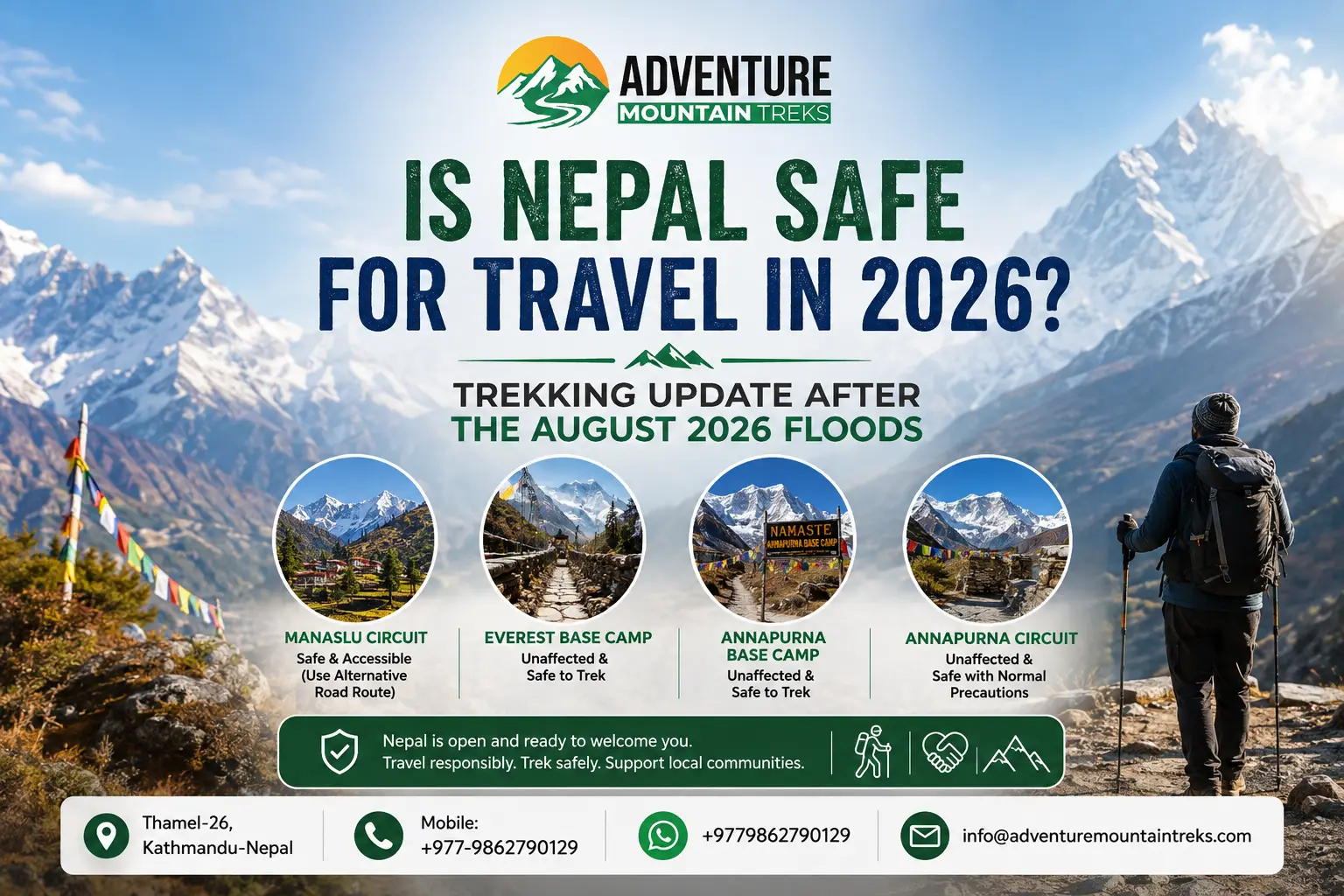
At the same time, the latest trekking-route safety information reported by the Trekking Agencies' Association of Nepal (TAAN) indicates that several of Nepal's major trekking regions remain unaffected by the recent disaster. These include the Everest region, Manaslu region, and Annapurna region.
For travelers planning the Manaslu Circuit Trek, Everest Base Camp Trek, Annapurna Base Camp Trek or Annapurna Circuit Trek, this distinction is important.
Is Nepal Safe for Tourists Right Now?
The most responsible answer is:
Nepal can still be visited, but travelers should choose their destination carefully, check access conditions immediately before departure, and travel with a flexible itinerary.
The recent disaster was concentrated around specific river systems and mountain corridors rather than across the entire country. TAAN's August 28 trekking safety update states that the Everest region and the Annapurna region were not affected by the recent Rasuwa flood, while the Manaslu region remains safe with a specific road-access adjustment.
This means travelers do not necessarily need to cancel their Nepal trip simply because they have seen images of the flooding.
Instead, the better approach is to understand where the disruption occurred and whether your particular trekking route depends on that corridor.
For a broader overview, travelers can also read our Nepal Flash Flood 2026 Travel & Trekking Safety Update.
Official Tourism Safety Message: Nepal Travel Update 2026
Following recent flooding and severe weather in parts of Nepal, travelers are encouraged to stay informed about local conditions and check the accessibility of their planned destinations before travelling. The Government of Nepal, through the Ministry of Culture, Tourism and Civil Aviation, continues to coordinate tourism-related assistance and recovery efforts in affected areas.
Nepal remains open to visitors, while travel conditions may vary between regions. Travelers are advised to follow official safety information, use registered tourism service providers, and make route and transportation arrangements according to the latest local conditions.
Watch the video for an important tourism and travel safety update for visitors planning to travel in Nepal in 2026.
Heavy monsoons and unexpected weather changes can temporarily disrupt mountain road networks. Make sure to review our recent heavy rain in Nepal travel safety update for 2026 before setting off.
What Happened in Nepal?
On August 26, 2026, a catastrophic flash flood affected the northern Nepal–Tibet border region. The event sent water and debris through the Lhende Khola and Bhote Koshi river systems, causing extensive destruction in parts of Rasuwa and surrounding areas.
The situation has been particularly serious around locations including Rasuwagadhi, Timure and the Syabrubesi/Trishuli access corridor.
The disaster has also caused significant road and bridge damage, meaning that some travel problems are related to transportation access rather than the trekking destination itself.
TAAN has therefore emphasized that travelers should obtain the latest access information and coordinate with trekking agencies before departure.
This distinction between trail conditions and access conditions is essential when planning a trek in Nepal.
What About the Manaslu Circuit Trek?
Current assessment: Manaslu trekking region remains safe
The Manaslu region, including Tsum Valley, Nubri and the Larke Pass, remains safe according to the latest TAAN trekking-route update.
If you're considering the trek, you can review the Manaslu Circuit Trek itinerary and route before making your travel plans.
The important consideration: road access
Travelers should pay attention to the road journey from Kathmandu toward the Manaslu trailhead.
The Malekhu-Dhadingbesi route currently has an infrastructure problem following the collapse of a bridge at Malekhu. TAAN has recommended that trekkers traveling toward Machha Khola and Jagat use the Benighat–Arughat route instead.
What does this mean for trekkers?
It does not mean that the Manaslu Circuit itself has been closed.
Rather, the practical travel plan may need to be adjusted before the trekking portion begins.
A responsible trekking operator should:
-
Check the latest road conditions before departure.
-
Use the recommended alternative approach where necessary.
-
Avoid damaged bridges and unsafe road sections.
-
Allow additional travel time.
-
Keep contingency plans available.
-
Monitor weather conditions throughout the journey.
For international trekkers, this is one reason why working with an experienced local trekking company can be valuable. Local operators can reassess transportation and trail conditions much more quickly than an itinerary published months earlier.
If you're choosing a trekking company, our guide on How to Choose a Travel Agency in Nepal explains some of the factors travelers should consider when selecting a local operator.
For additional preparation, you can also explore our Manaslu Circuit Trek Guide.
Is Everest Base Camp Trek Safe?
Current assessment: Everest region remains unaffected by the August 2026 Rasuwa flood
The latest TAAN safety update lists the Everest trekking region among the major trekking destinations that remain unaffected by the recent floods.
The Everest Base Camp Trek follows a different Himalayan drainage system and does not use the flood-damaged Rasuwa–Syabrubesi access corridor.
For most trekkers, the traditional Everest Base Camp Trek therefore remains a viable option.
The traditional Everest Base Camp route
The usual journey involves:
Kathmandu → Lukla → Phakding → Namche Bazaar → Tengboche → Dingboche → Lobuche → Everest Base Camp
The biggest consideration in late August and early autumn is not the recent Rasuwa disaster itself but the monsoon transition and mountain weather.
Flights to Lukla can be delayed by poor visibility or unfavorable weather. Trekkers should therefore maintain flexibility rather than planning their entire international itinerary around a single flight connection.
Once the autumn season becomes established, the Everest region traditionally becomes one of Nepal's busiest trekking destinations.
Is Annapurna Base Camp Trek Safe?
Current assessment: Annapurna region remains unaffected by the Rasuwa flood, but access roads require monitoring
TAAN's August 28 update lists the Annapurna region among the major trekking regions that remain unaffected by the recent Rasuwa flood.
However, this does not mean that every road and trail in the wider Annapurna area is automatically operating normally.
Earlier in August, flooding around the Modi River near Birethanti damaged important access routes toward Ghandruk, Poon Hill and the Annapurna area. TAAN Gandaki advised trekking agencies and guides to assess current road and trail conditions and use safe alternative routes where required.
Therefore, travelers planning the Annapurna Base Camp Trek should distinguish between:
The trekking destination
Generally unaffected by the August 26 Rasuwa disaster.
The access route
May require a current road-condition assessment and, where necessary, an alternative transportation arrangement.
This is exactly why travelers should avoid relying on a fixed transportation plan created weeks or months earlier.
Is the Annapurna Circuit Trek Safe?
Current assessment: Annapurna region remains unaffected by the August 26 Rasuwa disaster
The Annapurna region, including Manang and Mustang, is listed by TAAN among the trekking regions not affected by the recent Rasuwa flood.
The Annapurna Circuit Trek is geographically separate from the affected Rasuwa–Bhote Koshi corridor.
However, the Circuit covers a large area and uses multiple roads and mountain sections. Conditions can therefore vary between individual parts of the route.
Before starting the trek, travelers should confirm:
-
Current road conditions
-
Recent rainfall and landslide reports
-
Trail conditions
-
Pass conditions where applicable
-
Accommodation availability
-
Local transportation arrangements
-
Weather forecasts
For an autumn trek, building one or more buffer days into the itinerary is a sensible precaution.
If you're deciding between the Manaslu and Annapurna circuits, our Manaslu vs Annapurna Circuit Trek 2026 comparison can help you understand the differences between the two experiences.
Why You May See Confusing Information About Nepal
One of the biggest challenges after a natural disaster is that photographs and videos can make it appear as though an entire country has been affected.
Nepal is geographically complex.
A flood in one Himalayan river valley does not automatically close trekking trails hundreds of kilometers away.
For example:
|
Trek |
Current assessment |
Important consideration |
|
Manaslu Circuit |
🟢 Region remains safe |
Use alternative road access toward Machha Khola/Jagat where required |
|
Everest Base Camp |
🟢 Region unaffected |
Monitor Lukla flight/weather conditions |
|
Annapurna Base Camp |
🟢 Region unaffected by Rasuwa flood |
Check current road/trail access and local conditions |
|
Annapurna Circuit |
🟢 Region unaffected by Rasuwa flood |
Check road, trail and weather conditions before departure |
Important: “Unaffected” does not mean “risk-free.”
Nepal is still experiencing the monsoon season, and heavy rainfall can cause localized landslides, road closures, swollen rivers and flight disruptions.
TAAN specifically cautions that its assessment concerns the direct impact of the recent floods and that travelers should continue to exercise caution because the monsoon season has not yet ended.
A Safer Way to Trek Nepal in 2026
Rather than cancelling your Nepal adventure entirely, consider planning intelligently around current conditions.
1. Choose an unaffected trekking region
For the current situation, the latest TAAN assessment provides reassurance for the Everest, Manaslu and Annapurna regions.
2. Check access routes separately from trekking routes
A trekking trail can be perfectly fine while the road leading to its starting point has been damaged.
This is particularly relevant for Manaslu and parts of Annapurna.
3. Use alternative transportation routes when necessary
If a particular road is closed, your trekking agency should assess whether another road, flight or transportation arrangement can safely reach the trailhead.
For Manaslu, TAAN has specifically recommended the Benighat–Arughat approach instead of the Malekhu–Dhadingbesi route for travelers heading toward the Machha Khola/Jagat area.
4. Keep buffer days
Mountain travel does not always follow a fixed timetable.
A spare day can make a major difference if a flight is delayed, a road is temporarily closed or weather conditions change.
5. Travel with an experienced local operator
A local trekking agency can communicate with guides, drivers, accommodation providers and local authorities while conditions are changing.
For international visitors, this local connection can be especially useful during periods of unusual weather or infrastructure disruption.
For Manaslu trekkers, it is also useful to understand the role of local support. Our Manaslu Porter Guide provides additional information for travelers preparing for the trek.
6. Follow local safety advice
If authorities, guides or local communities advise against using a particular road, bridge or trail, do not attempt to bypass the restriction yourself.
A changed itinerary is always better than an unnecessary risk.
Preparing for a Manaslu Trek: Gear, Altitude and Permits
Safety isn't only about floods and roads. A successful Himalayan trek also depends on proper preparation.
If Manaslu is on your itinerary, consider reviewing our Manaslu Circuit Gear Guide before departure.
Altitude is another important consideration. The Manaslu Circuit reaches high elevations, including the Larkya La Pass, so trekkers should understand the symptoms of altitude-related illness and follow a properly planned acclimatization schedule. Our Manaslu Altitude Sickness Guide provides further preparation information.
Manaslu is also a restricted trekking area, so travelers should understand the applicable requirements before beginning their journey. See our guide to Restricted Area Trekking Permits in Nepal for 2026 for more information.
And if you're wondering about the physical demands of the route, our Manaslu Circuit Trek Difficulty Guide explains what trekkers should expect.
Should You Cancel Your Nepal Trek?
If you have planned a Manaslu Circuit Trek, Everest Base Camp Trek, Annapurna Base Camp Trek or Annapurna Circuit Trek, the latest information does not indicate that you need to cancel simply because of the August 26 flash flood.
The latest TAAN route assessment lists the Everest and Annapurna regions as unaffected and the Manaslu region as safe, while identifying specific access adjustments for Manaslu.
However, we recommend reviewing your itinerary shortly before arrival rather than relying on information published weeks earlier.
This is particularly important during the remaining monsoon period.
Your trekking plan should be treated as a living itinerary that can be adjusted according to road, weather and trail conditions.
Why Visiting Nepal Still Matters
Natural disasters can temporarily disrupt tourism, but they do not define an entire country.
Nepal remains home to some of the world's most extraordinary trekking landscapes, mountain communities and cultural heritage.
The Everest, Manaslu and Annapurna regions are geographically distinct, and the latest trekking-sector assessment indicates that these major destinations remain available to trekkers despite the serious situation in the Rasuwa flood-affected corridor.
Responsible tourism can also contribute to recovery.
When travelers visit safely, use local guides and porters, stay in locally operated accommodation, eat at local teahouses and purchase services from Nepali businesses, tourism spending reaches mountain communities that depend heavily on trekking.
The goal should not be to ignore the disaster.
The goal should be to travel responsibly, avoid affected areas, respect local instructions and continue supporting communities where tourism can safely operate.
Our Advice to Travelers Planning Nepal in Autumn 2026
At Adventure Mountain Treks, we believe trekking should never be about taking unnecessary risks.
Our approach is simple:
Check. Communicate. Adapt. Trek responsibly.
Before your departure, we recommend checking the latest:
-
Weather conditions
-
Road and trail status
-
Flight operations
-
Local authority notices
-
Trekking permits and entry requirements
-
Accommodation availability
-
Advice from your trekking agency and guide
If conditions change, your itinerary should change with them.
A responsible trekking company should never tell a traveler that a route is “100% safe.” Mountain environments are dynamic.
Instead, we believe travelers deserve current information, honest advice and practical alternatives.
The Bottom Line: Can You Still Trek in Nepal?
Yes — many travelers can still plan their Nepal trekking adventure responsibly.
The August 2026 flash flood is a serious national disaster, and the affected communities deserve attention and support. At the same time, it is important not to treat the situation as though every trekking destination in Nepal has been affected.
According to the latest TAAN trekking-route assessment:
-
🟢 Manaslu: Safe, with an alternative road approach recommended.
-
🟢 Everest: Unaffected by the recent Rasuwa flood.
-
🟢 Annapurna: Unaffected by the recent Rasuwa flood, while individual access roads should still be checked.
-
🟢 Annapurna Circuit: The region remains unaffected, with normal mountain-travel precautions still necessary.
-
🔴 Affected Rasuwa/Trishuli corridors: Travelers should follow current restrictions and avoid damaged access routes.
Conditions can change quickly during the monsoon, so this information should be considered a current situation update rather than a permanent guarantee.
If you are planning to visit Nepal in the coming weeks or for the autumn 2026 trekking season, contact your trekking operator before finalizing transportation and ask for the latest route and access update.
Nepal is still waiting to welcome trekkers — and responsible travel can be part of the country's recovery.
Related Trekking Planning Guides
If you are preparing for a Himalayan trek, these guides can help you plan with more confidence:
About Adventure Mountain Treks
Adventure Mountain Treks is a Nepal-based trekking company specializing in Himalayan trekking and mountain travel. Our local team works with experienced guides and support staff to help travelers plan their journeys according to current trail, weather and access conditions.
For the latest situation, we recommend speaking directly with our team before your trek so that your itinerary can be reviewed against the latest local conditions.
Plan with care. Trek with confidence. Explore Nepal responsibly.
Adventure Mountain Treks
Thamel-26, Kathmandu-Nepal
Mobile: +977-9862790129
WhatsApp: +9779862790129
Email: info@adventuremountaintreks.com